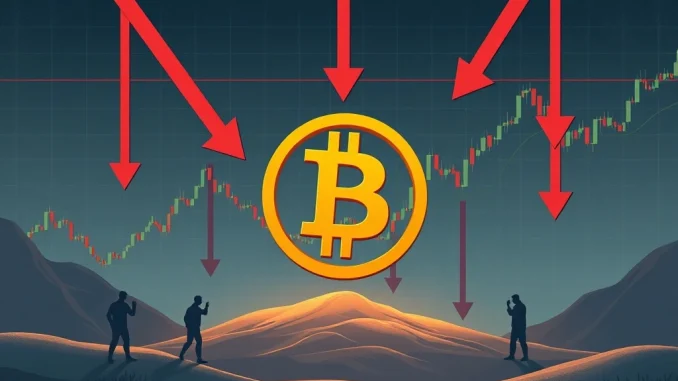
The cryptocurrency market often presents complex dynamics. Currently, Bitcoin (BTC) navigates a challenging phase. On-chain data indicates significant Bitcoin selling pressure. This pressure primarily originates from short-term holders. Understanding these market forces is crucial for investors and traders alike.
Unpacking Bitcoin Selling Pressure from Short-Term Holders
Recent insights from Glassnode, a prominent on-chain analytics firm, highlight a critical development. Bitcoin is trading within a specific range. This range spans approximately $113,600 to $115,600. Significantly, this price band aligns with the average acquisition cost for a particular group of investors. These are the short-term holders who purchased BTC one to three months ago.
For these holders, the current price represents a break-even point or a slight loss. Consequently, any upward movement in price often triggers a sell-off. They aim to recover their initial investment. This behavior creates substantial resistance. It limits potential short-term upside for Bitcoin.
The Role of Short-Term Holders in Crypto Market Dynamics
Who exactly are short-term holders? Generally, they are entities holding Bitcoin for less than 155 days. Their trading patterns often differ from long-term investors. Long-term holders typically accumulate and hold through market volatility. Conversely, short-term holders are more sensitive to price fluctuations. They react quickly to profit opportunities or loss mitigation.
Glassnode’s analysis underscores their immediate impact. When BTC reaches their cost basis, these holders face a decision. They can hold on, hoping for further gains. Alternatively, they can sell to avoid deeper losses or to exit at breakeven. This current scenario points to the latter. Therefore, their collective actions create a formidable supply wall.
Glassnode’s Crucial Insight: A Deep Dive into BTC Price Analysis
The data from Glassnode offers a granular view. It pinpoints the exact price levels where selling pressure becomes most acute. The $113,600 to $115,600 range is not arbitrary. It represents a psychological and financial threshold for many recent buyers. For instance, consider an investor who bought BTC at $115,000 a month ago. Seeing the price return to this level after a dip prompts them to sell. They aim to avoid further risk.
This dynamic is a common feature in cryptocurrency markets. Previous cycles have shown similar patterns. When a large cohort of investors is at a loss, their collective desire to ‘get even’ can suppress price rallies. Thus, this specific range now acts as a significant resistance zone. Overcoming it will require substantial buying volume.
Understanding Resistance and Support Levels
In technical analysis, resistance levels are price points where an upward trend is expected to pause or reverse. Support levels are where a downward trend is expected to pause. The current range, identified by Glassnode, functions as a strong resistance. This is because it aligns with the average cost basis of short-term holders. Therefore, a large supply of BTC is ready to enter the market at these levels.
This phenomenon illustrates the interplay between on-chain data and traditional market analysis. On-chain metrics provide unique insights into investor behavior. They reveal the underlying psychology driving supply and demand. Consequently, these insights can offer a clearer picture of potential price movements.
Implications for Current Crypto Market Dynamics
The presence of heavy Bitcoin selling pressure has several implications. Firstly, it suggests limited upside potential in the immediate future. Any rally towards the $113,600-$115,600 range will likely face strong headwinds. Sellers will step in, pushing the price back down. Secondly, it could prolong the current consolidation phase. Bitcoin might trade sideways until this cohort of short-term holders is either flushed out or the market finds new catalysts.
Furthermore, if this resistance proves too strong, BTC could retest lower support levels. A sustained break below critical support could trigger further downside. Investors should monitor these levels closely. They provide important clues about market direction.
Navigating the Market: What This Means for Investors
For those involved in the crypto market, this analysis offers valuable context. It suggests caution for aggressive long positions at these levels. Instead, observing how BTC interacts with this resistance is key. A clear break above the $115,600 level, sustained by strong volume, would signal a shift. Conversely, repeated rejections from this range could confirm its strength as a ceiling.
Diversifying strategies might also be prudent. Considering other assets or waiting for clearer market signals could reduce risk. Ultimately, understanding the behavior of different holder cohorts provides a deeper understanding of market structure. This enhances decision-making for all participants.
Looking Ahead: The Future of Bitcoin Price Analysis
The current situation highlights the importance of on-chain data in modern cryptocurrency analysis. Glassnode’s ongoing reports offer vital intelligence. They help market participants anticipate potential movements. While short-term challenges exist due to Bitcoin selling pressure from recent buyers, the long-term outlook for Bitcoin remains a subject of ongoing debate. However, these immediate hurdles cannot be ignored.
As the market evolves, so too will the behavior of its participants. Monitoring key metrics like holder cost basis, exchange flows, and whale activity will continue to be essential. These tools provide transparency into a market often perceived as opaque. Therefore, staying informed through reliable analytics is paramount for navigating the dynamic crypto landscape.
In conclusion, Bitcoin faces a significant test. The resistance posed by short-term holders’ cost basis is a formidable barrier. Overcoming this will require renewed market conviction. Until then, caution and close observation of price action are advisable for those tracking BTC price analysis.
Frequently Asked Questions (FAQs)
Q1: What is a short-term holder in the context of Bitcoin?
A short-term holder (STH) typically refers to an entity that has held Bitcoin for less than 155 days. These holders are often more reactive to market fluctuations compared to long-term investors.
Q2: Why does Bitcoin face selling pressure from short-term holders at current levels?
According to Glassnode, the current price range ($113,600-$115,600) corresponds to the average purchase price for STHs who bought BTC 1-3 months ago. These holders are selling to break even or minimize losses, creating resistance.
Q3: What does Glassnode’s analysis suggest for Bitcoin’s short-term upside?
Glassnode’s analysis suggests that the heavy selling pressure from STHs at their cost basis will likely limit Bitcoin’s short-term upside. This price range acts as a strong resistance level.
Q4: How can investors use this information to navigate the crypto market dynamics?
Investors can use this information to exercise caution when taking long positions around the identified resistance levels. Monitoring how BTC interacts with this range can help anticipate potential price movements and adjust strategies accordingly.
Q5: Does this analysis mean Bitcoin’s long-term outlook is negative?
This analysis primarily focuses on short-term market dynamics and selling pressure from a specific group of holders. It does not necessarily dictate Bitcoin’s long-term outlook, which involves many other fundamental and macroeconomic factors.