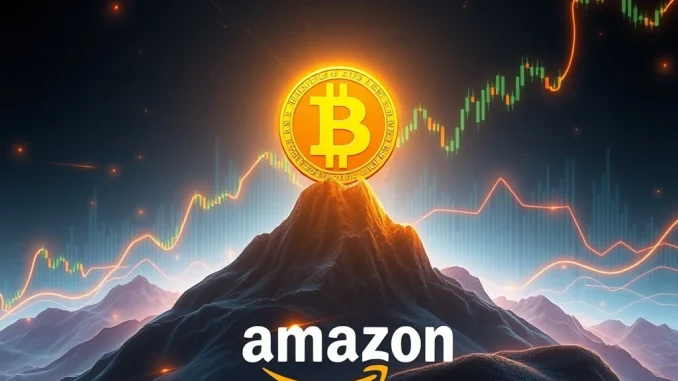
The cryptocurrency world is buzzing with excitement! Bitcoin (BTC), the pioneering digital asset, has once again asserted its formidable presence on the global stage. In a significant milestone, Bitcoin has climbed back to the fifth position among the world’s largest assets by market capitalization, officially surpassing e-commerce giant Amazon. This achievement isn’t just a number; it reflects growing confidence and adoption in the digital economy.
Bitcoin’s Phenomenal BTC Market Cap Surge
This recent surge marks Bitcoin’s first return to the coveted fifth spot since May 9, showcasing its resilience and sustained growth momentum. Currently, BTC is trading at approximately $118,671, reflecting a robust 6.76% increase over the past 24 hours. More impressively, its BTC market cap now stands at an astounding $2.36 trillion, according to data from CoinMarketCap. This valuation not only positions it above Amazon but also puts it in an elite club of assets globally.
What Does Bitcoin’s Global Asset Ranking Mean for Investors?
Bitcoin’s re-entry into the top five global assets by market cap is more than just a statistical update; it carries significant implications for investors and the broader financial landscape. Here’s why this matters:
- Increased Legitimacy: Surpassing a household name like Amazon reinforces Bitcoin’s status as a serious, legitimate asset class, moving beyond its ‘speculative’ label.
- Institutional Confidence: This milestone often attracts more institutional investors who look for assets with substantial market presence and liquidity. Their increased participation can bring greater stability and capital into the ecosystem.
- Broader Acceptance: As Bitcoin climbs the ranks, it becomes harder for traditional finance to ignore. This can accelerate mainstream adoption, leading to more accessible investment products and services.
- Market Maturation: The consistent growth and recovery indicate a maturing market, where Bitcoin is increasingly seen as a long-term store of value, akin to digital gold.
The Journey of Cryptocurrency Ranking: A Volatile Path
Bitcoin’s journey to this prominent cryptocurrency ranking has been anything but linear. Since its inception, Bitcoin has experienced dramatic price swings, periods of immense euphoria, and sharp corrections. It has fallen out of the top rankings before, only to rebound stronger. This volatility is a characteristic of emerging asset classes, particularly those that challenge traditional financial paradigms. However, each time Bitcoin reclaims its position, it demonstrates a fundamental strength and an expanding network effect. This resilience speaks volumes about its underlying technology and the conviction of its growing community.
For context, here’s a simplified look at the current top global assets (rankings can fluctuate daily):
| Rank | Asset | Approx. Market Cap |
|---|---|---|
| 1 | Gold | ~$16 trillion |
| 2 | Apple (AAPL) | ~$3.2 trillion |
| 3 | Microsoft (MSFT) | ~$3.1 trillion |
| 4 | NVIDIA (NVDA) | ~$2.9 trillion |
| 5 | Bitcoin (BTC) | ~$2.36 trillion |
| 6 | Amazon (AMZN) | ~$2.34 trillion |
Beyond Amazon: Understanding Bitcoin’s Unique Value Proposition
While comparing Amazon market cap to Bitcoin’s is a useful benchmark for size, it’s crucial to understand that these assets operate on fundamentally different principles. Amazon is a centralized, publicly traded company with tangible assets, revenue streams, and a traditional corporate structure. Bitcoin, on the other hand, is a decentralized digital currency and a network, powered by blockchain technology. Its value proposition stems from:
- Scarcity: A fixed supply of 21 million coins makes it deflationary by design.
- Decentralization: No single entity controls Bitcoin, making it resistant to censorship and manipulation.
- Global Accessibility: It can be sent and received anywhere in the world, 24/7, with an internet connection.
- Store of Value: Increasingly viewed as a hedge against inflation and economic instability, similar to gold.
This unique blend of attributes distinguishes Bitcoin from traditional corporate assets and underpins its long-term growth potential.
Actionable Insights for Navigating the Bitcoin Market
For those looking to engage with the Bitcoin market, its recent performance offers a compelling narrative, but prudent action is key:
- Do Your Research: Understand Bitcoin’s technology, its market dynamics, and the risks involved before investing.
- Long-Term Perspective: While daily fluctuations occur, Bitcoin’s strength often lies in its long-term growth trend. Consider a long-term investment strategy rather than short-term trading.
- Risk Management: Only invest what you can afford to lose. Diversify your portfolio and don’t put all your eggs in one basket.
- Stay Informed: Follow reputable crypto news sources and market analyses to stay updated on developments that could impact Bitcoin’s price and ranking.
Conclusion
Bitcoin’s re-ascension to the fifth spot among global assets by market capitalization is a powerful testament to its enduring appeal and growing acceptance. It signifies more than just a price increase; it represents a deepening integration of digital currencies into the mainstream financial ecosystem. As Bitcoin continues to demonstrate its resilience and unique value proposition, its journey remains a compelling narrative for investors, technologists, and anyone interested in the future of finance. This milestone is a clear signal that Bitcoin is not just a passing trend, but a significant and evolving player on the world’s economic stage.
Frequently Asked Questions (FAQs)
1. What is market capitalization?
Market capitalization, or market cap, is the total value of all outstanding shares of a public company or the total value of all circulating units of a cryptocurrency. For Bitcoin, it’s calculated by multiplying the current price of one Bitcoin by the total number of Bitcoins currently in circulation.
2. How does Bitcoin compare to traditional assets like gold or stocks?
Bitcoin shares some characteristics with traditional assets but also has distinct differences. Like gold, it’s considered a store of value due to its scarcity. Like stocks, its price can be volatile and influenced by market sentiment. However, unlike traditional assets, Bitcoin is decentralized, operates on a blockchain, and is not issued or controlled by any government or central bank.
3. Why is Bitcoin’s market cap growing?
Bitcoin’s market cap grows primarily due to increasing demand, which drives up its price, and the issuance of new coins through mining (though the rate of new coins decreases over time). Factors contributing to demand include growing institutional adoption, increased retail investor interest, its narrative as a hedge against inflation, and expanding utility within the digital economy.
4. Is Bitcoin a good investment right now?
Whether Bitcoin is a ‘good’ investment depends on individual financial goals, risk tolerance, and market conditions. While its recent performance is strong, all investments carry risk. It’s crucial to conduct thorough research, consider your personal financial situation, and consult with a financial advisor if needed before making investment decisions.
5. What factors influence Bitcoin’s price?
Several factors influence Bitcoin’s price, including supply and demand dynamics, regulatory news, macroeconomic trends (like inflation or interest rates), technological developments (e.g., upgrades to the Bitcoin network), adoption rates, and market sentiment (e.g., fear, uncertainty, and doubt, or FUD, versus fear of missing out, or FOMO).