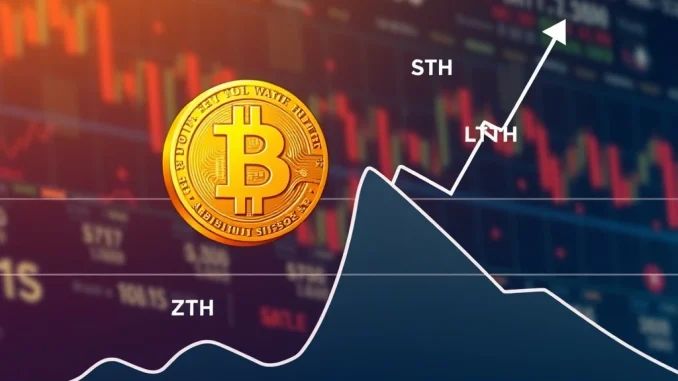
Are you feeling the market jitters? Recent insights from prominent crypto on-chain analysts suggest that a temporary Bitcoin price pullback might be on the horizon. While the broader market remains bullish, fueled by the unwavering conviction of long-term holders, a closer look at the behavior of short-term participants reveals potential headwinds. Understanding these dynamics is crucial for navigating the volatile world of cryptocurrencies.
Understanding the Bitcoin Price Pullback: What’s Happening?
In a recent update, crypto on-chain analyst AbramChart issued a cautionary note regarding the immediate future of Bitcoin’s price. The analyst pointed to an increased likelihood of a temporary correction, primarily driven by anticipated selling pressure from Bitcoin Short-Term Holders (STHs). This isn’t a call for panic, but rather an observation based on intricate market data that can help investors prepare.
For context, Bitcoin holders are broadly categorized into two groups:
- Long-Term Holders (LTHs): These are investors who typically hold their Bitcoin for more than 155 days. They are often seen as the ‘strong hands’ of the market, less reactive to short-term price swings and generally accumulating during dips.
- Short-Term Holders (STHs): These are newer entrants or traders who have held their Bitcoin for less than 155 days. They are generally more sensitive to price fluctuations and tend to realize profits or cut losses more quickly.
The current market situation, as highlighted by AbramChart, indicates a divergence in behavior between these two groups, which could lead to a minor retracement in Bitcoin’s upward trajectory.
Decoding Bitcoin STH Selling Pressure: The Short-Term Holder Factor
The core of the analyst’s concern lies with the behavior of Short-Term Holders. When Bitcoin experiences a rebound or significant price appreciation, STHs, who might have acquired their coins at lower levels or during recent dips, are often quick to realize profits. This profit-taking activity creates selling pressure, which can temporarily halt or reverse upward momentum.
Consider the typical STH psychology:
- Quick Gains: Many STHs enter the market looking for rapid returns. Once a certain profit threshold is met, they are inclined to sell.
- Sensitivity to Volatility: STHs are generally more susceptible to market fear and greed. A sudden price increase makes them eager to lock in gains, while a slight dip might trigger panic selling.
- Lower Conviction: Compared to LTHs, STHs often have less conviction in Bitcoin’s long-term value, making them more prone to exit positions based on short-term price action.
This natural tendency of Bitcoin STH selling to occur after price rallies is a well-observed phenomenon in on-chain analysis. It’s a healthy part of market cycles, allowing for profit distribution and often creating better entry points for new capital.
Navigating the Crypto Market Correction: Insights from On-Chain Metrics
To support the observation of potential STH-driven selling, AbramChart specifically referenced the Net Unrealized Profit/Loss (NUPL) indicator. The NUPL metric is a powerful on-chain tool that assesses the overall profitability of the Bitcoin network by comparing the unrealized profit or loss of all coins in circulation.
Here’s what the NUPL data is telling us:
- LTH NUPL: The NUPL indicator for Bitcoin Long-Term Holders (LTHs) currently sits above 0.5. This signifies that a significant portion of LTHs are holding their coins at a substantial profit. When LTH NUPL is above 0.5, it generally indicates a strong conviction phase, where LTHs are less likely to sell and are often in an accumulation or holding pattern, providing a strong underlying bullish trend.
- STH NUPL: In contrast, the NUPL metric for Bitcoin Short-Term Holders (STHs) is fluctuating at lower levels. This indicates that while some STHs might be in profit, many are either at break-even or experiencing smaller unrealized gains. As Bitcoin prices rebound, these STHs will see their positions move into profitability, increasing their incentive to sell and realize those gains.
This divergence between LTH and STH NUPL suggests that while the long-term trend remains robust due to LTHs holding firm, the immediate path might encounter speed bumps from STHs. It’s a classic example of how on-chain data can provide early warnings about potential short-term market movements, helping investors navigate a potential crypto market correction with greater foresight.
The Power of Bitcoin On-Chain Analysis: LTHs vs. STHs
The ability to distinguish between the behavior of LTHs and STHs is one of the most compelling aspects of Bitcoin on-chain analysis. Unlike traditional market analysis that relies on price charts and trading volumes, on-chain analysis delves into the underlying blockchain data, providing a deeper understanding of investor sentiment and capital flows.
Here’s a comparison of their typical market roles:
| Characteristic | Long-Term Holders (LTHs) | Short-Term Holders (STHs) |
|---|---|---|
| Holding Period | Typically > 155 days | Typically < 155 days |
| Market Impact | Provide strong support, drive long-term trends, accumulate during dips. | Contribute to short-term volatility, often take profits on rallies. |
| Profit/Loss Behavior | Often hold through large unrealized profits, sell only in extreme euphoria. | Quick to realize smaller profits, prone to selling at break-even or slight loss. |
| Sentiment | High conviction, bullish long-term outlook. | More speculative, reactive to immediate market sentiment. |
This interplay is vital. While LTHs lay the groundwork for a sustained bull market, STHs often dictate the short-term fluctuations, creating opportunities for those who understand these dynamics.
Leveraging the NUPL Indicator for Smarter Decisions
The NUPL indicator, along with other on-chain metrics, provides valuable context that traditional charts alone cannot. For investors, this translates into actionable insights:
- Risk Management: Knowing that a temporary pullback is possible due to STH selling pressure allows you to adjust your risk exposure. This might involve setting tighter stop-losses, taking some profits, or simply preparing for potential volatility.
- Strategic Accumulation: Pullbacks, especially those driven by short-term profit-taking rather than fundamental weakness, often present excellent opportunities for dollar-cost averaging or accumulating more Bitcoin at a discount.
- Avoiding Panic: Understanding the ‘why’ behind a price dip – that it’s likely due to STH behavior and not a fundamental market collapse – can prevent irrational panic selling.
- Long-Term Perspective: The strong position of LTHs, as indicated by their NUPL, reinforces the overall bullish outlook. Short-term corrections are part of the journey in a bull market, not an end to it.
Staying informed through reliable on-chain analysis can empower you to make more calculated decisions, transforming potential market challenges into strategic advantages.
Conclusion: Navigating the Waves of Market Dynamics
The crypto market is a complex ecosystem driven by a myriad of factors, not least of which is investor psychology. While the overarching bullish trend in Bitcoin is robust, underpinned by the conviction of Long-Term Holders, the recent analysis by AbramChart serves as a timely reminder of the influence of Short-Term Holders. Their tendency to realize profits after price rebounds can indeed lead to a temporary Bitcoin price pullback.
This isn’t a sign of a market collapse, but rather a healthy, albeit sometimes uncomfortable, part of the market cycle. By paying attention to metrics like the NUPL indicator and understanding the distinct behaviors of LTHs and STHs, investors can better anticipate these short-term fluctuations. Armed with this knowledge, you can approach the market with greater confidence, prepared to navigate potential dips and position yourself for continued long-term growth. Staying vigilant and informed remains the best strategy in this dynamic digital asset landscape.
Frequently Asked Questions (FAQs)
1. What is a Bitcoin Short-Term Holder (STH)?
A Bitcoin Short-Term Holder (STH) is an entity or address that has held their Bitcoin for less than 155 days. These holders are typically more reactive to price changes and are often quicker to buy or sell based on short-term market movements.
2. How does STH selling pressure impact Bitcoin’s price?
When Bitcoin’s price rises, STHs who bought at lower levels may decide to sell their holdings to realize profits. This influx of selling orders into the market creates selling pressure, which can temporarily slow down or even reverse the price increase, leading to a minor pullback or correction.
3. What is the NUPL indicator, and how does it relate to LTHs and STHs?
NUPL stands for Net Unrealized Profit/Loss. It’s an on-chain indicator that measures the aggregate unrealized profit or loss of all Bitcoin in circulation. It’s calculated by subtracting the realized cap from the market cap, divided by the market cap. When applied specifically to LTHs and STHs, it shows their respective aggregate profitability. A high LTH NUPL indicates strong underlying conviction, while a fluctuating STH NUPL at lower levels suggests potential profit-taking at rebounds.
4. Does this mean a major crypto market correction is coming?
Not necessarily. The analyst specifically points to a ‘temporary pullback’ or ‘correction,’ which is different from a major bear market or prolonged downturn. It’s more about short-term profit-taking by STHs, while the underlying long-term trend, supported by LTHs, remains bullish.
5. What can investors do during a potential Bitcoin price pullback?
During a potential pullback, investors can consider several strategies: adjusting stop-losses, taking partial profits to de-risk, preparing funds for potential dollar-cost averaging into the dip, or simply holding firm if their long-term conviction remains strong. The key is to avoid panic selling and make informed decisions based on a broader understanding of market dynamics.
6. Where can I find reliable Bitcoin on-chain analysis?
Reliable Bitcoin on-chain analysis can be found from various reputable sources, including dedicated on-chain analytics platforms (like Glassnode, CryptoQuant), independent analysts who share their findings on platforms like X (formerly Twitter) or YouTube, and specialized crypto news outlets that cover on-chain metrics extensively. Always verify information from multiple sources.