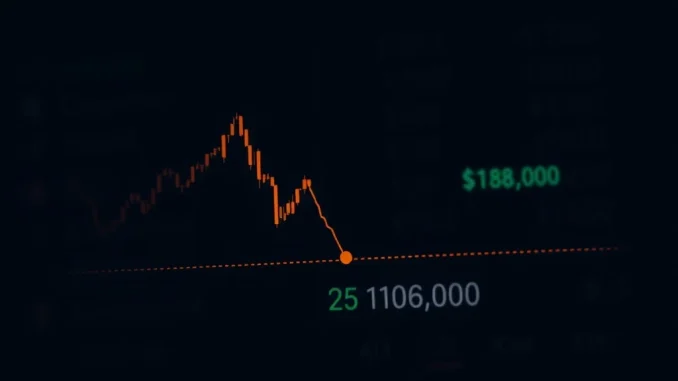
The cryptocurrency world is abuzz, and not for the reasons many investors hoped for. Recent data from Coin Pulse market monitoring reveals a significant shift, as the Bitcoin Price has taken a noticeable tumble, falling sharply below the $118,000 mark. This sudden downturn has sent ripples across the entire digital asset landscape, leaving many wondering about the immediate future of the market. Currently, on the Binance USDT market, Bitcoin is trading around $117,975, a figure that has certainly caught the attention of traders and long-term holders alike. This isn’t just a minor fluctuation; it’s a move that demands closer inspection and understanding.
What Triggered This Alarming Bitcoin Price Plunge?
The cryptocurrency market is renowned for its volatility, and today’s Bitcoin Price action is a stark reminder of that. While specific catalysts for such rapid movements can often be multifaceted and emerge over time, the immediate observation points to a decisive break below a key psychological and technical level. For weeks, analysts have watched Bitcoin hover around certain price points, and the $118,000 threshold was considered by many as a significant support line. Its breach suggests a shift in market sentiment, potentially driven by a confluence of factors.
According to Coin Pulse’s detailed market monitoring, the drop was swift, indicating strong selling pressure. This kind of rapid descent often suggests large sell orders, possibly from institutional players or ‘whales’ moving significant portions of their holdings. Such large transactions can quickly overwhelm buy orders, leading to cascading liquidations, especially in a highly leveraged market like crypto. The specific trading at $117,975 on the Binance USDT market is a real-time reflection of this downward momentum, highlighting where the bulk of the trading activity is currently centered for this asset.
- Increased Selling Pressure: Large sell orders impacting market depth.
- Breach of Key Support Levels: Technical breakdown below established price floors.
- Liquidation Cascades: Automated selling triggered by margin calls.
Understanding the BTC Drop: Is This a Healthy Correction or Something More?
Whenever there’s a significant BTC Drop, the immediate question on everyone’s mind is whether it’s a temporary correction – a natural part of a healthy market cycle – or the beginning of a more prolonged downtrend. Market corrections are common and often necessary to “reset” the market, shake out over-leveraged positions, and allow for new accumulation phases. However, the speed and magnitude of this particular drop warrant a deeper look.
From a technical analysis perspective, breaking below $118,000 suggests that previous support has now turned into resistance. Traders will be closely watching the next significant support levels, which could be much lower. The trading volume accompanying this drop is also crucial; high volume on a down move indicates strong conviction among sellers, while low volume might suggest less significant movement. Initial reports indicate substantial volume, lending credence to the idea of a genuine shift in momentum rather than a mere blip.
For investors, distinguishing between a healthy pullback and a more concerning downturn involves looking beyond just the price. It requires assessing fundamental factors, broader market sentiment, and macroeconomic indicators that might be influencing investor behavior. Is there new regulatory news? Are interest rates rising? These external factors can often provide context for why a significant BTC Drop occurs.
Navigating Crypto Market Volatility: What Factors Are At Play?
The inherent Crypto Market Volatility is both its allure and its challenge. Several overarching factors often contribute to significant price swings, and the current downturn is likely no exception. Understanding these drivers is crucial for anyone trying to make sense of the market’s movements:
- Macroeconomic Headwinds: Global economic conditions, such as inflation concerns, rising interest rates, and fears of recession, often lead investors to de-risk. This means pulling capital from speculative assets like cryptocurrencies and moving it into safer havens.
- Regulatory Uncertainty: Ongoing discussions and potential new regulations in major economies can create apprehension. News of stricter oversight or bans, even if localized, can have a ripple effect on global crypto sentiment.
- Whale Movements and Liquidations: Large holders (whales) can significantly impact market dynamics. A single large sell order can trigger a cascade of liquidations, especially on derivatives exchanges, pushing prices down rapidly.
- Geopolitical Events: International conflicts or political instability can also cause investors to seek safety, leading to outflows from riskier assets.
- Market Sentiment and FUD (Fear, Uncertainty, Doubt): Negative news, rumors, or even social media trends can quickly amplify fear, leading to panic selling among retail investors. The Fear & Greed Index is a common tool used to gauge this sentiment.
- Technical Breakdown: As mentioned, breaching key support levels can trigger automated sell orders and change the technical outlook, leading more traders to short the asset.
These factors don’t always act in isolation; often, it’s a combination that creates the perfect storm for increased Crypto Market Volatility, leading to sharp price movements like the one we’ve witnessed.
Strategic Bitcoin Trading: What Should Investors Consider Now?
For those engaged in Bitcoin Trading, moments like these are often testaments to one’s strategy and discipline. While a price drop can induce panic, it also presents potential opportunities for those with a clear plan. Here are some considerations for investors navigating the current environment:
| Strategy | Description | Considerations |
|---|---|---|
| Assess Your Risk Tolerance | Understand how much you’re willing to lose without impacting your financial stability. | Crucial before making any decisions; avoid emotional trading. |
| Dollar-Cost Averaging (DCA) | Invest a fixed amount regularly, regardless of price, to average out your purchase cost. | Can reduce risk in volatile markets; avoids trying to “time the bottom.” |
| Review Your Portfolio | Check your asset allocation. Are you over-exposed to certain cryptocurrencies? | Diversification can mitigate risk during market downturns. |
| Set Stop-Loss Orders | Automate selling if the price falls to a certain level to limit losses. | Essential for risk management, especially for active traders. |
| Avoid Emotional Decisions | Don’t panic sell based on fear. Base decisions on research and your long-term strategy. | Market bottoms are often formed during peak fear. |
| Conduct Thorough Research | Understand the fundamentals of the assets you hold. Is the project still viable? | Strong fundamentals can weather market storms. |
Whether you’re a seasoned trader or new to the space, a disciplined approach to Bitcoin Trading is paramount. This includes having a clear entry and exit strategy, managing leverage carefully, and continuously educating yourself on market dynamics.
Is This a Broader Market Correction? Analyzing the Ripple Effect
When Bitcoin, the undisputed leader of the crypto pack, experiences a significant downturn, it often triggers a broader Market Correction across the entire digital asset ecosystem. This phenomenon, often referred to as “Bitcoin dominance,” means that altcoins (alternative cryptocurrencies) tend to follow Bitcoin’s lead, albeit often with amplified movements.
A Market Correction is typically defined as a 10% or greater decline in the price of a security or market index from its most recent peak. While Bitcoin’s drop below $118,000 certainly qualifies for this definition from its recent highs, the question is whether this will lead to a sustained bear market or if it’s merely a temporary dip before recovery. Historically, Bitcoin has undergone numerous corrections, some minor, some significant, only to rebound stronger. The key is to observe if the selling pressure extends beyond Bitcoin to other major cryptocurrencies like Ethereum, Solana, or BNB, and if the overall market capitalization shrinks considerably.
Furthermore, the crypto market’s correlation with traditional financial markets, particularly tech stocks, has been a subject of debate. In times of global economic uncertainty, both often experience similar sell-offs as investors shed risk assets. Monitoring traditional market indices can provide additional clues about the potential duration and depth of a crypto Market Correction.

What’s Next for Bitcoin and the Crypto Landscape?
The recent Bitcoin Price drop below $118,000 is a crucial moment for the cryptocurrency market. While such events can be unsettling, they are also a natural part of volatile asset classes. The market will now be closely watching for signs of stabilization, potential bounce-backs from key support levels, and any new fundamental developments that could shift sentiment.
For investors, patience, disciplined strategy, and continuous education remain paramount. The crypto market is dynamic, and understanding its underlying drivers – from macroeconomic factors to technical indicators – is key to navigating its ups and downs. Whether this marks a temporary blip or a more extended period of consolidation, Bitcoin’s resilience has been proven time and again. The community will now look to see how it responds to this latest challenge.
Frequently Asked Questions (FAQs)
1. What does it mean when BTC falls below a certain price?
When Bitcoin (BTC) falls below a significant price point, especially one that has acted as a strong support level, it often indicates increased selling pressure and a shift in market sentiment. It can trigger further automated sell orders (liquidations) and signal a potential downtrend or a deeper market correction.
2. Is this Bitcoin price drop a sign of a bear market?
A single price drop, even a significant one, doesn’t automatically confirm a bear market. It could be a healthy market correction, a response to specific news, or a temporary dip. A bear market is typically characterized by a sustained period of declining prices, often 20% or more from recent highs, accompanied by negative sentiment and lower trading volumes.
3. How should investors react to high crypto market volatility?
In times of high volatility, it’s crucial to avoid emotional decisions. Investors should stick to their pre-defined strategies, which might include dollar-cost averaging, setting stop-loss orders, diversifying portfolios, and conducting thorough research. Panic selling can lead to significant losses, while opportunistic buying (if aligned with a long-term strategy) can yield returns.
4. What are the main factors influencing Bitcoin’s price?
Bitcoin’s price is influenced by a multitude of factors, including supply and demand dynamics, macroeconomic conditions (inflation, interest rates), regulatory news, technological developments, adoption rates, market sentiment (fear and greed), geopolitical events, and the actions of large institutional investors or “whales.”
5. Where can I monitor real-time Bitcoin price movements?
You can monitor real-time Bitcoin price movements on various cryptocurrency exchanges like Binance, Coinbase, Kraken, and by using market data aggregators such as Coin Pulse (as mentioned in the article), CoinMarketCap, CoinGecko, or TradingView. These platforms provide live price charts, trading volumes, and market depth information.