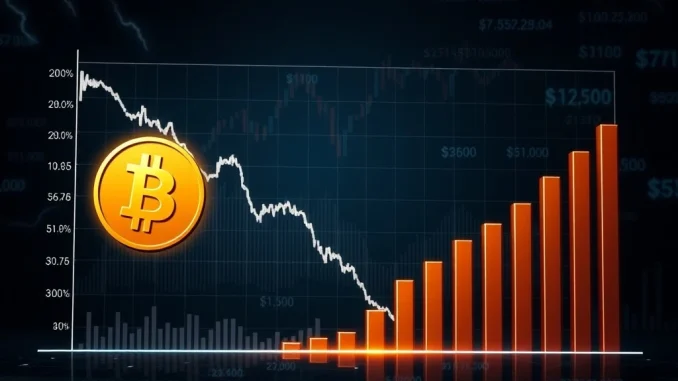
The cryptocurrency world is abuzz following a significant downturn in the Bitcoin price, which saw the leading digital asset plummet by 6% in just a few days. This sharp decline, however, was accompanied by an unprecedented surge in Bitcoin’s open interest, reaching an all-time high of $44.5 billion. This stark divergence between falling prices and rising leveraged positions paints a compelling, albeit concerning, picture of the current crypto market dynamics. What does this mean for traders and investors, and are we headed for more turbulent times?
Why Did Bitcoin Price Plummet While Open Interest Soared?
On July 11, 2025, Bitcoin’s price dipped to $115,002, a 6% drop from its recent high on July 14. This move alone would be noteworthy, but the simultaneous surge in open interest to a record $44.5 billion truly amplifies the situation. Open interest, which represents the total number of outstanding derivative contracts (like futures and perpetual swaps) that have not yet been settled, is a key indicator of leveraged trading activity.
- Leveraged Positions Amplified: According to CryptoQuant contributor Arab Chain, the concurrent fall in price and rise in open interest suggests that speculators, particularly those utilizing significant leverage, are increasingly driving market movements. This aggressive positioning creates a volatile environment.
- Risk of Cascading Liquidations: The high concentration of leveraged positions means that even minor price reversals could trigger a cascade of liquidations. When a trader’s leveraged position loses a certain amount of value, their broker automatically closes the position to prevent further losses, which can then put more selling pressure on the market.
- Spot vs. Futures Premium: CryptoQuant analyst BorisVest noted that Bitcoin’s perpetual contracts on Binance briefly traded at a premium (approximately 0.5%) over the spot price. This positive spread indicates growing long-side pressure, with traders betting on short-term rebounds despite the prevailing downward momentum.
Understanding the Open Interest Surge and Its Implications
The record-breaking open interest figure isn’t just a number; it’s a reflection of heightened speculation and a significant shift in market sentiment. While some might interpret this as strong demand for leveraged exposure, it also signals increased systemic fragility within the market.
Earlier in the week, a brief rally to $120,000 acted as a psychological resistance level. This short-lived bounce attracted a wave of retail long positions, but larger market participants capitalized on this level to execute sell orders, effectively dragging the price back down. This rapid reaction to price fluctuations, without waiting for clear directional signals, makes the market highly susceptible to sudden and sharp shifts.
Navigating Crypto Market Volatility: Technical Indicators to Watch
Technical analysis further underscores the weakening bullish momentum in the crypto market. Here’s what the charts are telling us:
- Bollinger Bands Break: On the daily chart, Bitcoin has fallen below the 20-day Bollinger Bands’ middle line, which was at $116,305. This move brings it closer to the lower band near $109,000, a level that could act as temporary support. A sustained break below $109,000 would likely trigger further selling pressure.
- RSI Decline: The Relative Strength Index (RSI) has dropped to 52.58. An RSI below 70 generally indicates diminishing upward momentum, and a continued decline suggests that selling pressure is gaining dominance.
- Key Price Levels: A recovery above $120,000 would be a strong signal that buyers are regaining control. However, given the concentration of leveraged positions, even minor price reversals could lead to significant liquidations, exacerbating price swings.
The Perils of Leveraged Trading in a Volatile Environment
The current market structure heavily favors short-term traders over long-term holders, especially with the surge in leveraged trading. Arab Chain emphasized that leveraged positions tend to amplify short-term volatility at the expense of sustained growth. This dynamic could prolong the current consolidation phase, making it a challenging period for investors.
Market participants are divided. Some see the record open interest as a sign of underlying strength and demand for Bitcoin exposure, albeit through derivatives. Others view it as a warning sign, highlighting the increased risk of sharp corrections due to excessive leverage. The outcome hinges on whether buyers can stabilize the crucial $116,000–$117,000 range or if bearish pressure will ultimately prevail.
What Do These Market Dynamics Mean for Your Strategy?
The interplay between falling prices and surging open interest creates complex market dynamics. For traders, this means increased opportunities for quick gains, but also significantly higher risks. For long-term investors, it highlights the importance of understanding underlying fundamentals versus speculative trends.
It’s crucial to:
- Exercise Caution: The market is highly sensitive to news and large liquidations.
- Manage Risk: If engaging in leveraged trading, use strict stop-loss orders.
- Stay Informed: Keep a close eye on technical indicators and open interest data.
- Consider Long-Term View: For long-term holders, short-term volatility might be noise, but understanding the drivers behind it is still important.
The current environment is a test of resilience for Bitcoin. While the record open interest indicates robust engagement from traders, it also underscores the fragility introduced by high leverage. As the market navigates this consolidation phase, vigilance and a clear understanding of risk are paramount. Whether Bitcoin stabilizes in the $116,000-$117,000 range or succumbs to further bearish pressure remains to be seen, but the ride will undoubtedly be eventful.
Frequently Asked Questions (FAQs)
Q1: What is ‘Open Interest’ in the context of Bitcoin?
Open interest refers to the total number of outstanding derivative contracts, such as futures or perpetual swaps, that have not yet been settled or closed. A high open interest indicates a large amount of money is currently tied up in these leveraged positions, reflecting significant market speculation.
Q2: Why is a surge in open interest alongside a price drop concerning?
When open interest surges while the price drops, it suggests that many traders are taking leveraged ‘long’ positions (betting on a price increase) even as the market is falling. This creates a high risk of cascading liquidations, where a small price drop can force many leveraged positions to close, leading to further, rapid price declines.
Q3: What are ‘cascading liquidations’?
Cascading liquidations occur when a significant number of leveraged trading positions are automatically closed by exchanges due to price movements against them. This forced selling puts additional downward pressure on the asset’s price, which in turn triggers more liquidations, creating a domino effect that can lead to rapid and sharp price crashes.
Q4: How do technical indicators like Bollinger Bands and RSI help understand Bitcoin’s price movement?
The 20-day Bollinger Bands indicate price volatility and potential support/resistance levels. When Bitcoin falls below the middle band, it suggests weakening momentum and a potential move towards the lower band (support). The Relative Strength Index (RSI) measures the speed and change of price movements, with a drop to 52.58 indicating diminishing upward momentum and increasing selling pressure.
Q5: Is leveraged trading always risky?
Leveraged trading inherently carries higher risk than spot trading because it allows traders to control a larger position with a smaller amount of capital. While it can amplify profits, it also significantly amplifies losses. In volatile markets like cryptocurrency, the risks are even greater due to rapid price swings that can quickly lead to liquidations.