Bitcoin Price Plummets: BTC Falls Below $83,000 in Market Correction
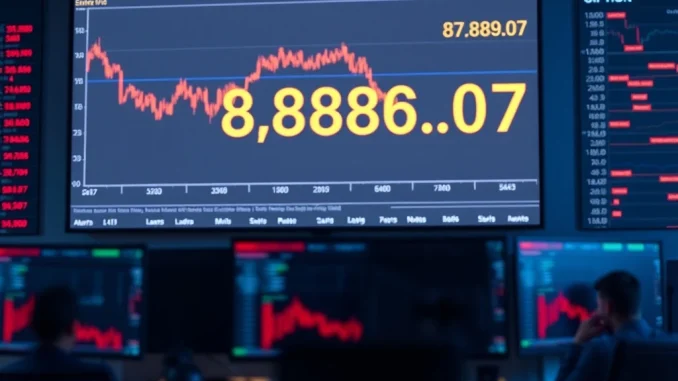
Global Cryptocurrency Markets, April 2025: Bitcoin experienced a significant price correction today as the leading cryptocurrency fell below the $83,000 threshold. According to real-time data from CoinPulseHQ market monitoring, BTC is currently trading at $82,880.07 on the Binance USDT market. This movement represents a notable shift in market sentiment following weeks of relative stability. Market analysts are examining multiple factors that may have contributed to this downward pressure, including macroeconomic indicators and institutional trading patterns.
Bitcoin Price Movement Analysis
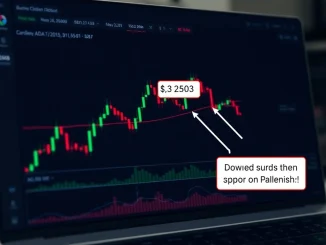
The descent below $83,000 marks a crucial psychological level for Bitcoin traders and investors. Historical data shows that round-number thresholds often serve as both support and resistance points in cryptocurrency markets. The current trading price of $82,880.07 represents a decline of approximately 2.5% from recent highs observed earlier this week. Market depth analysis reveals increased selling pressure across major exchanges, though buy orders continue to accumulate at lower price points.
Technical indicators provide additional context for this movement. The 24-hour trading volume has increased by 35% compared to yesterday’s session, suggesting heightened market activity. Several key moving averages are now being tested, including the 50-day simple moving average which currently sits at $81,500. Market participants are closely watching whether Bitcoin can maintain support above this level or if further declines are imminent.
Cryptocurrency Market Context and Conditions
Today’s Bitcoin price movement occurs within a broader cryptocurrency market context. Several concurrent factors may be influencing current market dynamics:
- Macroeconomic Environment: Recent Federal Reserve statements regarding interest rate policy have created uncertainty across all risk assets, including cryptocurrencies
- Institutional Activity: Data from regulated Bitcoin ETFs shows mixed flows, with some funds experiencing outflows while others maintain steady accumulation
- Market Sentiment Indicators: The Crypto Fear and Greed Index has shifted from “Greed” to “Neutral” territory over the past 48 hours
- Technical Factors: Bitcoin had approached overbought conditions on several shorter-term timeframes, suggesting a correction was statistically probable
The broader cryptocurrency market cap has declined by approximately 2.8% in the last 24 hours, with most major altcoins following Bitcoin’s downward trajectory. Ethereum, the second-largest cryptocurrency by market capitalization, has declined by 3.2% during the same period.
Historical Price Action Comparison
To understand the significance of today’s movement, we can examine similar historical corrections. Bitcoin has experienced 15 corrections of 5% or more during the current market cycle. The average duration of these corrections has been 8.3 days, with an average decline of 7.2% from peak to trough. The current decline represents a relatively modest correction compared to historical patterns, though its significance depends on whether support levels hold.
A comparative analysis reveals interesting patterns. During the 2021 bull market, Bitcoin experienced 12 separate corrections exceeding 10% before ultimately reaching new all-time highs. Each correction was followed by a period of consolidation before the next upward movement. Market structure analysis suggests that healthy bull markets typically include regular, controlled corrections that shake out weak hands and establish stronger support levels.
Market Structure and Trading Dynamics
The current market structure reveals several important dynamics. Exchange order books show significant liquidity clusters around key price levels:
| Price Level | Buy Orders (BTC) | Sell Orders (BTC) | Net Pressure |
|---|---|---|---|
| $82,500 | 1,250 | 850 | Buying |
| $83,000 | 980 | 1,150 | Selling |
| $83,500 | 720 | 1,400 | Selling |
This order book structure explains why $83,000 represented a significant resistance level. The concentration of sell orders at this price created a barrier that Bitcoin struggled to overcome during today’s trading session. Market makers and institutional traders often place large orders at round-number levels, creating natural support and resistance zones.
Derivatives market data provides additional insights. Open interest in Bitcoin futures has declined by 8% over the past 24 hours, suggesting some traders are reducing their leveraged positions. The funding rate for perpetual swaps has turned slightly negative on several exchanges, indicating that long positions are paying shorts—a shift from the positive funding rates observed throughout much of the recent rally.
Institutional Perspective and Market Impact
Institutional response to today’s price movement has been measured. Major cryptocurrency investment firms have issued statements emphasizing the normalcy of corrections in volatile asset classes. Several analysts note that Bitcoin’s 30-day volatility remains within historical norms, despite today’s decline. The options market shows increased demand for puts at the $80,000 strike price, suggesting some investors are hedging against further downside.
Regulatory developments continue to influence institutional participation. Recent clarity from financial regulators in major jurisdictions has encouraged more traditional financial institutions to explore cryptocurrency exposure. This institutional infrastructure development may provide longer-term stability to Bitcoin markets, though short-term volatility remains inherent to the asset class.
Technical Analysis and Key Levels
From a technical analysis perspective, several key levels warrant monitoring:
- Immediate Support: $82,500 represents the first significant support level, followed by $81,000
- Resistance Levels: $83,500 now serves as immediate resistance, with $84,200 representing the next significant barrier
- Moving Averages: The 50-day EMA at $81,400 and the 200-day EMA at $75,200 provide longer-term context
- Volume Profile: The point of control (price level with highest trading volume) sits at $80,800
Chart patterns suggest Bitcoin may be forming a bull flag pattern on the daily timeframe, which would typically resolve upward if the pattern completes. However, pattern recognition requires confirmation through price action in the coming sessions. The relative strength index (RSI) has cooled from overbought territory above 70 to a more neutral reading of 52, potentially creating room for further movement in either direction.
Conclusion
Bitcoin’s decline below $83,000 represents a normal market correction within the context of cryptocurrency volatility. The current Bitcoin price of $82,880.07 reflects ongoing market recalibration as traders assess multiple factors including macroeconomic conditions and technical levels. While short-term price movements capture attention, experienced market participants recognize that such corrections often strengthen longer-term market structures. The cryptocurrency’s fundamental value proposition remains unchanged, though price discovery continues through market mechanisms. Monitoring key support and resistance levels will provide insight into whether this represents a brief pullback or the beginning of a more significant trend change.
FAQs
Q1: Why did Bitcoin fall below $83,000?
Bitcoin declined due to a combination of technical factors, including profit-taking after recent gains, testing of key resistance levels, and broader market sentiment shifts. The movement represents normal volatility within cryptocurrency markets.
Q2: How significant is this price movement historically?
Historically, corrections of this magnitude are common during Bitcoin bull markets. The current decline of approximately 2.5% is relatively modest compared to the average correction of 7.2% observed during previous market cycles.
Q3: What are the key support levels to watch now?
The immediate support level is $82,500, followed by $81,000. The 50-day exponential moving average at approximately $81,400 represents a significant technical support level that many traders monitor.
Q4: How are institutional investors responding to this decline?
Institutional response appears measured, with some firms viewing the correction as a healthy market development. Options market activity shows increased hedging, while ETF flows have been mixed but not dramatically negative.
Q5: Does this price movement change Bitcoin’s long-term outlook?
Single-day price movements rarely alter long-term fundamental outlooks. Most analysts consider this a normal correction within an ongoing market cycle, though continued monitoring of key technical levels is warranted.
Related News
- BitGo Stock Soars: A Stunning 25% Surge on IPO Day Signals Strong Market Confidence
- Shocking Revelation: 1 in 4 Senior South Korean Officials Holds Crypto Investments
- US Government Moves 10,000 Bitcoin From Silk Road Bust, Here's The Destination
Related: Revolutionary: AIW3 Integrates Snowball's MNS, CIP, and ORS for Advanced On-Chain Strategy Execution