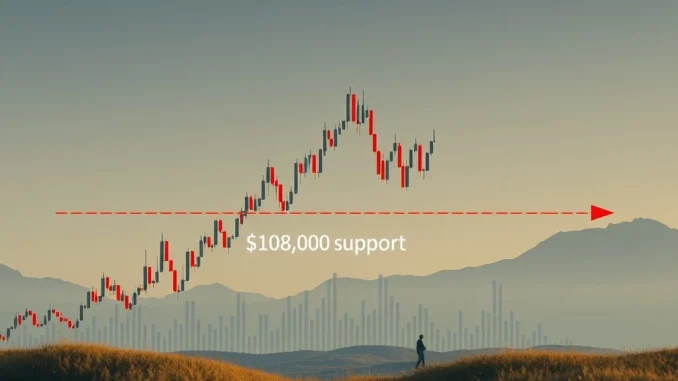
Bitcoin has once again captured the crypto world’s attention, not just with a significant surge, but with a looming challenge that could dictate its immediate future. After a robust 13% climb over the past month, the flagship cryptocurrency finds itself at a pivotal juncture, currently trading around $118,090. However, all eyes are on a critical $108,000 test. Will this be the springboard to new highs, or a precarious drop that redefines the current bullish sentiment?
Bitcoin Price: The Critical $108K Test and Bearish Patterns
The recent rally in the Bitcoin price has been impressive, but analysts warn of underlying fragility. The 13% surge has brought Bitcoin to significant resistance, but the real test lies at the $108,000 mark. According to prominent cryptocurrency analyst DonAlt, a breakdown below this key threshold could trigger a substantial 9% decline, signaling structural weaknesses within the market. This isn’t just a random number; it represents a crucial support level that has held firm in previous price actions.
Adding to the caution is the emergence of a ‘rising wedge’ pattern. This technical formation, observed between $110,000 and $119,500, is typically considered a bearish consolidation structure. It suggests that while prices are moving higher, the momentum is weakening, and a potential reversal or collapse below the psychological $100,000 threshold is a distinct possibility. Traders are closely monitoring this pattern, as its resolution will likely dictate Bitcoin’s trajectory in the coming days.
Institutional Demand: A Double-Edged Sword for the Crypto Market
The role of institutional demand in Bitcoin’s recent stability cannot be overstated. Current corporate treasury purchases have provided a significant bedrock of support, absorbing selling pressure and injecting capital into the ecosystem. However, this reliance on institutional players presents a double-edged sword for the broader crypto market.
DonAlt has emphasized that a slowdown or, worse, a halt in corporate Bitcoin acquisitions could introduce substantial selling pressure. Such a scenario would likely end the current uptrend and force a sharp price correction. Unlike retail investors, institutional movements often involve large volumes, capable of shifting market dynamics swiftly and decisively. Their continued participation is vital for sustaining the current price levels, making their future purchasing patterns a critical factor to watch.
On-Chain Data and Shifting Crypto Market Dynamics
Delving deeper into the crypto market, on-chain data provides a granular view of Bitcoin’s vulnerabilities. The data shows a concentrated liquidity zone in the $110,000–$119,500 range. This means a significant amount of buy and sell orders are clustered here. A failure to sustain buying activity within this range could lead to a breakdown below $115,600, potentially testing the deeper accumulation zone between $110,000 and $112,000.
Furthermore, the market is experiencing a notable divergence between Bitcoin and altcoins. While Bitcoin has been consolidating in a sideways pattern, altcoins have surged, fueled by record leverage in sectors like AI tokens, DeFi, and meme coins. Open interest in altcoins such as Ethereum and XRP has reached an astounding $45 billion, reflecting aggressive speculative positioning. Analyst Michaël van de Poppe notes that Bitcoin’s indecision has ceded momentum to altcoins, raising systemic liquidity risks as traders shift capital away from the flagship asset in pursuit of higher gains.
Bitcoin News: Regulatory Winds and Near-Term Outlook
The broader landscape of Bitcoin news is also influenced by regulatory developments. The Trump administration’s clearer guidelines for crypto assets have, in some ways, further fueled altcoin optimism by providing a more defined operational environment. However, Bitcoin’s own on-chain metrics remain mixed, indicating a lack of clear directional conviction despite the positive regulatory sentiment.
Bitcoin’s near-term outlook hinges significantly on its ability to break out of its current consolidation range. A sustained move above $119,500 could reignite bullish momentum, potentially setting the stage for new highs. Conversely, a decisive drop below $115,600 risks reigniting bearish sentiment, confirming the ‘rising wedge’ breakdown. The $117,000 level, which has shown resilience, remains a critical psychological barrier for traders. Moving forward, traders will closely monitor:
- Volume Shifts: Are buying volumes increasing on upward moves and decreasing on downward moves?
- Liquidity Flows: How are bids and asks positioned around key support and resistance levels?
- Institutional Activity: Are major institutions continuing their accumulation, or is there a pause/reversal?
- Macroeconomic Factors: Broader economic indicators and global market sentiment continue to influence crypto assets.
The coming days will be crucial for Bitcoin. Its ability to navigate the $108,000 test, overcome the bearish implications of the rising wedge, and maintain institutional confidence will determine whether its recent surge leads to continued growth or a significant correction. Investors and traders alike are advised to remain vigilant, as the market navigates these complex technical and fundamental signals.
Frequently Asked Questions (FAQs)
1. What is the current status of Bitcoin’s price trend?
Bitcoin has recently surged approximately 13% over the past month, currently trading around $118,090. However, it faces a critical test at the $108,000 support level, which analysts believe could determine the continuation of its uptrend.
2. Why is $108,000 a critical level for Bitcoin?
The $108,000 level is considered critical because prominent analysts like DonAlt suggest that a breakdown below this threshold could trigger a significant 9% decline, indicating underlying structural weaknesses in the market.
3. What is a ‘rising wedge’ pattern and what does it imply for Bitcoin?
A ‘rising wedge’ pattern is a technical analysis formation where price consolidates upward with converging trendlines, but it is typically considered a bearish signal. For Bitcoin, a rising wedge between $110,000 and $119,500 suggests weakening momentum and raises concerns about a potential collapse below $100,000.
4. How does institutional demand impact Bitcoin’s price?
Institutional demand, through corporate treasury purchases, has provided stability for Bitcoin. However, it’s a double-edged sword: a slowdown or halt in these acquisitions could introduce significant selling pressure, potentially ending the uptrend and forcing a sharp price correction.
5. Why are altcoins surging while Bitcoin consolidates?
While Bitcoin has been in a sideways consolidation pattern, altcoins have surged due to record leverage in sectors like AI tokens, DeFi, and meme coins. Analysts note that Bitcoin’s indecision has ceded momentum to altcoins, leading traders to shift capital for potentially higher returns, though this also raises systemic liquidity risks.
6. What are the key price levels to watch for Bitcoin’s near-term outlook?
Traders should closely monitor $119,500 (a sustained move above this could reignite bullish momentum), $115,600 (a drop below risks reigniting bearish sentiment), and the critical $117,000 level, which serves as a psychological barrier and immediate support.