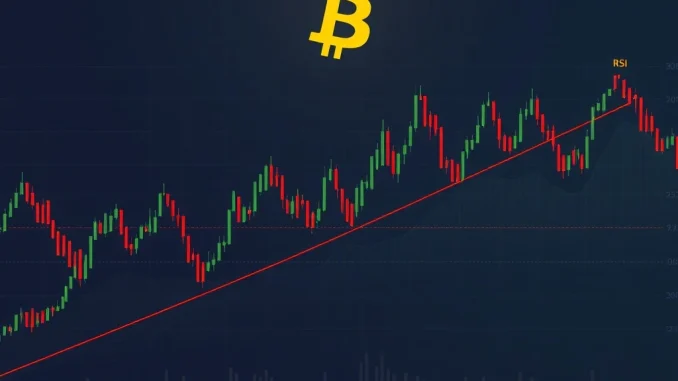
The crypto world is buzzing with the latest **Bitcoin news**! Just recently, the **Bitcoin price** soared past the impressive $118,000 mark, capturing the attention of investors worldwide. This significant surge, a robust 2.37% increase, has propelled the digital asset into a fascinating consolidation phase. But what does this mean for the future of the **crypto market**? Let’s dive deep into the mixed signals, key drivers, and expert opinions shaping Bitcoin’s journey.
What Does Bitcoin Price Consolidation Mean for You?
After such a strong upward move, Bitcoin isn’t just rocketing higher; it’s taking a breath. This period of ‘consolidation’ means the **Bitcoin price** is currently trading within a defined range, specifically between $117,500 and $119,500. This isn’t necessarily a bad sign; in fact, it often indicates that the market is absorbing recent gains and preparing for its next major move. We’re seeing an ‘ascending triangle’ pattern forming, which typically suggests that buyers are showing resilience, stepping in to support the price near the $117,500 level. However, there’s still notable resistance around $119,500, meaning sellers are active at that point. This tug-of-war is crucial because how Bitcoin resolves this consolidation will largely dictate its short-term trajectory. Are buyers strong enough to push through, or will sellers regain control?
How Are Institutional Investors Shaping Bitcoin’s Future?
A significant shift is underway in the forces driving **Bitcoin price** movements. While past bull runs were often fueled by widespread retail enthusiasm, the current landscape tells a different story. Today, it’s the ‘whales’ – large holders and **institutional investors** – who are increasingly dictating the market’s rhythm. Instead of chasing every price pump, these sophisticated players are strategically accumulating Bitcoin during price pullbacks. This calculated approach contrasts sharply with typical retail behavior and underscores the growing maturity and institutionalization of the **crypto market**. This strategic accumulation by institutions during dips suggests a long-term conviction in Bitcoin’s value, rather than short-term speculation. Their presence provides a more stable foundation, potentially reducing the volatility often associated with retail-driven surges. Understanding their movements is paramount for anyone tracking Bitcoin’s trajectory.
Decoding Bitcoin’s Technical Analysis: What Do the Signals Say?
For traders and analysts, **technical analysis** provides crucial insights into Bitcoin’s immediate future. Currently, the Relative Strength Index (RSI), a momentum indicator, remains above 60. While this generally suggests bullish sentiment, its recent flattening indicates a temporary pause in aggressive buying pressure. More notably, the Moving Average Convergence Divergence (MACD) histogram has turned negative at -161. This crossover is a short-term bearish signal, hinting that the immediate momentum might be leaning downwards, or at least sideways, for a brief period. These mixed signals from key indicators highlight the current uncertainty. From a price action perspective, two critical thresholds are under the microscope:
- Resistance Breakout: A decisive push above $119,500 could open the path towards $123,236, with further ambitious targets around $131,000 if momentum and trading volume remain strong.
- Support Breakdown: Conversely, a failure to hold the $117,400 support level could trigger a pullback towards $115,000. A more significant drop below $114,000 would be a concerning development, potentially invalidating some short-term bullish setups and signaling a deeper correction.
Beyond Bitcoin: How is the Broader Crypto Market Reacting?
The movements of **Bitcoin price** inevitably ripple across the entire **crypto market**. During this period of Bitcoin consolidation, we’ve observed altcoins largely trading within muted ranges. This suggests that while Bitcoin is pausing, capital isn’t necessarily flowing aggressively into alternative cryptocurrencies. Bitcoin’s dominance, a measure of its market capitalization relative to the total crypto market, remains largely unchallenged. This indicates that despite the current indecision, Bitcoin continues to be the primary focus for investors. Beyond the immediate charts, broader macroeconomic uncertainties also cast a shadow. Global economic conditions, interest rate policies, and geopolitical events can significantly influence investor sentiment and capital flows into risk assets like cryptocurrencies. Therefore, a comprehensive understanding of the market requires not just looking at Bitcoin’s chart but also keeping an eye on the wider economic landscape.
Expert Forecasts: Where Do Analysts See Bitcoin Price Heading Next?
The current state of **Bitcoin price** has led to a fascinating divergence in expert opinions, adding another layer of complexity to the ongoing **Bitcoin news**. On one hand, prominent market commentator Tom Lee, known for his often bullish outlook, has cited strong technical indicators as justification for a bold $240,000 price target for Bitcoin. His perspective suggests that the underlying market structure remains robust, setting the stage for significant future appreciation. This optimistic view fuels much of the bullish sentiment among long-term holders.
However, not all analysts share this unwavering optimism. Warnings from CoinCentral and Mitrade analysts, for instance, highlight a potential downside risk. They caution that if Bitcoin fails to decisively breach its current resistance levels, a significant correction – potentially up to 50% – could be on the cards. This ‘bull trap’ scenario, where traders pile into long positions only to be caught by a sudden downturn, remains a concern, particularly given the mixed on-chain signals. Brave New Coin analysts further echo this sentiment, noting that the current range-bound trading could resolve in either direction – a powerful breakout or a deeper correction – heavily dependent on sustained institutional confidence and broader market clarity. The market is truly at a crossroads, with compelling arguments from both sides.
In summary, the recent surge in **Bitcoin price** past $118,000 is a testament to its resilience, even after events like Galaxy Digital’s sell-offs. However, its subsequent entry into a consolidation phase, marked by mixed **technical analysis** signals and strategic accumulation by **institutional investors**, paints a nuanced picture. While the ascending triangle offers a glimmer of hope for a continued uptrend, the flattening RSI and negative MACD histogram call for caution. The **crypto market** is holding its breath, awaiting a decisive move. Whether Bitcoin breaks out towards new highs or experiences a significant pullback will depend on the interplay of institutional conviction, retail participation, and broader macroeconomic forces. Investors are advised to remain vigilant, monitor key support and resistance levels, and understand that while optimism persists, prudence is paramount in these uncertain times.
Frequently Asked Questions (FAQs)
1. What does Bitcoin’s consolidation phase mean?
Bitcoin’s consolidation phase means its price is trading within a relatively narrow range after a significant move. It indicates that the market is taking a pause, absorbing recent gains, and often precedes another major price movement, either up or down.
2. How are institutional investors influencing Bitcoin’s price?
Institutional investors, or “whales,” are increasingly driving Bitcoin’s price by strategically accumulating during pullbacks rather than chasing rallies. Their long-term conviction and calculated buying provide a more stable foundation for the market, contrasting with past retail-driven cycles.
3. What technical signals should I watch for Bitcoin?
Key technical signals include the Relative Strength Index (RSI) for momentum and the MACD histogram for short-term trend. Additionally, monitoring crucial support levels (like $117,400, $115,000, $114,000) and resistance levels (like $119,500) is vital for understanding potential price movements.
4. What are the potential price targets for Bitcoin if it breaks out?
If Bitcoin successfully breaks above the $119,500 resistance, analysts suggest potential targets at $123,236 and even $131,000, provided there’s sustained momentum and trading volume.
5. What is a “bull trap” in the context of Bitcoin?
A “bull trap” is a false signal that suggests a downtrend is reversing and the price will move upwards, leading traders to open long positions. However, the price then reverses again, trapping the “bulls” who bought in, leading to potential losses. Analysts warn of this risk if Bitcoin fails to breach current resistance.
6. How does Bitcoin’s performance affect the broader crypto market?
Bitcoin’s performance often dictates the direction of the broader crypto market. During Bitcoin’s consolidation, altcoins tend to trade in muted ranges, and Bitcoin’s dominance remains largely unchallenged, indicating that capital is primarily focused on Bitcoin.