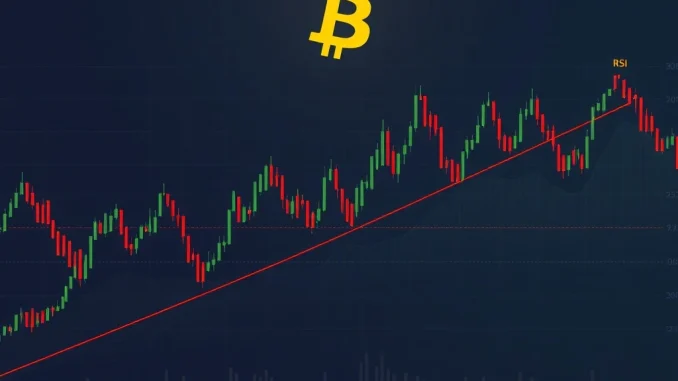
The cryptocurrency world is buzzing, but not with explosive rallies or dramatic crashes. Instead, the focus is squarely on the current state of Bitcoin price. For days now, the flagship cryptocurrency has been locked in a surprisingly tight range, oscillating between $116,000 and $120,000. This period of quiet is often misleading, as it masks underlying forces that could dictate Bitcoin’s next major move. While many might view this as stagnation, astute investors understand that consolidation phases are often precursors to significant shifts. But what’s truly brewing beneath the surface, and could Bitcoin be heading for a crucial test of its $111,000 support level?
Understanding BTC Consolidation: A Period of Equilibrium
When we talk about BTC consolidation, we’re referring to a phase where buying and selling pressures are largely in equilibrium. This results in the price trading within a relatively narrow range, often with subdued volatility. For Bitcoin, this current consolidation between $116K and $120K indicates a standoff between bulls and bears. Neither side has managed to gain a decisive upper hand, leading to a period of indecision in the market.
- What it means: A temporary pause in a trend, allowing the market to ‘catch its breath’ before a new directional move.
- Why it happens: Profit-taking by short-term traders, accumulation by long-term holders, or capital shifting into other assets (like altcoins, as some analysts suggest).
- Implications: Consolidation can resolve in either direction – a continuation of the prior trend or a reversal.
Historically, such periods have often preceded major upward movements for Bitcoin, suggesting that the current lull might be a healthy correction rather than a sign of fundamental weakness. However, the devil is always in the details, and a closer look at technical indicators reveals some cautionary signals.
The Warning Sign: Bitcoin’s RSI Divergence
One of the most critical indicators drawing attention is the Relative Strength Index (RSI). The RSI divergence, particularly a bearish one, is a signal that many traders closely monitor. What does it mean? In simple terms, while Bitcoin’s price has been making higher highs (or at least maintaining its high range), the RSI, which measures the speed and change of price movements, has been making lower highs. This discrepancy suggests that the underlying bullish momentum is weakening, even if the price itself hasn’t shown a significant decline yet.
A bearish RSI divergence often precedes a price correction or a trend reversal. It’s like a car still moving forward but with its engine losing power – it can’t maintain its speed for much longer. For Bitcoin, this divergence raises the risk of renewed selling pressure, potentially pushing the price downwards.
Navigating the Technical Landscape: Key Bitcoin Support Levels
Technical analysis offers a roadmap for potential price movements, and for Bitcoin, specific levels are now under the microscope. The 4-hour chart reveals a classic bullish flag pattern. This pattern typically suggests that the consolidation is a temporary pause within an ongoing uptrend. Price action has been printing higher highs and higher lows within an ascending trendline, currently near $114,000.
As long as this ascending trendline holds, the consolidation is generally considered healthy. However, the real test lies in the key Bitcoin support levels:
- The $114,000 Trendline: This is the immediate support. A breakdown below this level would invalidate the bullish flag pattern and signal increased bearish momentum.
- The $111,000 Liquidity Zone: This is the critical pivot point. If the $114,000 trendline fails, a sharper decline towards $111,000 is highly probable. This level is a significant liquidity zone, meaning a substantial amount of buy orders are likely clustered here, potentially offering strong support.
The interplay between these technical indicators is crucial. A failure to hold $114,000 would heighten the risk of a test of the $111,000 threshold. Conversely, if $111,000 holds firm, it could set the stage for Bitcoin to retest $120,000 and potentially resume its broader uptrend.
On-Chain Insights: What Are Whales and Retail Doing in the Crypto Market?
Beyond price charts, on-chain data provides invaluable insights into the behavior of different market participants. The current consolidation phase has seen an increase in retail participation, evidenced by a surge in small-sized futures positions. This indicates that individual retail traders are actively engaging within the $116K–$120K range, perhaps attempting to capitalize on short-term fluctuations or accumulating at these levels.
Crucially, the data also highlights an absence of large-scale sell-side activity, which is often associated with institutional investors or ‘whales’ – entities holding significant amounts of Bitcoin. The lack of offloading by these major players is a strong vote of confidence in the ongoing bullish trend. Historical patterns show that similar setups, where whales hold firm during consolidation, have often preceded major upward moves.
This suggests that while retail traders are active, the ‘smart money’ isn’t panicking. Their confidence reinforces the view that the current phase is more of a consolidation for future gains rather than a precursor to a major trend reversal. However, their continued holding pattern is contingent on key support levels remaining intact.
The Road Ahead for Bitcoin: A Mixed Outlook
The current landscape for Bitcoin presents a mixed outlook. On one hand, the bearish RSI divergence and the proximity to key support levels introduce short-term risks. If the $114,000 trendline and subsequently the $111,000 support fail to hold, a more significant correction could be on the cards.
On the other hand, the underlying bullish flag pattern and the steadfastness of large holders suggest that the broader market structure remains intact. The absence of whale capitulation indicates that major players anticipate further upside, viewing the current consolidation as a necessary re-accumulation phase.
The resolution of this consolidation will be pivotal. Traders and investors should closely monitor the $114,000 and $111,000 levels. A bounce from these areas would strengthen the bullish case, while a decisive breakdown could trigger further downside. Both retail and institutional sentiment will play crucial roles in determining Bitcoin’s next directional move, making vigilant observation of market dynamics more important than ever.
Frequently Asked Questions (FAQs)
Q1: What is Bitcoin price consolidation?
Bitcoin price consolidation refers to a period where the cryptocurrency’s price trades within a narrow range, typically with reduced volatility. It indicates a balance between buying and selling pressures, often preceding a significant price movement in either direction.
Q2: What does an RSI divergence mean for Bitcoin?
An RSI (Relative Strength Index) divergence occurs when the price makes new highs (or stays high) but the RSI indicator makes lower highs. A bearish RSI divergence suggests that the underlying bullish momentum is weakening, signaling a potential price correction or reversal.
Q3: Why is the $111,000 level important for Bitcoin?
The $111,000 level is considered a critical support level and a key liquidity zone for Bitcoin. If the price breaks below immediate support levels, this point is expected to offer strong buying interest, potentially preventing further declines and acting as a springboard for recovery.
Q4: How do whale movements impact Bitcoin’s price?
Whales, or large holders of Bitcoin, can significantly influence its price. Their selling activity can trigger major corrections, while their accumulation or holding patterns often signal confidence in the market’s future direction, reinforcing bullish sentiment.
Q5: Should I be worried about Bitcoin’s current consolidation?
Consolidation itself is a natural part of market cycles and not inherently worrying. However, the presence of a bearish RSI divergence combined with the proximity to critical support levels ($114K, $111K) suggests increased short-term risk. It’s crucial to monitor these levels closely before making investment decisions.