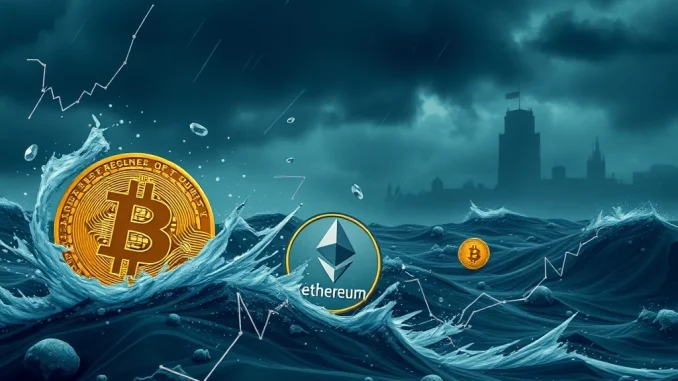
The cryptocurrency world is buzzing with a mix of anticipation and apprehension. While Bitcoin has shown remarkable resilience, the broader **crypto market** is bracing for a potential storm. The latest **Bitcoin News Today** highlights a period of heightened volatility, largely fueled by looming European Union regulatory measures. Analysts are sounding the alarm, warning of significant disruptions, especially to altcoin prices and overall market dynamics. If you’re invested in digital assets, understanding these shifts is crucial for navigating the choppy waters ahead.
Bitcoin News Today: Navigating Unprecedented Volatility
As of July 23, 2025, Bitcoin (BTC) is holding strong near $117,800. This might seem like a comfortable position, but don’t let the number fool you. The underlying currents suggest a market on edge. Bitcoin, often seen as the anchor of the crypto universe, dictates much of the sentiment for other digital assets. When BTC experiences even minor fluctuations, the ripple effect on altcoins can be substantial, often amplified due to their higher leverage.
What’s particularly interesting, as noted by market analyst Kyle, is the current Bitcoin Flow Wave. This metric, which tracks on-chain activity, is showing a divergence from patterns observed before major sell-offs in 2017 and 2021. While large holders appear to be retaining BTC on exchanges, the possibility of unexpected inflows remains a key concern. Such inflows could quickly destabilize the market, leading to rapid price corrections. Investors are advised to keep a close eye on these on-chain indicators, as they often provide early warnings of significant shifts.
The Looming Shadow of EU Sanctions on Crypto
The primary driver of current market uncertainty stems from the European Union’s potential imposition of new sanctions. These regulatory measures are not just about compliance; they’re designed to curb financial crime and align with global standards. However, the path to implementation is fraught with challenges and skepticism.
Navarro, a prominent trade advisor, has voiced concerns about the EU’s negotiations with the U.S., suggesting that any delayed announcements or perceived lack of coordination could severely disrupt market confidence. Once implemented, these sanctions could exacerbate the crypto market’s downward trajectory. Here’s why these sanctions are a big deal:
- Increased Scrutiny: The EU’s agenda aims to tighten oversight on crypto transactions, making it harder for illicit funds to move through decentralized systems.
- Innovation vs. Regulation: There’s a delicate balance. While necessary for security, overly stringent regulations risk stifling innovation, particularly in tokenization—a technology crucial for bridging traditional and digital finance.
- Enforcement Challenges: Reports indicate that some exchanges have already facilitated transactions involving sanctioned entities. This highlights the inherent difficulties in enforcing traditional financial rules within a decentralized ecosystem.
- Global Disparity: The absence of a unified global regulatory framework creates loopholes that bad actors can exploit, making the EU’s efforts potentially less effective without broader international cooperation.
Why the Crypto Market is Bracing for Impact
Beyond the direct impact of EU sanctions, the broader global economic landscape is adding layers of complexity and vulnerability to the **crypto market**. Several interconnected factors are at play, compounding the existing uncertainties:
- U.S.-EU Trade Tensions: Ongoing disputes between two of the world’s largest economic blocs can create ripple effects across all financial markets, including crypto. Investor sentiment often sours when major economies are at odds.
- Inflationary Pressures: Persistent inflation globally continues to be a concern. While crypto is sometimes seen as an inflation hedge, prolonged inflationary environments can lead to tighter monetary policies, reducing liquidity and investor appetite for risk assets.
- Oil Price Volatility: The price of oil is highly sensitive to geopolitical events, tariff uncertainties, and shifting trade dynamics. Volatile oil prices can indirectly impact investor confidence and their willingness to allocate capital to riskier assets like cryptocurrencies.
These macroeconomic pressures create a challenging environment for any asset class, but particularly for volatile ones like cryptocurrencies. The interconnectedness of these global factors underscores the critical need for coordinated policy responses to mitigate systemic risks and stabilize markets.
Decoding the Potential Altcoin Slump: 10-20% Declines Ahead?
While Bitcoin attempts to hold its ground, altcoins are in a much more precarious position. Market commentator Altcoin Sherpa has a stark forecast: a BTC drop to $116,000 could trigger 10-20% losses for altcoins. We’ve already seen tokens like XRP experiencing declines approaching 10%, a clear sign of the sector’s fragility.
Unlike prior market corrections where Bitcoin often led the charge downwards, the current scenario suggests that Bitcoin’s pullback could disproportionately affect altcoins. This is largely due to the heightened leverage present in many altcoin positions. When prices start to fall, leveraged positions are quicker to be liquidated, accelerating the downward spiral.
Bearish signals are also emerging in specific altcoins. TraderLeevis, for instance, warned on July 16 of a potential drop for the DeFi token AAVE, predicting it could fall to $275 if market conditions align with his analysis. These types of warnings, often overlooked during bullish phases, become critically important during periods of elevated risk and the pervasive fear of missing out (FOMO) that can lead to poor decisions. Investors are strongly advised to heed these expert analyses, as market corrections can accelerate with alarming speed.
What’s Next for Ethereum Price and Beyond?
Ethereum (ETH), currently trading near $3,600, is also facing significant pressure. The prospect of EU sanctions and the broader market uncertainty mean that ETH could soon test its $3,400 support level. A breach of this level could signal further declines, impacting the entire DeFi ecosystem built on Ethereum.
The performance of Ethereum is crucial, as it underpins a vast array of decentralized applications, NFTs, and other altcoins. A significant drop in **Ethereum Price** would likely drag down many other projects tied to its ecosystem. Investors should monitor key support and resistance levels for ETH, as its movements will be a strong indicator of broader altcoin health.
Strategic caution is paramount in these unpredictable conditions. Investors are urged to avoid aggressive positions and instead prioritize robust risk management. This means:
- Setting Stop-Losses: Protect your capital by automatically selling if a token drops to a certain price.
- Diversification: Don’t put all your eggs in one basket. Spread your investments across different assets.
- Reduced Leverage: If you’re using leverage, consider reducing your exposure to minimize liquidation risks.
- Cash Reserves: Having stablecoin or fiat reserves allows you to capitalize on potential dips.
- Stay Informed: Continuously monitor market news, regulatory updates, and expert analyses.
Conclusion: Navigating the Turbulent Crypto Seas
As the EU’s regulatory stance crystallizes, the crypto markets are facing a pivotal test. The coming months will determine whether these measures bolster market stability or amplify existing turbulence. The interplay between innovation and compliance will shape global policy trends and dictate the future trajectory of digital assets. While the immediate outlook suggests caution, informed investors who prioritize risk management and stay abreast of the latest developments will be best positioned to navigate these challenging times. The current environment underscores that the crypto market is not an isolated entity but deeply intertwined with global geopolitics, macroeconomic trends, and regulatory shifts. Staying vigilant and adaptable will be key to weathering the storm.
Frequently Asked Questions (FAQs)
Q1: What are the primary concerns for the crypto market regarding EU sanctions?
The primary concerns include potential disruptions to market confidence, increased sell-offs, particularly for altcoins, and the risk that stringent regulations might stifle innovation in areas like tokenization. There’s also the challenge of enforcing these rules in a decentralized system and the lack of a unified global regulatory framework.
Q2: How might Bitcoin’s price movements affect altcoins in this scenario?
Analysts predict that even a moderate drop in Bitcoin’s price (e.g., to $116,000) could lead to significant 10-20% losses for altcoins. This is because altcoins often have higher leverage, making them more susceptible to rapid declines when Bitcoin, the market leader, shows weakness.
Q3: What role do macroeconomic factors play in the current crypto market volatility?
Global macroeconomic factors like U.S.-EU trade tensions, persistent inflationary pressures, and oil price volatility indirectly impact investor appetite for risk assets, including cryptocurrencies. These factors can reduce overall liquidity and confidence, making the crypto market more vulnerable to downturns.
Q4: What is the significance of the Bitcoin Flow Wave divergence?
The Bitcoin Flow Wave is a metric tracking on-chain activity. Its current divergence from patterns seen before major sell-offs in 2017 and 2021 suggests a unique market phase. While large holders are retaining BTC, unexpected inflows could still destabilize the market, indicating that traditional indicators might not fully capture the current risk.
Q5: What are the recommended strategies for investors during this period of uncertainty?
Investors are advised to exercise strategic caution. Key recommendations include avoiding aggressive positions, focusing on robust risk management (e.g., setting stop-losses, reducing leverage), diversifying portfolios, maintaining cash reserves, and staying continuously informed about market news and regulatory updates.