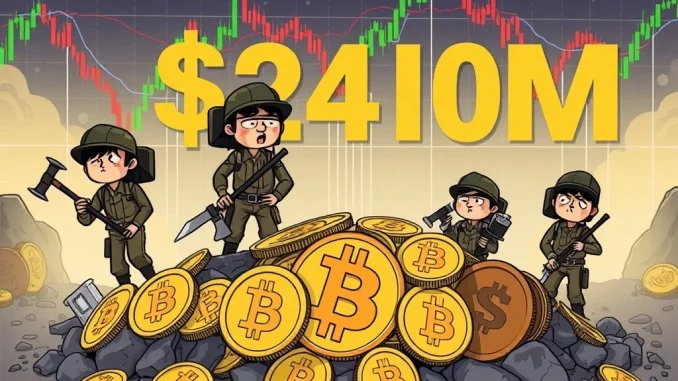
The cryptocurrency world often experiences rapid shifts. Recently, a significant event captured the attention of investors and analysts alike. **Bitcoin miners** sold a substantial amount of their holdings. This move has sparked considerable discussion about its potential effects on the market. Consequently, many are now closely watching the **BTC price** movements.
Bitcoin Miners Initiate Substantial Sell-Off
In a notable development, **Bitcoin miners** offloaded a significant portion of their assets. Over the past three days, these miners sold approximately 2,000 BTC. This volume represents a staggering value of about $240 million. The data comes from CryptoQuant, as cited by JinSe Finance. This rapid liquidation by **Bitcoin miners** suggests a strategic or necessary move within their operations.
Typically, miners accumulate Bitcoin as they successfully mine new blocks. However, they also face significant operational costs. These costs include electricity, hardware maintenance, and infrastructure development. Therefore, selling a portion of their mined Bitcoin is a regular practice. This covers expenses and secures profits. Nevertheless, the scale of this particular **miner selling** event warrants close examination.
Such a large volume of sales in a short period can indicate several things. It might suggest a need for immediate liquidity. Perhaps miners are upgrading equipment or facing increased energy costs. It could also reflect a bearish outlook from some mining entities. This would lead them to reduce exposure to potential price drops. Ultimately, this significant **Bitcoin sell-off** by a key market segment demands attention.
Impact on BTC Price and Market Dynamics
Any large sale of Bitcoin can influence the **BTC price**. When a substantial amount of BTC enters the market, it increases supply. If demand does not keep pace, prices tend to decline. This fundamental economic principle applies directly to cryptocurrency markets. Thus, the $240 million **Bitcoin sell-off** by miners naturally raises questions about price stability.
Market participants often monitor miner activity closely. Miners represent a consistent source of new Bitcoin supply. Their selling behavior can offer insights into market sentiment and potential price pressures. A sudden increase in **miner selling** can create downward pressure on the **BTC price**. Conversely, a decrease in selling might signal bullish sentiment or a period of accumulation.
Furthermore, the market’s reaction to such events is crucial. If the market absorbs the selling pressure effectively, it demonstrates resilience. However, if the selling triggers widespread panic or further liquidations, it could exacerbate price declines. Investors are now keenly observing how the **BTC price** reacts in the coming days. They seek to understand the long-term implications of this substantial miner activity.
Analyzing the Broader Crypto Market Reaction
The actions of **Bitcoin miners** extend beyond just the **BTC price**. They often send ripples throughout the entire **crypto market**. Bitcoin remains the dominant cryptocurrency. Its price movements frequently dictate the overall market sentiment. Therefore, a significant **Bitcoin sell-off** can affect altcoins and other digital assets.
When Bitcoin experiences volatility, altcoins often follow suit. This correlation is a well-established pattern in the **crypto market**. A downturn in Bitcoin’s value can lead to a general risk-off sentiment. Investors might then move funds out of riskier assets, including altcoins. This creates a broader market decline. Conversely, a stable or rising Bitcoin price can foster a more optimistic environment for altcoins.
Moreover, large-scale **miner selling** can impact investor confidence. It might signal underlying weaknesses or perceived risks. This perception can lead to reduced trading volumes or increased caution among traders. Consequently, the entire **crypto market** could experience reduced liquidity. This makes price recovery more challenging. Understanding these interconnected dynamics is vital for all market participants.
Understanding Miner Selling Trends
**Miner selling** is not a new phenomenon. It forms an integral part of the Bitcoin ecosystem. Miners operate complex and resource-intensive businesses. They must sell Bitcoin to cover their operational expenses. These expenses include electricity bills, cooling systems, and hardware upgrades. Without selling, miners cannot sustain their operations.
Several factors influence the rate of **miner selling**. These include:
Bitcoin Halving Events: These events reduce the block reward by half. Miners might sell more BTC immediately before or after a halving. This helps to secure profits or cover costs during a period of reduced revenue.
Bitcoin Price Volatility: When the **BTC price** surges, miners might increase selling. They lock in higher profits. Conversely, during sharp declines, some miners might sell to cut losses or avoid further exposure.
Operational Costs: Fluctuations in electricity prices or the cost of mining equipment directly impact profitability. Higher costs often necessitate increased **miner selling** to maintain operations.
Network Difficulty: As more miners join the network, mining becomes harder. This can reduce individual miner profitability. Some might sell off assets or even exit the market if they cannot compete.
Analysts frequently track metrics like the Miner Position Index (MPI) or miner outflow data. These tools help gauge the current level of **miner selling**. Such data provides valuable insights into potential supply-side pressures on Bitcoin.
Navigating the Bitcoin Sell-Off Landscape
A significant **Bitcoin sell-off** by miners can create a challenging environment for investors. However, understanding the context is key. Not all selling is necessarily bearish. Sometimes, it represents routine business operations. Other times, it might signal a shift in market sentiment. Therefore, investors should approach such events with a balanced perspective.
During periods of increased **miner selling**, market participants often consider several strategies:
Risk Management: Evaluate portfolio exposure. Adjust positions if necessary. This might involve reducing leverage or diversifying holdings.
Long-Term Perspective: Remember Bitcoin’s historical resilience. Short-term selling pressures often do not alter its long-term trajectory. Focus on fundamental analysis.
Monitoring On-Chain Data: Keep an eye on miner outflow data and exchange inflows. This provides real-time insights into supply dynamics. This can help anticipate further **BTC price** movements.
Dollar-Cost Averaging (DCA): Consider buying small amounts regularly. This strategy mitigates risk during volatile periods. It averages out the purchase price over time.
The **crypto market** is inherently volatile. Significant events like a **Bitcoin sell-off** by miners are part of its natural cycle. Informed decision-making, based on data and a clear understanding of market mechanics, remains paramount.
The recent $240 million **Bitcoin sell-off** by **Bitcoin miners** highlights the continuous interplay between supply, demand, and market sentiment. While significant, such events are a regular part of the **crypto market**’s evolution. They underscore the importance of monitoring on-chain data and understanding the motivations behind large asset movements. Ultimately, how the market absorbs this supply will dictate the short-term **BTC price** trajectory. Investors must remain vigilant and adaptable to these dynamic conditions.
Frequently Asked Questions (FAQs)
Q1: Why did Bitcoin miners sell $240 million worth of BTC?
Bitcoin miners typically sell BTC to cover their significant operational costs. These include electricity, hardware maintenance, and infrastructure development. The recent large sale likely reflects a need for liquidity, perhaps for upgrades or to manage increased expenses. It could also signal a strategic move based on their market outlook.
Q2: How does miner selling impact the BTC price?
When miners sell a large amount of Bitcoin, it increases the circulating supply. If this increased supply is not met with sufficient demand, it can put downward pressure on the **BTC price**. Large sales can also affect market sentiment, leading to further selling by other investors.
Q3: Is this a normal occurrence for the crypto market?
Yes, **miner selling** is a normal and necessary part of the Bitcoin ecosystem. Miners need to sell BTC to fund their operations. However, the scale and speed of a sell-off can vary. A $240 million sale in three days is significant and warrants attention, though similar large sales have occurred historically.
Q4: What metrics can indicate future miner selling?
Investors can monitor several on-chain metrics to gauge miner activity. These include the Miner Position Index (MPI), which tracks miner net flows, and miner outflow data from exchanges. Observing these metrics can provide insights into whether miners are accumulating or distributing their Bitcoin holdings.
Q5: How should investors react to a Bitcoin sell-off by miners?
Investors should approach such events with caution but also a long-term perspective. It is crucial to avoid panic selling. Instead, consider risk management strategies, monitor market reactions, and perhaps use dollar-cost averaging if looking to buy. Understanding the underlying reasons for the sell-off is key.