A staggering claim of $354 million in **lost Bitcoin** recently faced a decisive blow. A U.S. court has dismissed a Florida man’s lawsuit against the government. This significant ruling underscores the complexities surrounding digital asset ownership and recovery in legal proceedings. For many cryptocurrency enthusiasts, this case serves as a stark reminder of the importance of verifiable evidence in the digital age.
U.S. Court Dismisses Major Crypto Lawsuit
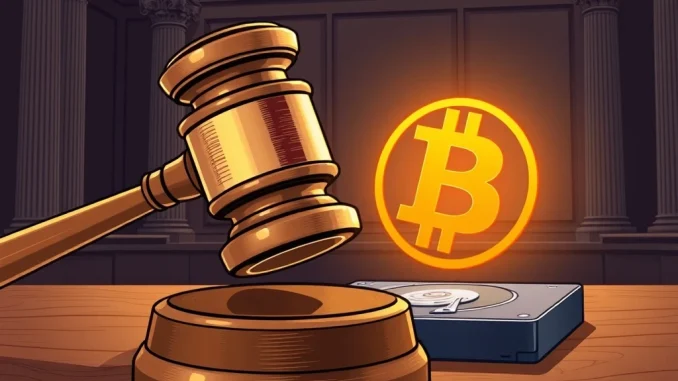
In a landmark decision, a U.S. court definitively dismissed a **Florida man lawsuit** seeking a colossal $354 million in damages. The plaintiff, Michael Prime, alleged the government was responsible for his substantial Bitcoin loss. However, the court found no credible basis for his claim. Specifically, the ruling stated there was no evidence to suggest a seized hard drive actually contained any Bitcoin. This outcome sets a precedent for future cases involving digital assets.
Prime’s legal battle began after his 2019 arrest. Authorities charged him with counterfeiting and identity theft. During the arrest, investigators confiscated his hard drive. This device later became the central piece of evidence in his lawsuit. The sequence of events leading to the drive’s destruction is particularly noteworthy.
The Plaintiff’s Shifting Testimony Regarding Lost Bitcoin
Crucially, Michael Prime’s account of the hard drive’s contents changed dramatically over time. During the initial investigation, Prime consistently asserted that the seized drive held no cryptocurrency. This testimony was recorded and documented by authorities. Acting on this information, and likely deeming the drive irrelevant to the counterfeiting and identity theft charges, authorities proceeded to destroy it. They believed it contained no valuable digital assets.
However, after completing his prison sentence, Prime dramatically recanted his earlier statements. He then filed the substantial lawsuit, claiming the destroyed hard drive contained hundreds of millions of dollars worth of Bitcoin. This sudden change in testimony proved problematic for his case. The court carefully reviewed all available evidence. It considered the initial statements and the subsequent claim. Ultimately, the court found the lack of prior disclosure damning. This highlights the critical role of consistent and truthful testimony in legal matters, especially concerning high-value digital assets.
Navigating Digital Asset Seizure and Proof
The case of Michael Prime offers valuable insights into the challenges of **digital asset seizure**. When law enforcement confiscates digital devices, proving the presence and value of cryptocurrencies becomes paramount. Unlike physical cash, Bitcoin exists as entries on a blockchain. Accessing it requires private keys or specific wallet software. Therefore, merely possessing a hard drive does not automatically equate to possessing Bitcoin. Verifiable proof is always necessary.
- Proof of Ownership: Individuals must demonstrate they owned the claimed cryptocurrency.
- Access to Funds: Evidence of private keys or wallet access is often required.
- Contemporaneous Records: Transaction history or exchange records can corroborate claims.
The court’s decision emphasizes the need for concrete evidence. It cannot rely solely on post-facto claims. This applies especially when previous statements contradict new assertions. Consequently, the burden of proof rests heavily on the plaintiff in such scenarios. The government’s actions, in this instance, were based on the plaintiff’s own initial representations.
Implications for Future Crypto Lawsuits
This dismissal carries significant implications for future **crypto lawsuits**. It reinforces the idea that courts demand robust evidence when dealing with claims of lost or seized digital assets. Furthermore, it highlights the potential pitfalls of inconsistent statements. Any individual making claims about digital assets in a legal context must be prepared to provide clear, verifiable proof. This includes transaction records, wallet addresses, and private key information if relevant.
The ruling also serves as a cautionary tale for those involved in criminal investigations. Providing false or misleading information to authorities can have severe consequences later. Such actions can undermine the credibility of subsequent claims. Legal experts suggest this case will influence how similar disputes are handled. Courts will likely scrutinize claims of digital asset loss more closely. They will demand a high standard of evidence.
Protecting Your Digital Assets: Lessons from the Florida Man Lawsuit
The outcome of the **Florida man lawsuit** offers crucial lessons for all cryptocurrency holders. Protecting digital assets extends beyond just technical security. It also involves preparing for potential legal challenges. Consider these proactive steps:
- Document Everything: Keep meticulous records of all cryptocurrency purchases, sales, and transfers.
- Secure Private Keys: Store private keys and seed phrases securely, preferably offline, and in multiple locations.
- Regular Backups: Back up wallet data and any relevant documentation.
- Legal Counsel: Seek legal advice promptly if assets are seized or compromised.
Furthermore, understand the legal landscape surrounding digital assets in your jurisdiction. Laws are constantly evolving. Staying informed helps protect your investments. The lack of verifiable evidence was a critical factor in this case. Therefore, ensuring you can prove ownership and access to your Bitcoin is vital. This proactive approach minimizes risks in potential legal disputes.
The Broader Context of Digital Asset Disputes
As the cryptocurrency market matures, the number of legal disputes involving digital assets continues to grow. These cases range from theft and fraud to regulatory compliance and asset recovery. The **U.S. court dismisses** ruling contributes to a growing body of case law. This body of law defines how traditional legal systems interact with novel digital assets. Courts are increasingly grappling with the unique characteristics of cryptocurrencies.
For instance, the fungibility and pseudonymous nature of Bitcoin present challenges for identification and tracking. Therefore, legal frameworks must adapt to these technological realities. This case exemplifies the judicial system’s cautious approach. It emphasizes the need for concrete proof in claims involving intangible digital wealth. The dismissal reinforces the principle that extraordinary claims require extraordinary evidence. This applies especially when the claimant’s own prior statements contradict the new allegations.
Conclusion: A Precedent for Proving Lost Bitcoin Claims
The dismissal of Michael Prime’s $354 million lawsuit over allegedly **lost Bitcoin** marks a significant moment in cryptocurrency legal history. The U.S. court’s decision underscores the paramount importance of consistent testimony and verifiable evidence in digital asset disputes. It serves as a powerful reminder that claims of substantial cryptocurrency losses must be supported by irrefutable proof, not just retrospective allegations. This case will undoubtedly influence how courts handle similar claims, setting a precedent for a high standard of evidence in the evolving landscape of crypto litigation. For all cryptocurrency holders, the message is clear: document your assets meticulously and be prepared to prove your claims under scrutiny.
Frequently Asked Questions (FAQs)
Q1: Why did the U.S. court dismiss the Florida man’s lawsuit?
A1: The court dismissed the lawsuit primarily because there was no basis to believe the hard drive seized by investigators contained any Bitcoin. The plaintiff, Michael Prime, had consistently stated during the initial investigation that the drive held no cryptocurrency, leading authorities to destroy it. His later claim, made after his prison sentence, contradicted his earlier testimony.
Q2: What was the value of the lost Bitcoin claimed in the lawsuit?
A2: The Florida man, Michael Prime, was seeking $354 million in damages from the government over the allegedly lost Bitcoin.
Q3: What charges did Michael Prime originally face?
A3: Michael Prime was arrested in 2019 on charges of counterfeiting and identity theft, during which authorities confiscated his hard drive.
Q4: What are the key takeaways for cryptocurrency holders from this crypto lawsuit?
A4: This case highlights the critical importance of documenting all cryptocurrency holdings, securing private keys, and maintaining consistent, truthful statements regarding digital assets, especially in legal or investigative contexts. Proving ownership and access to Bitcoin requires verifiable evidence.
Q5: How do courts typically handle claims involving lost or seized digital assets?
A5: Courts generally require robust, verifiable evidence to support claims of lost or seized digital assets. This includes proof of ownership, access to funds (e.g., private keys), and contemporaneous records like transaction histories. Inconsistent testimony can significantly weaken a plaintiff’s case.