The cryptocurrency market often presents unique regional price discrepancies. Recently, the **Bitcoin Kimchi Premium** surged, capturing significant attention from traders and analysts alike. This premium, a notable price difference for Bitcoin between South Korean exchanges and global platforms, currently stands at an impressive 2.1%. Such a significant gap highlights the distinct dynamics of the South Korean crypto market. Investors closely monitor this metric as it often signals intense local demand. Understanding this phenomenon is crucial for anyone following global crypto trends.
What is the Bitcoin Kimchi Premium?
The **Bitcoin Kimchi Premium** refers to the phenomenon where Bitcoin trades at a higher price on South Korean cryptocurrency exchanges compared to international exchanges. This price divergence is named after “kimchi,” a staple Korean side dish, underscoring its unique connection to the region. Historically, this premium has fluctuated significantly, sometimes reaching double-digit percentages during periods of high market enthusiasm. Understanding this premium requires examining several factors unique to the South Korean financial landscape. It represents more than just a simple price difference; it reflects complex economic and regulatory forces at play.
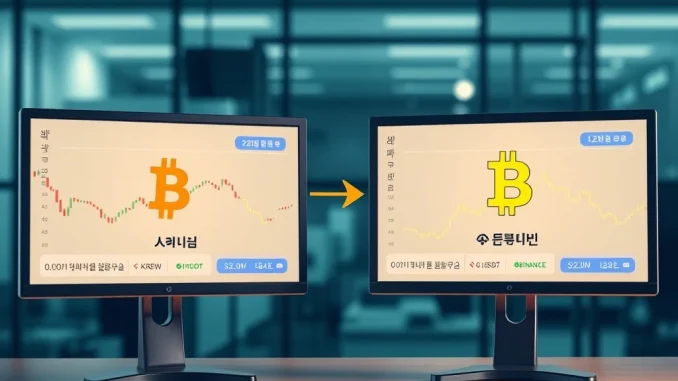
Currently, data reveals a clear disparity. On Upbit, a leading South Korean exchange, Bitcoin trades at approximately 155,872,000 Korean Won (KRW). In contrast, on a global exchange like Binance, Bitcoin is priced around 152,650,867 KRW, after converting from its USD or USDT value. This conversion uses an exchange rate of 1,420 KRW per USDT. Therefore, the premium indicates how much more South Korean investors are willing to pay for Bitcoin locally. This situation presents both opportunities and challenges for market participants. Ultimately, it highlights market inefficiencies driven by regional factors.
Analyzing the Current 2.1% Kimchi Premium Surge
The recent rise to a 2.1% **Kimchi Premium** is a significant development. This figure indicates that Bitcoin buyers on South Korean platforms are paying 2.1% more than their counterparts on international exchanges. To illustrate, let’s break down the provided figures. A Bitcoin on Binance, valued at 152,650,867 KRW, would cost 155,872,000 KRW on Upbit. This translates to a difference of 3,221,133 KRW. When calculated as a percentage of the international price, this yields approximately 2.109%. Such a premium can fluctuate rapidly, influenced by real-time trading volumes and market sentiment. Therefore, monitoring these figures becomes crucial for informed decision-making.
Several underlying factors contribute to this persistent **Bitcoin price difference**. Firstly, South Korea possesses a highly active and enthusiastic retail investor base for cryptocurrencies. This strong domestic demand often outstrips the available supply on local exchanges. Secondly, stringent capital controls in South Korea make it challenging for individuals to easily move large sums of money in and out of the country. This restriction limits the ability of arbitrageurs to profit from the price gap by buying low internationally and selling high locally. Consequently, the premium tends to persist, driven by the unique market structure. Furthermore, the limited number of fiat on-ramps and off-ramps also plays a role in restricting liquidity flow. These combined elements create a distinct trading environment.
Driving Factors Behind the Bitcoin Price Difference
Understanding the specific drivers behind the **Bitcoin price difference** is essential. One primary factor is the robust demand for cryptocurrencies within South Korea. The nation has a tech-savvy population and a high rate of crypto adoption. Many South Koreans view Bitcoin as a viable investment asset, especially during periods of market optimism. This strong domestic buying pressure naturally pushes local prices higher. However, this demand is not easily met by international supply due to regulatory hurdles. This imbalance directly fuels the premium.
Furthermore, South Korea’s strict capital control regulations significantly impact the premium. These rules make it difficult for large institutional players or even individual traders to easily transfer funds across borders. Consequently, this prevents efficient arbitrage, where traders would typically buy Bitcoin on cheaper international exchanges and sell it on more expensive South Korean exchanges to equalize prices. Without such free flow of capital, the price discrepancies endure. Moreover, the regulatory landscape for crypto exchanges in South Korea also contributes to market segmentation. This creates an isolated market where local supply and demand dynamics dictate prices more profoundly. Ultimately, these factors combine to create a sustained premium.
Historical Context of the Kimchi Premium
The **Kimchi Premium** is not a new phenomenon; it has a rich and often dramatic history. It first gained widespread attention during the 2017 bull run, when Bitcoin prices soared globally. During that period, the premium reached astonishing levels, sometimes exceeding 50%. This created immense arbitrage opportunities, though executing them proved incredibly difficult due to the aforementioned capital controls. Subsequently, the premium re-emerged during the 2021 bull market, albeit at lower percentages. These historical peaks demonstrate the intensity of South Korean investor interest during periods of market euphoria. They also highlight the consistent challenges in bridging this price gap. Observing these past trends provides valuable context for the current 2.1% surge. It shows a cyclical pattern tied to broader market sentiment.
Analyzing historical data reveals a correlation between the premium’s size and overall market sentiment. When Bitcoin experiences significant upward momentum globally, the premium tends to widen. Conversely, during bear markets or periods of consolidation, the premium often shrinks or even turns negative (a “Kimchi discount”). This indicates that local demand in South Korea is highly sensitive to market trends. Therefore, the current 2.1% premium could signal renewed optimism among South Korean investors. However, it also serves as a reminder of the market’s inherent inefficiencies and regional disparities. This historical perspective is crucial for any comprehensive understanding of the premium.
Implications for South Korea Crypto Investors
For investors operating within the **South Korea crypto** market, the Kimchi Premium carries several implications. Firstly, local buyers consistently pay a higher price for their Bitcoin compared to investors in other regions. This means their initial investment cost is inflated. Secondly, while the premium might seem like an opportunity for local sellers to realize higher profits, exiting the market and converting profits back into foreign currency or moving them internationally faces significant regulatory hurdles. Thus, the premium can create a “locked-in” effect for local capital. Ultimately, this dynamic shapes investment strategies and risk assessments for South Korean participants.
Furthermore, the existence of the premium can influence trading behavior. Some local traders might hold onto their Bitcoin longer, hoping the premium widens further. Others might view it as a signal of an overheated market, prompting caution. The premium also affects the perception of Bitcoin’s true value within the country. While global prices serve as a benchmark, the local premium suggests a distinct, localized valuation. This unique market condition requires a nuanced approach from investors. They must consider both global trends and domestic factors when making decisions. Therefore, understanding the premium is paramount for anyone involved in the **South Korea crypto** space.
The Role of Arbitrage Trading
Arbitrage trading theoretically offers a way to profit from the **Bitcoin price difference**. In a perfectly efficient market, arbitrageurs would quickly buy Bitcoin on cheaper international exchanges and sell it on more expensive South Korean exchanges. This action would naturally drive prices closer together. However, the Kimchi Premium persists precisely because these arbitrage opportunities are not easily accessible. Strict regulations on foreign exchange, anti-money laundering (AML) checks, and capital outflow limits prevent large-scale, cross-border arbitrage. These barriers make it extremely difficult for individuals or institutions to exploit the price gap effectively. Consequently, the premium remains a testament to market segmentation. Thus, despite the clear price discrepancy, profiting from it legally and at scale is challenging.
Individuals attempting arbitrage face significant logistical and legal obstacles. Moving large amounts of Korean Won out of the country, or converting foreign currency into KRW for local purchases, involves complex banking regulations. These processes are often slow, costly, and subject to intense scrutiny. Moreover, South Korean authorities actively monitor large transactions to prevent illicit financial activities. Therefore, while the mathematical opportunity for arbitrage is clear, the practical execution is severely constrained. This reality ensures that the **Kimchi Premium** remains a distinct feature of the South Korean market. It highlights the power of regulatory frameworks in shaping local market dynamics.
Broader Market Impact of Bitcoin Price Difference
The persistent **Bitcoin price difference** in South Korea has broader implications beyond its borders. It serves as an indicator of strong retail investor interest in a key Asian market. This robust demand can contribute to overall positive sentiment for Bitcoin globally, especially if it reflects a broader trend of increasing adoption in developed economies. However, it also highlights potential inefficiencies and fragmentation within the global cryptocurrency market. While Bitcoin aims for decentralization and seamless global transactions, regional premiums demonstrate that local regulatory and economic conditions still significantly influence pricing.
Furthermore, the Kimchi Premium can attract international attention to the South Korean crypto market. Analysts and investors worldwide often monitor this metric as a barometer for regional demand. A widening premium might signal an upcoming surge in retail interest or a bullish sentiment that could potentially spread. Conversely, a shrinking premium could indicate cooling demand. Ultimately, the existence of such a distinct **Bitcoin price difference** underscores the ongoing evolution of the global crypto ecosystem. It reminds us that local factors can indeed create unique market conditions, impacting global perceptions and trading strategies. Thus, it remains a crucial metric for observation.
Navigating the South Korea Crypto Landscape
Operating within the **South Korea crypto** landscape requires careful consideration of its unique characteristics. The market is highly regulated, with exchanges adhering to strict licensing and anti-money laundering (AML) guidelines. This regulatory environment aims to protect investors but also contributes to the market’s isolation and the persistence of the Kimchi Premium. Investors must understand that local market dynamics can diverge significantly from global trends. Accessing major exchanges like Upbit, Bithumb, Coinone, and Korbit typically requires a South Korean bank account linked to a real-name verification system. This further restricts participation for non-residents. Consequently, the local market operates with distinct rules and influences.
For those interested in the **South Korea crypto** market, staying informed about local news, regulatory updates, and economic indicators is paramount. The government’s stance on cryptocurrencies can directly impact market sentiment and the premium itself. Moreover, understanding the cultural propensity for investment in speculative assets also provides insight into the high demand. Ultimately, the South Korean market, with its vibrant retail base and regulatory framework, offers a compelling case study in regional crypto dynamics. It continues to be a significant player in the global Bitcoin ecosystem, largely defined by phenomena like the Kimchi Premium. Navigating it successfully demands local expertise.
In conclusion, the recent surge of the **Bitcoin Kimchi Premium** to 2.1% underscores the enduring unique characteristics of the South Korean cryptocurrency market. This price difference, driven by strong local demand and restrictive capital controls, continues to be a key indicator for market observers. While it presents theoretical arbitrage opportunities, practical execution remains challenging due to regulatory hurdles. As the global crypto landscape evolves, regional phenomena like the Kimchi Premium offer valuable insights into the complex interplay of economics, regulation, and investor sentiment. Monitoring this premium will continue to provide a window into the dynamic and often isolated world of South Korean crypto trading.
Frequently Asked Questions About the Bitcoin Kimchi Premium
Here are some common questions regarding the Bitcoin Kimchi Premium:
Q1: Why does the Bitcoin Kimchi Premium exist?
A1: The premium primarily exists due to strong retail demand for Bitcoin in South Korea combined with strict capital controls. These regulations make it difficult to move funds across borders, limiting arbitrage opportunities and keeping local prices elevated.
Q2: How is the Kimchi Premium calculated?
A2: It is calculated as the percentage difference between Bitcoin’s price on a South Korean exchange (like Upbit) and its price on an international exchange (like Binance), typically converted into Korean Won. For example, if Bitcoin is 155,872,000 KRW on Upbit and 152,650,867 KRW on Binance, the premium is approximately 2.1%.
Q3: Is it possible to profit from the Kimchi Premium through arbitrage?
A3: While the price difference presents a theoretical arbitrage opportunity, practically executing it is extremely challenging. South Korea’s stringent capital controls, anti-money laundering (AML) regulations, and the difficulty of cross-border fund transfers make large-scale, legal arbitrage very difficult for most individuals and institutions.
Q4: What are the historical highs of the Bitcoin Kimchi Premium?
A4: The Kimchi Premium reached its highest levels during the 2017 bull market, often exceeding 50%. It also saw significant surges during the 2021 bull run, though generally at lower percentages compared to 2017. These peaks correlate with periods of intense market euphoria.
Q5: What impact does the Kimchi Premium have on South Korean investors?
A5: South Korean investors often pay a higher entry price for Bitcoin due to the premium. While it could mean higher local profits, exiting the market and moving funds internationally faces significant regulatory hurdles. This creates a somewhat isolated market dynamic for local participants.
Q6: Does the Kimchi Premium affect global Bitcoin prices?
A6: While the premium is a localized phenomenon, it can serve as an indicator of strong regional demand, potentially contributing to overall positive sentiment in the global Bitcoin market. It also highlights market inefficiencies and regional fragmentation within the broader crypto ecosystem.