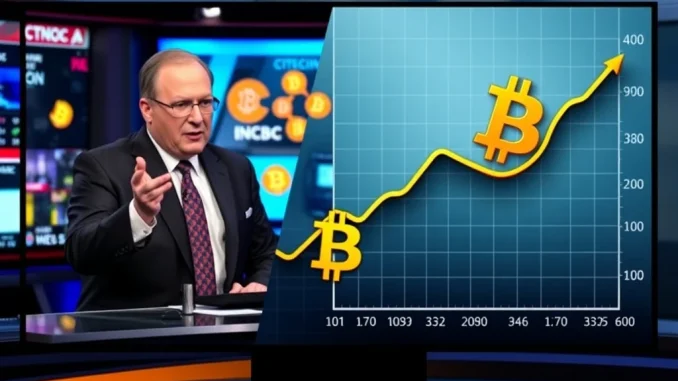
In a surprising and significant move that has captured the attention of both traditional finance and the crypto world, veteran Wall Street commentator and ‘Mad Money’ host Jim Cramer has publicly announced an increase in his personal Bitcoin holdings. This isn’t just a speculative flutter; Cramer frames his decision as a strategic defense mechanism against the formidable and ever-growing U.S. federal debt, which has now soared past an astonishing $37 trillion. His recent remarks on CNBC underscore a profound shift in perspective, suggesting that even established financial figures are looking beyond conventional assets for stability in an era of unprecedented fiscal uncertainty.
Why is Jim Cramer Betting Big on Bitcoin?
Jim Cramer’s pivot towards Bitcoin as a hedge is rooted in a pragmatic assessment of the current economic landscape. During a July 2025 CNBC segment, Cramer articulated his belief that people are increasingly seeking alternatives to traditional safe-haven assets. He stated, “I think people want to hold some as a hedge against $37 trillion debt. They want to own it.” When pressed on Bitcoin’s resilience in a financial crisis, his response was a confident “Yes.”
His rationale hinges on several key characteristics of Bitcoin:
Decentralized Structure: Unlike fiat currencies controlled by central banks, Bitcoin operates on a decentralized network, making it less susceptible to government intervention or inflationary policies.
Capped Supply: With a hard cap of 21 million coins, Bitcoin’s scarcity stands in stark contrast to the unlimited printing capabilities of fiat money. This limited supply is a fundamental argument for its potential as a long-term store of value.
Inflationary Hedge: In an environment of expansive government spending and rising national debt, there’s an inherent risk of currency devaluation. Bitcoin’s scarcity positions it as a potential counterbalance to this inflationary pressure.
Cramer’s decision extends beyond mere short-term trading; he explicitly mentioned purchasing Bitcoin for his children, signaling a long-term conviction in its durability for family wealth preservation. This evolving perspective is partly attributed to his discussions with prominent crypto advocate Anthony Pompliano, who has consistently championed Bitcoin as a systemic risk mitigator.
The $37 Trillion Question: Bitcoin as a US Debt Hedge
The U.S. federal debt exceeding $37 trillion is not merely a number; it’s a significant macroeconomic concern with far-reaching implications for inflation, interest rates, and overall fiscal sustainability. This escalating debt has intensified the debate among policymakers and investors alike, prompting a search for robust hedges.
Historically, gold has been the go-to safe-haven asset during times of economic uncertainty. However, the narrative around digital assets, particularly Bitcoin, is gaining traction as a modern alternative. Figures like Michael Saylor, CEO of MicroStrategy, have long advocated for large-scale Bitcoin accumulation as a defensive strategy against inflation and currency depreciation.
Cramer’s endorsement aligns with this growing sentiment that traditional asset classes might not sufficiently address the unique risks posed by unprecedented national debt. While Bitcoin’s notorious volatility remains a point of contention for critics, its decentralized nature and scarcity are increasingly seen as powerful strengths in scenarios where fiat currencies face an erosion of purchasing power.
Beyond Speculation: Digital Assets for Long-Term Wealth
The conversation around digital assets is shifting from pure speculation to a more mature consideration of their role in diversified portfolios. Cramer’s move exemplifies this evolution, suggesting that Bitcoin is not just for tech enthusiasts or day traders, but potentially for mainstream investors seeking long-term wealth preservation. His actions provide a tangible example of how a high-profile traditional finance personality is integrating crypto into a serious investment strategy.
The broader institutional acceptance of digital assets continues to grow, albeit cautiously. Major financial firms are exploring crypto-related investments, navigating complex regulatory landscapes and market uncertainties. Cramer’s advocacy, particularly his framing of Bitcoin as a hedge against sovereign debt, contributes significantly to mainstreaming a narrative that challenges traditional economic paradigms.
What Are the Broader Implications for Cryptocurrency?
Cramer’s public endorsement has implications that extend beyond individual investment strategies. By positioning cryptocurrency, specifically Bitcoin, as a viable hedge against U.S. debt, he has helped legitimize a perspective that could influence broader policy discussions. As governments worldwide grapple with the long-term consequences of fiscal expansion, the role of decentralized digital currencies in mitigating these risks may become a more central topic.
However, the journey for cryptocurrencies into mainstream institutional portfolios is still evolving. Regulatory frameworks are being developed, and market dynamics remain complex. While Bitcoin’s future is subject to these factors, its utility in mitigating risks tied to sovereign debt and inflationary pressures has undeniably gained significant traction. The market will undoubtedly continue to monitor how investors balance recommendations from influential figures like Cramer with broader macroeconomic indicators and the evolving regulatory landscape.
Conclusion: A Shifting Tide in Financial Strategy
Jim Cramer’s decision to increase his Bitcoin holdings as a hedge against the staggering $37 trillion U.S. debt marks a pivotal moment. It underscores a growing recognition within traditional finance of Bitcoin’s potential as a resilient store of value in an increasingly uncertain economic climate. This move, driven by a desire for long-term family wealth preservation, highlights the shifting perceptions of digital assets from speculative ventures to strategic components of a diversified portfolio. As the global economic landscape continues to evolve, the conversation around Bitcoin and its role in safeguarding wealth against systemic risks is only set to intensify.
Frequently Asked Questions (FAQs)
Q1: Why is Jim Cramer buying Bitcoin now?
Jim Cramer is increasing his Bitcoin holdings as a strategic hedge against the escalating U.S. federal debt, which now exceeds $37 trillion. He views Bitcoin’s decentralized structure and capped supply as a strong counterbalance to potential fiat currency devaluation in an inflationary environment.
Q2: Can Bitcoin truly act as a hedge against national debt?
Proponents, including Jim Cramer, argue that Bitcoin’s finite supply (21 million coins) and decentralized nature make it immune to the inflationary pressures that can devalue traditional fiat currencies when governments incur massive debts. This scarcity and independence are seen as key attributes for a long-term store of value.
Q3: What is the significance of the $37 trillion U.S. debt?
The $37 trillion U.S. national debt raises significant concerns about fiscal sustainability, potential inflation, and the long-term stability of the U.S. dollar. It drives investors to seek alternative assets that may offer protection against economic uncertainty and currency depreciation.
Q4: Is Bitcoin’s volatility a concern for it to be considered a safe-haven asset?
While Bitcoin’s volatility remains a significant concern for many investors and critics, its proponents argue that in the long term, its fundamental properties (scarcity, decentralization) outweigh short-term price fluctuations, especially when compared to the long-term risks associated with unlimited fiat currency creation and national debt.
Q5: How does Jim Cramer’s view compare to other institutional investors?
Cramer’s view aligns with a growing sentiment among some institutional investors and prominent figures like Michael Saylor, who advocate for Bitcoin as a defensive strategy against inflation and currency depreciation. While mainstream adoption is still cautious, his public endorsement adds significant weight to the narrative of Bitcoin as a legitimate financial asset.