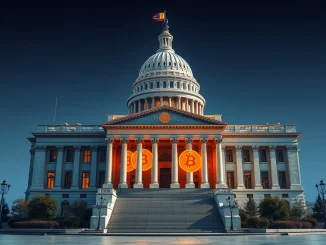
For years, Bitcoin was the domain of cypherpunks and early adopters, a digital rebellion against traditional finance. But 2025 has marked a monumental shift: the era of Bitcoin institutional adoption. This dramatic influx of corporate and governmental interest has sparked a vital debate: Is this mainstream embrace a triumphant validation for the original visionaries, or does it subtly erode the very decentralized principles they championed? This article delves into this critical juncture, exploring what this means for the future of the world’s leading cryptocurrency and the early Bitcoin believers who paved the way.
The Unstoppable March of Bitcoin Institutional Adoption
Bitcoin’s journey from a niche asset to an institutional darling has been nothing short of meteoric. By Q1 2025, U.S. Bitcoin ETFs alone attracted $4.5 billion in inflows, with BlackRock’s IBIT amassing a staggering $18 billion in assets under management (AUM). Simultaneously, corporations like MicroStrategy (MSTR) and Tesla (TSLA) treated Bitcoin as a strategic reserve, with MSTR alone holding 461,000 BTC by mid-2025. The Trump administration’s March 2025 executive order establishing a U.S. Strategic Bitcoin Reserve further cemented Bitcoin’s status as a legitimate asset class.
These developments reflect a broader shift: institutional investors now view Bitcoin as a hedge against inflation and a diversification tool. The U.S. Dollar Index (DXY), which hit a multi-year low in 2025, underscored Bitcoin’s inverse correlation with fiat currencies, making it an attractive counterparty-free alternative. This surge in Bitcoin institutional adoption signals a new era for the digital asset, integrating it deeply into global financial structures.
For Early Bitcoin Believers: Navigating a New Landscape
What does this mean for those who entered the Bitcoin narrative in its nascent stages? For early Bitcoin believers, the institutionalization of Bitcoin has been a double-edged sword. On one hand, it has validated their long-held belief in Bitcoin’s value proposition. The drop in Bitcoin’s annualized volatility by 75% since 2022, coupled with the rise of institutional-grade custody solutions, has made Bitcoin a more attractive component of diversified portfolios.
On the other hand, the influx of institutional capital has raised concerns about market dynamics. For example, Tesla’s 2022 decision to sell its Bitcoin holdings—now worth $5 billion if retained—highlighted the risks of short-term profit-taking by large players. Similarly, the rapid accumulation of Bitcoin by corporations and governments has led to a concentration of ownership, with mid-tier holders (100–1,000 BTC) increasing their share of total supply to 23.07% by April 2025. This concentration sparks questions about the true spirit of decentralization.
The Decentralization Dilemma: Is Bitcoin Decentralization at Risk?
Does mass adoption threaten Bitcoin’s core philosophy? Critics argue that institutional adoption undermines Bitcoin’s foundational principles. The concentration of Bitcoin in custodial ETFs (6.6% of total supply) and corporate treasuries creates potential points of failure. A regulatory reversal or market shock could trigger cascading liquidations, as seen in July 2025’s $425 million in short liquidations.
Moreover, the rise of central bank digital currencies (CBDCs) and the U.S. Strategic Bitcoin Reserve signal a shift toward centralized control. While Bitcoin’s decentralized network remains intact, the growing influence of institutional players and regulators risks transforming Bitcoin into a “regulated asset” rather than a “decentralized protocol.” The core question remains: can Bitcoin decentralization truly thrive under the weight of such centralized interest?
Crafting Effective Bitcoin Investment Strategies
How can investors navigate this evolving market? For investors, the key is to leverage Bitcoin’s institutional appeal while mitigating its risks. Here’s how to refine your Bitcoin investment strategies in this new environment:
- Diversify Exposure: Use a mix of direct Bitcoin holdings and regulated ETFs to balance decentralization and liquidity.
- Monitor Regulatory Trends: Track developments like the BITCOIN Act of 2025 and state-level Strategic Bitcoin Reserve (SBR) initiatives to anticipate policy shifts.
- Hedge Against Volatility: Utilize derivatives and hedging strategies to manage risk, especially as institutional inflows create short-term price swings.
- Support Decentralized Infrastructure: Invest in projects that enhance Bitcoin’s scalability, privacy, and accessibility without compromising its decentralized nature.
The Transformative Role of Bitcoin ETFs
Beyond simple access, how have Bitcoin ETFs reshaped the market? The approval of spot ETFs has been a game-changer, dramatically increasing accessibility for traditional investors. These funds have provided a regulated, familiar pathway for capital to flow into Bitcoin, boosting its legitimacy and liquidity. The rise of tokenized assets and Bitcoin’s impressive $2 trillion market cap (as of 2025) further demonstrate its deep integration into global finance. While they simplify investment, the growth of Bitcoin ETFs also contributes to the centralization debate, as they hold Bitcoin in custody for many investors.
Bitcoin’s institutional adoption in 2025 is a testament to its resilience and adaptability. While the risks of centralization and regulatory capture are real, the benefits of increased liquidity, legitimacy, and macroeconomic hedging cannot be overlooked. For early Bitcoin believers, the challenge is to navigate this evolving landscape without losing sight of Bitcoin’s original mission: to create a decentralized, trustless financial system. As the market matures, the fate of Bitcoin—and its value proposition for investors—will depend on the ability of the community, developers, and regulators to strike a balance between innovation and integrity.
Frequently Asked Questions (FAQs)
1. What is Bitcoin institutional adoption?
Bitcoin institutional adoption refers to the increasing investment and integration of Bitcoin by large financial institutions, corporations, and even governments. This includes the launch of Bitcoin ETFs, companies holding Bitcoin on their balance sheets, and the establishment of strategic national reserves.
2. How does institutional adoption affect Bitcoin’s decentralization?
While Bitcoin’s underlying network remains decentralized, institutional adoption can lead to a concentration of ownership in custodial entities like ETFs and corporate treasuries. Critics argue this creates potential points of failure and regulatory influence, potentially shifting Bitcoin towards a more centralized, regulated asset.
3. What are the benefits of Bitcoin ETFs for investors?
Bitcoin ETFs provide traditional investors with a regulated and familiar way to gain exposure to Bitcoin without directly holding the cryptocurrency. They offer liquidity, ease of access, and often come with institutional-grade custody solutions, making Bitcoin more accessible to a broader market.
4. How can early Bitcoin believers protect their interests amid institutionalization?
Early believers can protect their interests by diversifying their exposure (direct holdings + ETFs), monitoring regulatory trends, utilizing hedging strategies to manage volatility, and actively supporting decentralized infrastructure projects that enhance Bitcoin’s core principles of scalability, privacy, and accessibility.
5. Is Bitcoin still a good hedge against inflation in 2025?
The article suggests that in 2025, Bitcoin continues to be viewed by institutional investors as a hedge against inflation, especially given the U.S. Dollar Index (DXY) hitting a multi-year low. Its inverse correlation with fiat currencies reinforces its appeal as a counterparty-free alternative for preserving value.