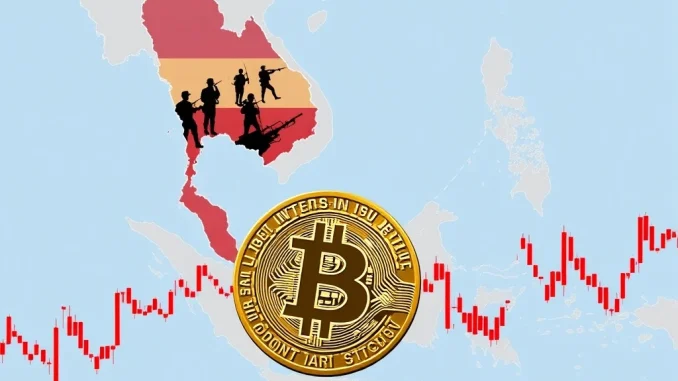
The cryptocurrency world is abuzz with the latest turn of events as Bitcoin news today dominates headlines. What’s causing this ripple effect? Escalating tensions between Thailand and Cambodia are casting a long shadow over financial markets, pushing Bitcoin’s price into a critical phase. Investors are grappling with heightened geopolitical risks, creating a volatile backdrop that demands close attention.
Unpacking the Thailand-Cambodia Conflict: A Catalyst for Market Volatility
The recent clashes along the shared border between Thailand and Cambodia, particularly near the ancient Ta Mone Thom and Ta Krabey temples on July 24, 2025, have ignited significant regional instability. These confrontations are not isolated incidents; they represent a worrying intensification of long-standing disputes. In response, Thailand has deployed F-16 fighter jets, signaling a heightened state of alert, while Cambodia has sought urgent intervention from the United Nations to de-escalate the situation. The implications are profound:
- Defense Spending Surge: Both nations have reportedly increased their defense spending by a staggering 20% year-over-year. This rapid acceleration in military procurement underscores the severity of the border instability and the commitment of both governments to fortify their positions.
- Supply Chain Disruptions: Southeast Asia is a crucial hub for global supply chains. The escalating conflict raises significant concerns about potential disruptions, which could have far-reaching economic consequences.
- Risk-Averse Behavior: As uncertainty mounts, investors in Asian financial markets are exhibiting classic risk-off behavior, shifting capital towards traditional safe havens like gold and the U.S. dollar. This capital flight from riskier assets is a direct response to the perceived instability.
This Thailand Cambodia conflict serves as a stark reminder of how regional disputes can reverberate globally, influencing investor sentiment and asset allocation across the board.
Bitcoin Price Under Pressure: Navigating Key Support Levels
The cryptocurrency market has mirrored this pervasive risk-off sentiment, with Bitcoin (BTC) bearing the brunt of the selling pressure. The digital asset has notably broken below a key support level near $115,000, sending jitters through the community. Technical analysis provides a clearer picture of the challenges ahead:
- Formidable Resistance: Bitcoin faces a formidable resistance zone between $120,000 and $121,500. This area has seen significant selling pressure, indicating strong resistance to upward movement.
- Critical Threshold: Bitunix analysts emphasize that if BTC fails to reclaim the $115,000 threshold soon, it could retest lower support levels around $112,300. This level will be crucial in determining Bitcoin’s short-term trajectory.
- Volume Confirmation: Any potential rebound in Bitcoin’s price must be accompanied by strong volume confirmation. A rebound without significant buying volume could indicate a weak recovery, prone to further declines.
- Leverage Caution: Amid a rising VIX index, which signals sustained risk-off dynamics and increased market volatility, analysts caution against excessive leverage in crypto portfolios. High leverage can amplify losses during periods of uncertainty.
Understanding these technical levels and market indicators is vital for investors trying to navigate the current choppy waters for Bitcoin price.
Broader Geopolitical Risks: Beyond Southeast Asia
The challenges facing the market extend beyond the immediate regional conflict. Broader geopolitical risks are further complicating the market environment, adding layers of uncertainty that influence investor decisions across asset classes. These include:
- U.S.-China Trade Disputes: Ongoing trade tensions between the world’s two largest economies continue to create headwinds for global trade and economic stability.
- Potential EU Retaliatory Tariffs: The threat of new tariffs from the European Union against the U.S. adds another layer of complexity, potentially impacting international supply chains and corporate earnings.
- Oil Price Volatility: Fluctuations in oil prices can strain global supply chains and contribute to inflationary pressures, further complicating the macroeconomic outlook.
While Bitcoin’s role as a hedge against geopolitical uncertainty remains a subject of intense debate, its recent performance underscores mixed signals. El Salvador’s Bitcoin holdings, exceeding 6,237 BTC acquired at an average of $42,000, remain within their fiscal program limits. However, analysts note that the cryptocurrency’s speculative nature complicates its appeal as a traditional safe haven asset during times of crisis.
Navigating the Crypto Market: What’s Next for Investors?
The current environment highlights how regional conflicts can have a significant ripple effect across various asset classes, particularly within the crypto market, where sentiment and macro trends often dominate. Forecasts for BTC’s price trajectory remain speculative, with some analysts projecting a target of $119,000 by 2030, but immediate challenges loom large.
Investors are now closely monitoring whether diplomatic resolutions to the Thailand-Cambodia dispute will alleviate risks or if further escalation could trigger broader market sell-offs. The dual nature of Bitcoin—as both a speculative investment and a potential inflation hedge—adds complexity to its trajectory amid heightened geopolitical uncertainty. For those in the crypto space, it’s a time for prudence, careful risk management, and staying informed on both geopolitical developments and on-chain metrics.
In conclusion, the confluence of escalating regional conflicts, broader geopolitical tensions, and macroeconomic pressures is creating a challenging landscape for Bitcoin and the wider crypto market. While Bitcoin’s long-term potential remains a topic of bullish speculation, its immediate future is intricately linked to global stability and the resolution of current geopolitical flashpoints. Staying informed and exercising caution will be paramount for navigating these turbulent times.
Frequently Asked Questions (FAQs)
1. What specifically caused Bitcoin’s recent price drop?
Bitcoin’s recent price drop below $115,000 is primarily attributed to escalating tensions between Thailand and Cambodia. Clashes along their shared border, increased defense spending by both nations, and the resulting shift of investor capital towards traditional safe havens like gold and the U.S. dollar have created a risk-off sentiment in financial markets, directly impacting Bitcoin.
2. Is Bitcoin considered a safe haven asset during geopolitical conflicts?
Bitcoin’s role as a safe haven asset during geopolitical uncertainty is a subject of ongoing debate. While some proponents argue it can act as a hedge against traditional financial instability, its recent performance, where it mirrored the broader risk-off sentiment, suggests a mixed signal. Its speculative nature often complicates its appeal as a traditional safe haven compared to assets like gold or the U.S. dollar.
3. What are the key technical levels for Bitcoin investors to watch?
Currently, Bitcoin faces strong resistance between $120,000 and $121,500. If it fails to reclaim the $115,000 support level soon, it could test lower support around $112,300. Investors should also monitor trading volume, as a rebound without significant volume confirmation may indicate a weak recovery.
4. How do broader geopolitical tensions, like U.S.-China trade disputes, affect the crypto market?
Broader geopolitical tensions, such as U.S.-China trade disputes and potential EU retaliatory tariffs, add significant layers of uncertainty to the global economic outlook. These tensions can disrupt supply chains, impact corporate earnings, and contribute to overall market volatility. The crypto market, while often seen as an alternative, is not immune to these macro trends and can experience correlated sell-offs as investors de-risk their portfolios.
5. What is the VIX index, and why is it relevant to crypto investors?
The VIX index, often called the ‘fear gauge,’ measures the market’s expectation of future volatility based on S&P 500 index options. A rising VIX indicates increasing market uncertainty and risk-off dynamics. For crypto investors, a rising VIX signals a period where market participants are more risk-averse, which can lead to increased selling pressure across all asset classes, including cryptocurrencies. It’s a key indicator for assessing overall market sentiment and potential volatility.