The **Bitcoin Futures Market** is experiencing a significant transformation. Recent insights from industry leaders suggest a profound change in who drives trading activity. This shift carries substantial implications for the broader cryptocurrency landscape.
The Shifting Landscape of the **Bitcoin Futures Market**
Ju Ki-young, the CEO of CryptoQuant, recently highlighted a notable trend on X. He observed that the **Bitcoin Futures Market** is now predominantly influenced by retail investors. This represents a considerable change from earlier periods. Historically, institutional players often held a larger share of futures trading.
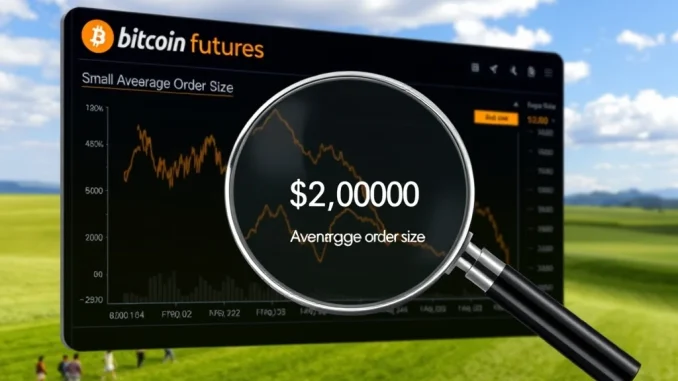
Furthermore, Ki-young pointed out a crucial metric: the average order size. This figure has seen a sharp decline. At the start of the year, the average order size stood at $6,000. It has now dropped significantly to just $2,000. This decrease signals a clear change in the typical size of transactions occurring within the market.
Such a reduction in average transaction value strongly suggests a rise in smaller, individual trades. Therefore, this points directly to increased participation from **Retail Crypto Investors**. Understanding this shift is essential for anyone monitoring Bitcoin’s future price movements and market stability. It indicates a democratization of access, but also potential new vulnerabilities.
Identifying **Retail Crypto Investors**
Who exactly are **Retail Crypto Investors**? These are individual traders who typically invest smaller amounts of capital. They often use accessible trading platforms. Unlike large institutions, they may have less sophisticated trading strategies. Their decisions are sometimes driven by social media trends or market sentiment. Increased retail involvement often brings different dynamics to a market.
Their growing presence in the **Bitcoin Futures Market** is noteworthy. It suggests that futures trading is becoming more accessible to the general public. This accessibility can boost liquidity. However, it can also introduce higher volatility. Retail traders may react more impulsively to news. Consequently, this can amplify price swings in the short term. The average **BTC order size** directly reflects this trend.
This demographic shift is not unique to crypto. Nevertheless, its rapid pace in the Bitcoin ecosystem is striking. It signals a maturation of the market in some ways. Yet, it also poses questions about market resilience. Monitoring these patterns is crucial for comprehensive market analysis.
**CryptoQuant Analysis**: What the Data Reveals
CryptoQuant provides on-chain and market data analysis. Their insights are highly regarded within the crypto community. Ju Ki-young’s observations stem from detailed **CryptoQuant Analysis**. This analysis tracks various metrics. It helps to identify underlying market trends. The average order size is a key indicator they monitor.
The data clearly shows a sustained decrease in the average **BTC order size**. This trend did not happen overnight. Instead, it developed over several months. Such consistent data points to a fundamental shift. It is not merely a temporary fluctuation. The implications of this sustained retail dominance are far-reaching. They touch upon market structure and risk profiles.
Furthermore, CryptoQuant’s findings often precede major market movements. Their ability to dissect trading behaviors offers a unique perspective. Therefore, their latest report demands attention. It provides critical context for understanding Bitcoin’s current trajectory. This **CryptoQuant Analysis** helps investors make informed decisions.
Impact on **BTC Order Size** and Market Liquidity
The reduction in average **BTC order size** has several impacts. Firstly, it indicates fragmentation of trading activity. More participants are entering the market with smaller capital. Secondly, it could affect market liquidity. While more trades occur, the depth of individual orders might decrease. This can make the market more susceptible to large price movements.
Increased retail activity can also lead to different trading patterns. Retail investors often exhibit herding behavior. They might follow popular narratives. This can create self-fulfilling prophecies in the market. Consequently, this behavior can increase volatility. It also poses challenges for institutional players. They must adapt their strategies to these new dynamics. Understanding the average **BTC order size** is crucial for risk management.
The overall market structure is evolving. Liquidity pools might become more dispersed. This requires exchanges to adapt their matching engines. Ultimately, the market becomes more complex. It demands sophisticated tools for analysis. The shift in **BTC order size** reflects a broader evolution of the market itself.
Broader **Cryptocurrency Market Dynamics** and Implications
This trend in Bitcoin futures reflects wider **Cryptocurrency Market Dynamics**. The crypto space has seen increasing mainstream adoption. More individuals are entering the market. They are attracted by potential gains and technological innovation. This influx of **Retail Crypto Investors** is reshaping various segments of the market. It extends beyond just futures.
For instance, decentralized finance (DeFi) platforms also show similar patterns. Smaller transactions and broader participation are common. This suggests a growing comfort level among everyday investors. They are exploring more complex financial instruments. This is a positive sign for market growth. However, it also highlights the need for robust regulatory frameworks.
Regulators are already grappling with how to oversee this rapidly expanding sector. The dominance of retail traders in futures adds another layer of complexity. It raises questions about investor protection. It also concerns market manipulation. Therefore, understanding these **Cryptocurrency Market Dynamics** is paramount. It will inform future policy decisions and market development. The market is becoming more inclusive but also more intricate.
Navigating the New Retail-Dominated Landscape
Navigating a retail-dominated **Bitcoin Futures Market** requires new strategies. Institutions may need to adjust their trading algorithms. They must account for increased small-scale activity. For individual investors, education remains vital. Understanding the risks associated with futures trading is paramount. The market’s structure is changing, and so must the approach to it.
This shift could also impact market sentiment. Retail investors are often more sensitive to news and social media. This can create rapid swings in sentiment. Therefore, market participants must monitor these factors closely. The collective behavior of many small investors can have a significant impact. It can rival the influence of a few large players.
Ultimately, the observations from CryptoQuant offer a valuable snapshot. They show an evolving market. The **Bitcoin Futures Market** is becoming more accessible. It is also becoming more unpredictable. All participants must adapt to these new realities. The ongoing **CryptoQuant Analysis** will continue to shed light on these critical developments.
The trend of decreasing average **BTC order size** is a clear indicator. It points to the growing influence of **Retail Crypto Investors**. This development has profound implications for the **Bitcoin Futures Market**. It also affects the broader **Cryptocurrency Market Dynamics**. As the market continues to evolve, ongoing analysis and adaptation will be key for all participants.
Frequently Asked Questions (FAQs)
What is the significance of the average Bitcoin futures order size dropping?
The drop in average **BTC order size** from $6,000 to $2,000 signifies a shift towards smaller, individual trades. This indicates increased participation from **Retail Crypto Investors** in the **Bitcoin Futures Market**. It can lead to changes in market liquidity, volatility, and overall trading patterns.
Who are “retail investors” in the crypto market?
Retail investors are individual traders who typically invest smaller amounts of capital using accessible trading platforms. They contrast with institutional investors, who manage larger funds. Their growing presence reflects broader mainstream adoption of cryptocurrencies.
How does increased retail participation affect the Bitcoin futures market?
Increased retail participation can boost market accessibility and potentially liquidity. However, it may also lead to higher volatility due to more impulsive trading behaviors. It can also fragment trading activity, influencing overall **Cryptocurrency Market Dynamics**.
What is CryptoQuant’s role in providing market insights?
CryptoQuant is a prominent provider of on-chain and market data analysis for the cryptocurrency space. Their **CryptoQuant Analysis** offers deep insights into market trends, investor behavior, and fundamental shifts, helping traders and institutions understand complex market movements.
Are there any potential risks associated with retail dominance in Bitcoin futures?
Yes, potential risks include increased market volatility, greater susceptibility to herd behavior, and challenges for market makers in maintaining deep liquidity. It also raises questions about investor protection and potential for market manipulation, given the less sophisticated nature of some retail trading strategies.
What does this trend suggest about the future of the cryptocurrency market?
This trend suggests a continued democratization and mainstreaming of the cryptocurrency market. It indicates that more individuals are engaging with complex financial instruments like futures. This points towards a more inclusive but potentially more volatile and intricate market landscape in the future.