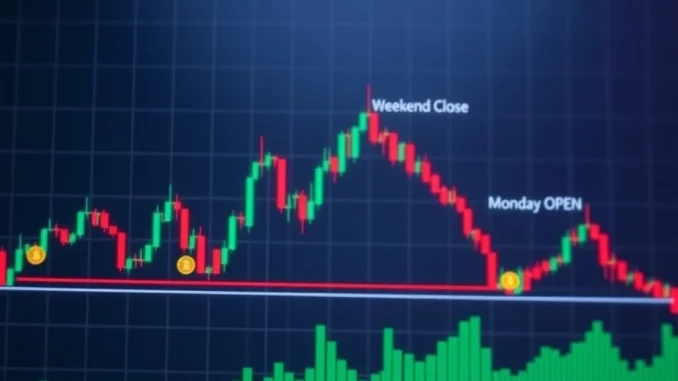
The cryptocurrency world constantly generates significant headlines. This week, a notable event immediately captured the attention of traders and analysts: the opening of **CME Bitcoin futures** on Monday. A substantial gap of approximately $1,440 emerged, setting the stage for potentially dynamic market movements. This phenomenon, known as a ‘gap,’ often sparks intense speculation and influences trading decisions across the entire **crypto market analysis** landscape.
Understanding the CME Bitcoin Futures Gap
On Monday, **CME Bitcoin futures** began the new trading week at $111,355. This marked a significant jump from their previous closing price of $109,915. The resulting difference, or gap, of about $1,440 is a direct consequence of how traditional futures markets operate compared to the 24/7 nature of the spot Bitcoin market. While Bitcoin spot prices fluctuate continuously, CME Group’s futures market observes weekend closures. Therefore, price action occurring over the weekend on the spot market does not immediately reflect in the futures market until it reopens. This creates the observed price discrepancy.
The size of this **Bitcoin price gap** often serves as an indicator of weekend volatility. A larger gap typically suggests more significant price swings in the underlying asset during the closure period. Consequently, market participants closely monitor these gaps. They often anticipate that the futures price will eventually move to ‘fill’ this void, returning to the level where the previous session ended. This expectation forms a core part of many **futures trading strategies**.
Why Weekend Volatility Creates Gaps
Bitcoin’s inherent nature allows it to trade globally, every hour of every day. In contrast, regulated futures exchanges like the CME operate on set schedules. They open during weekdays and close for weekends and holidays. During these closure periods, the spot Bitcoin market continues its operations. It responds to global news, macroeconomic events, and shifts in supply and demand. Therefore, if Bitcoin’s price experiences a sharp increase or decrease over a weekend, the CME futures market will open at a new, adjusted price point on Monday, leaving a gap from its Friday close. This is a common occurrence in traditional markets as well, affecting commodities and stocks that have underlying assets trading in different time zones or continuous markets.
Traders view these gaps as potential areas of interest. They represent zones where price action has not occurred on the futures chart. Many believe that markets tend to revisit these unfilled areas over time. This belief drives certain trading behaviors and predictions. For instance, an upward gap, like the one observed, might lead some to anticipate a downward correction to ‘fill’ the gap. Conversely, a downward gap could suggest an upward movement. This makes **crypto market analysis** around these events particularly keen.
Historical Context of Bitcoin Price Gaps
Historically, CME Bitcoin futures gaps have shown a tendency to fill. However, this is not a guaranteed outcome, nor does it happen immediately. The concept of ‘gap filling’ suggests that the price will eventually retrace to touch the level where the gap began. Analysts often study past gap-filling rates to inform their current outlook. Some gaps fill within hours or days, while others might take weeks or even months. Certain gaps, in fact, never fully fill, especially if a strong, sustained trend emerges in the market.
For example, during periods of extreme bullish sentiment, upward gaps might remain unfilled for extended periods as prices continue to climb. Conversely, during bear markets, downward gaps might persist. Therefore, while the tendency to fill is a popular theory, it remains a statistical probability rather than a certainty. Traders must consider broader market conditions and technical indicators alongside gap analysis. Understanding this nuance is vital for effective **futures trading strategies**.
Implications for Futures Trading Strategies
The emergence of a significant **Bitcoin price gap** immediately influences various **futures trading strategies**. Traders often adopt specific approaches based on the expectation of a gap fill. Here are some common strategies:
- Gap Fill Reversal: Some traders might open positions betting on the price to move back and fill the gap. For an upward gap, this would mean shorting futures contracts, anticipating a downward move.
- Trend Continuation: Other traders might view the gap as a sign of strong momentum. They might enter positions in the direction of the gap, expecting the trend to continue rather than reverse.
- Confirmation Trading: Conservative traders often wait for further price action to confirm a direction. They might look for additional technical signals before committing to a trade.
- Risk Management: Regardless of the strategy, robust risk management is paramount. Stop-loss orders are crucial to limit potential losses if the market moves contrary to expectations.
The high **Bitcoin volatility** inherent in the crypto market makes these strategies particularly risky but potentially rewarding. Therefore, traders must exercise caution and conduct thorough due diligence.
The Role of Bitcoin Volatility in Gap Formation
**Bitcoin volatility** plays a crucial role in both the formation and the size of these weekend gaps. Bitcoin is known for its dramatic price swings, which can occur rapidly and unexpectedly. When these significant price movements happen over a weekend, while the CME futures market is closed, they inevitably lead to large gaps upon reopening. A period of low weekend volatility might result in a small, almost negligible gap, or no gap at all. However, a weekend filled with major news, significant trading volume, or sudden shifts in sentiment can easily produce a substantial gap.
High volatility also impacts how quickly and whether a gap fills. In highly volatile environments, prices can swing wildly, making gap filling more unpredictable. Sometimes, the market might quickly fill a gap, only to reverse course just as rapidly. This creates challenging conditions for traders. Therefore, understanding the current market’s volatility levels is essential for interpreting the significance of any given gap. This forms a critical component of any comprehensive **crypto market analysis**.
Broader Crypto Market Analysis and Sentiment
A large **CME Bitcoin futures** gap does more than just create a trading opportunity; it also offers insights into broader market sentiment. A substantial upward gap, like the recent $1,440 one, often suggests strong buying pressure over the weekend. This indicates a bullish sentiment among market participants during the hours when traditional markets are closed. Conversely, a large downward gap would signal significant selling pressure.
Analysts integrate gap analysis into their wider **crypto market analysis**. They consider it alongside other indicators, such as:
- On-chain data: Examining network activity, transaction volumes, and whale movements.
- Macroeconomic factors: Assessing inflation, interest rates, and global economic stability.
- Technical indicators: Using moving averages, RSI, MACD, and support/resistance levels.
- News events: Monitoring regulatory developments, institutional adoption, and technological advancements.
Together, these elements paint a more complete picture of the market’s health and potential direction. The gap, therefore, acts as an additional data point, contributing to a more nuanced understanding of Bitcoin’s price trajectory and the overall health of the digital asset space.
Looking Ahead: What This Gap Suggests
The $1,440 **Bitcoin price gap** on **CME Bitcoin futures** opens the week with a clear point of focus for traders. While the expectation of a gap fill is common, the market’s actual response will depend on various factors throughout the week. Key considerations include:
- Spot Market Reaction: How does the spot Bitcoin price behave immediately after the futures open? Does it continue its weekend trend, or does it show signs of reversal?
- Volume and Liquidity: High trading volume accompanying a move towards or away from the gap can indicate stronger conviction.
- News Flow: Any significant news or regulatory announcements during the week could override the influence of the gap.
- Institutional Activity: Large institutional players often drive significant moves in the CME futures market. Their activity will be closely watched.
For those engaged in **futures trading strategies**, monitoring these elements will be critical. The gap serves as a reminder of the unique dynamics between the always-on crypto spot market and the scheduled traditional futures markets. It highlights the constant interplay between different trading venues and their influence on price discovery. This ongoing interaction provides rich data for **crypto market analysis** and helps shape market expectations.
Ultimately, the CME Bitcoin futures gap represents a fascinating aspect of cryptocurrency markets. It underscores the continuous nature of Bitcoin trading versus the structured hours of traditional finance. Traders and analysts will continue to monitor the market’s reaction. They will observe whether the futures price moves to fill this significant $1,440 void, or if new market forces drive prices further away. This event serves as a crucial data point for anyone tracking Bitcoin’s trajectory and planning their **futures trading strategies**.
Frequently Asked Questions (FAQs)
What is a CME Bitcoin futures gap?
A CME Bitcoin futures gap occurs when the opening price of CME Bitcoin futures on Monday is significantly different from its closing price on Friday. This happens because the spot Bitcoin market trades 24/7, while the CME futures market is closed over the weekend. Price movements in the spot market during the weekend create this discrepancy.
Why do CME Bitcoin futures gaps occur?
Gaps occur because the CME Group’s futures market observes traditional trading hours, closing on weekends. The underlying Bitcoin asset, however, trades continuously. Any substantial price change in Bitcoin during the weekend will result in a gap when the CME futures market reopens on Monday at a new price level.
Do CME Bitcoin futures gaps always fill?
Historically, CME Bitcoin futures gaps show a tendency to fill, meaning the price often retraces to cover the gap. However, this is not a guarantee. Some gaps fill quickly, others take a long time, and some may never fully fill, especially during strong, sustained market trends. Traders use this tendency as part of their **futures trading strategies**, but it carries inherent risks.
How does Bitcoin volatility affect these gaps?
**Bitcoin volatility** directly impacts the size of these gaps. High volatility over a weekend can lead to significant price changes in the spot market, resulting in larger gaps when CME futures reopen. Conversely, low volatility leads to smaller gaps. Volatility also influences how quickly and predictably a gap might fill.
What does a large Bitcoin futures gap mean for the crypto market?
A large Bitcoin futures gap, particularly an upward one, can indicate strong buying pressure and bullish sentiment over the weekend. For **crypto market analysis**, it provides a data point suggesting market momentum in a particular direction. Traders then use this information to inform their potential **futures trading strategies** and risk management decisions for the coming week.