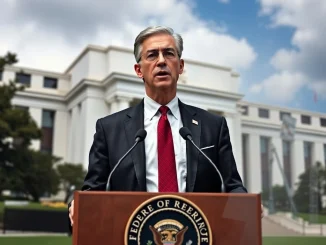
The cryptocurrency world is holding its breath as a pivotal week unfolds, dominated by the highly anticipated Fed Rate Decision. Investors are grappling with significant policy uncertainty, impacting everything from Bitcoin’s price movements to the broader Crypto Market. What exactly is at stake, and how might these macroeconomic shifts reshape the digital asset landscape?
Understanding the Urgent Fed Rate Decision
The Federal Reserve’s upcoming interest rate meeting is more than just a routine announcement; it’s a critical juncture for global financial markets, including cryptocurrencies. Scheduled for this week, the decision comes amidst a complex web of economic announcements and geopolitical developments. The market’s immediate focus is on the July 2025 meeting, where data from Polymarket suggests a 96.3% probability of no rate cut. This short-term caution reflects the current climate, but what does it mean for the volatile Crypto Market?
Historically, shifts in interest rates directly influence the appeal of risk assets like Bitcoin. Higher rates can make traditional investments more attractive, potentially drawing capital away from crypto. Conversely, lower rates tend to weaken the U.S. dollar, which can make alternative assets like Bitcoin more appealing. The Fed’s dual mandate—balancing inflation and employment—is the compass guiding these decisions, and its direction will be a critical determinant for crypto trajectories.
How Political Pressures Shape Monetary Policy
Beyond economic indicators, political dynamics are playing a significant role in the current climate. U.S. President Trump’s direct engagement with Federal Reserve Chair Jerome Powell underscores the high stakes involved. Trump’s recent visit to the Fed and his conditional support for rate cuts, tied to his tariff policies, highlight the interplay between political pressures and Monetary Policy. The administration is poised to send nearly 200 tariff letters by Friday, with delays risking U.S. credibility in trade negotiations. This complex political backdrop adds another layer of uncertainty for investors trying to predict market movements.
On the flip side, a potential trade agreement with the European Union could emerge as a bullish catalyst for cryptocurrencies by mid-week. Such an agreement could signal global economic stability, potentially boosting investor confidence across all asset classes, including digital currencies. This delicate balance between trade policy, inflation metrics, and Fed guidance is expected to shape market dynamics through August.
Bitcoin News: Navigating Recent Dips and Future Outlook
Recent Bitcoin News has reflected the broader market’s nervousness. Bitcoin experienced a 4% price decline, attributed to wider market volatility and speculation surrounding Powell’s future role. This dip exemplifies the sector’s fragility and its sensitivity to macroeconomic shifts. The total crypto market capitalization also saw a nearly 3% reduction this week as bullish momentum waned. These movements underscore how quickly the digital asset space reacts to external pressures.
Despite the short-term dips, longer-term expectations for easing policy remain embedded. Polymarket data indicates a 40% probability of two rate cuts by mid-December. This duality suggests that while immediate caution prevails, a degree of long-term optimism persists regarding future Interest Rates and their potential positive impact on crypto. Traders are closely monitoring the Fed’s final decision, Trump’s tariff actions, and any signs of progress in transatlantic trade talks, all of which could determine the next chapter for cryptocurrencies.
The Impact of Interest Rates on the Crypto Market
The relationship between Interest Rates and the Crypto Market is multifaceted. A rate cut, for instance, could lower borrowing costs, making it cheaper for businesses and consumers to borrow and spend. This can stimulate economic growth, but it also tends to weaken the U.S. dollar, which could drive capital into alternative assets like Bitcoin, perceived as a hedge against inflation or dollar depreciation. Conversely, maintaining or raising rates can strengthen the dollar and make riskier assets less appealing.
The market’s reaction to the Fed’s reported $100 billion loss, linked to Bitcoin’s failed $120k price target, further illustrates the sector’s sensitivity to macroeconomic data and policy surprises. This week is poised to deliver a high-stakes environment, with over 25 major events—including U.S. economic data releases, trade policy updates, and investor sentiment shifts—potentially influencing crypto markets. This confluence of factors has led some to dub it the “Week of the Year,” given its potential to set trends for months to come.
In summary, the current landscape for Bitcoin News and the broader Crypto Market is defined by a delicate balance between optimism and caution. The Federal Reserve’s Fed Rate Decision, coupled with political maneuvering and evolving trade policies, will undoubtedly shape investor sentiment and asset prices in the coming weeks and months. Staying informed and agile will be key for navigating this dynamic environment.
Frequently Asked Questions (FAQs)
Q1: Why is the Federal Reserve’s interest rate decision so important for the crypto market?
The Federal Reserve’s interest rate decisions significantly impact the crypto market because they influence the broader economic environment, including the strength of the U.S. dollar and investor appetite for risk. Lower interest rates can make traditional investments less attractive, potentially driving capital into cryptocurrencies, while higher rates can have the opposite effect.
Q2: What is the current market expectation for the July 2025 Fed meeting?
As of July 2025, Polymarket data indicates a 96.3% probability that the Federal Reserve will maintain current interest rates, meaning no rate cut is expected at this specific meeting. However, longer-term expectations for rate easing, such as two cuts by mid-December, still hold a 40% probability.
Q3: How do political factors, like President Trump’s actions, influence the crypto market?
Political factors, such as President Trump’s engagement with the Federal Reserve Chair and his tariff policies, introduce additional layers of uncertainty. Political pressures can influence monetary policy decisions, and trade agreements or disputes can impact global economic stability, which in turn affects investor confidence and the flow of capital into risk assets like cryptocurrencies.
Q4: Why did Bitcoin’s price recently dip by 4%?
Bitcoin’s recent 4% price decline is attributed to broader market volatility and speculation, particularly concerning the future role of Federal Reserve Chair Jerome Powell. This highlights the crypto market’s sensitivity to macroeconomic news, policy uncertainty, and high-profile leadership changes.
Q5: What are the key events investors should watch in the coming weeks?
Investors should closely monitor the Federal Reserve’s final rate decision, President Trump’s tariff actions and related trade policy updates, and any signs of progress in transatlantic trade talks. Additionally, over 25 major economic data releases are expected, all of which could significantly influence crypto market dynamics.