The cryptocurrency market is a dynamic landscape, constantly influenced by a myriad of factors, from macroeconomic shifts to the collective psychology of investors. Recently, a key indicator, the Bitcoin Fear Greed Index, registered a notable dip, sparking conversations across the crypto community. What does this shift truly signify for Bitcoin’s immediate future and the broader digital asset space? Let’s delve into the details.
What Does the Bitcoin Fear Greed Index Reveal About Current Sentiment?
The Bitcoin Fear Greed Index is a widely watched metric that distills various market factors—like volatility, market momentum, social media sentiment, and trading volumes—into a single numerical score, typically ranging from 0 (extreme fear) to 100 (extreme greed). A higher score indicates increased optimism and buying pressure, while a lower score suggests caution or panic.
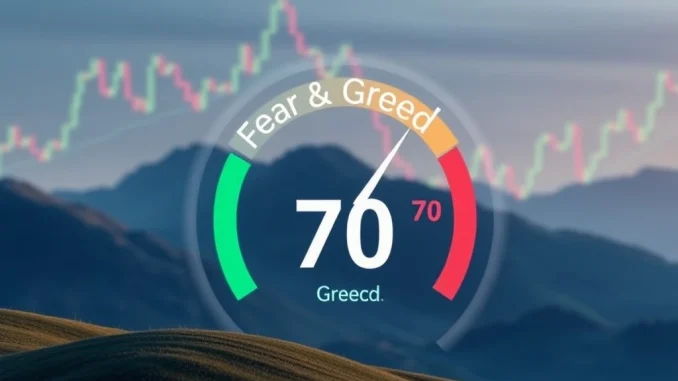
On July 25, the index fell to 70, a noticeable retreat from its July 24 reading of 74. While 70 still falls within the “greed” category—meaning investors are generally optimistic—it signals a clear move away from the heightened bullish enthusiasm observed just days prior. This shift underscores a growing caution among market participants, especially as momentum in the broader crypto markets appears to wane. It’s a reminder that even during periods of overall optimism, underlying currents of doubt or prudence can emerge.
Why Are Bitcoin Volatility and Trading Volumes Softening?
The decline in the Fear & Greed Index coincides with observable changes in market dynamics, specifically a softening in both Bitcoin Volatility and overall Trading Volumes. Compared to previous weeks, Bitcoin and Ethereum have seen reduced price swings and lower trading activity. This moderation isn’t an isolated event; it’s part of a broader market recalibration.
Several factors contribute to this softening:
- Profit-Taking Behavior: After a surge in aggressive buying earlier in the month, many traders are likely taking profits, leading to selling pressure and a natural cool-down period.
- Technical Factors: Bitcoin’s price consolidation near critical support levels has dampened speculative fervor. Traders are adopting more risk-averse strategies as the asset tests key technical boundaries.
- Reduced Derivatives Activity: A notable decline in open interest and derivatives volumes, which have historically signaled overbought conditions, further indicates a reduction in speculative trading. This suggests less leverage in the market, potentially leading to healthier, albeit quieter, price discovery.
This period of reduced activity is not uncommon in bull cycles; markets often consolidate after significant runs, allowing for accumulation and a re-evaluation of positions before the next potential move.
Navigating the Shifting Crypto Market Sentiment
The current moderation in Crypto Market Sentiment extends beyond Bitcoin, impacting altcoin activity and stablecoin flows. Traders are recalibrating their positions across the board, reflecting a more cautious stance following earlier aggressive buying. However, it’s crucial to understand that a dip in the Fear & Greed Index to 70 does not automatically signal a bearish reversal. Instead, it reflects a natural pause in a market that has been largely driven by macroeconomic optimism and expectations of central bank policy easing.
The index’s rapid shift from 74 to 70 over two days highlights its sensitivity to liquidity conditions and broader economic signals. While a prolonged stagnation near the “greed” threshold without corresponding volume spikes could signal eroding conviction, a more definitive bearish shift would typically be marked by a drop below the 50 neutral baseline. For now, the market seems to be catching its breath, absorbing recent gains, and waiting for clearer signals from global economic indicators.
What Does This Mean for Bitcoin Price Action?
For Bitcoin Price, this period of consolidation near critical support levels is a test of underlying strength. While speculative fervor has decreased, the fundamental drivers supporting Bitcoin’s long-term trajectory remain intact. The reduction in volatility and trading volumes, while indicative of a short-term correction, does not negate the broader narrative of institutional adoption, increasing utility, and the asset’s role as a potential inflation hedge.
Investors are urged to monitor on-chain metrics, which provide insights into network health and genuine user activity, as well as global economic indicators. These factors will likely dictate the next phase of market direction. A sustained period of low volatility without a significant drop in the index could indicate a healthy consolidation phase, setting the stage for future growth once macroeconomic conditions or specific catalysts provide renewed impetus.
Actionable Insights for Investors
Given the current market dynamics, what should investors consider?
- Stay Informed, Not Impulsive: While the Bitcoin Fear Greed Index provides a snapshot of sentiment, it should be used in conjunction with fundamental and technical analysis. Avoid making rash decisions based solely on this one metric.
- Observe On-Chain Metrics: Pay attention to data like active addresses, transaction volumes, and exchange flows. These can offer a clearer picture of real user adoption and network health beyond speculative trading.
- Monitor Macroeconomic Trends: Central bank policies, inflation data, and global economic growth forecasts significantly influence crypto markets. Keep an eye on these broader trends to anticipate potential market shifts.
- Consider Dollar-Cost Averaging (DCA): In periods of consolidation and reduced Bitcoin Volatility, DCA can be an effective strategy to accumulate assets gradually, mitigating the risk of trying to time the market perfectly.
- Diversify Wisely: While Bitcoin remains the market leader, understanding the broader Crypto Market Sentiment and how it affects altcoins can inform a more diversified portfolio strategy.
This phase highlights the delicate interplay between sentiment and fundamentals. While the index’s retreat suggests caution, further upside remains possible if macroeconomic data reinforces policy optimism. The market is maturing, and these periods of recalibration are a natural part of its evolution.
Conclusion: Navigating a Nuanced Market Phase
The recent dip in the Bitcoin Fear Greed Index to 70, accompanied by softer Trading Volumes and reduced Bitcoin Volatility, marks a period of increased caution rather than outright fear. This is a natural cool-down following a period of heightened exuberance, influenced by profit-taking and technical consolidation. While the immediate Bitcoin Price action might appear subdued, the underlying structural drivers supporting its long-term trajectory remain robust.
For investors, this phase presents an opportunity for measured assessment. By understanding the nuances of Crypto Market Sentiment and combining it with diligent research into on-chain metrics and macroeconomic factors, one can navigate this period with greater confidence, positioning themselves for future opportunities in the ever-evolving world of digital assets.
Frequently Asked Questions (FAQs)
What is the Bitcoin Fear & Greed Index?
The Bitcoin Fear & Greed Index is a tool that analyzes various market factors (volatility, momentum, social media, trading volumes, dominance, trends) to gauge overall market sentiment. It ranges from 0 (extreme fear) to 100 (extreme greed), helping investors understand if the market is overly optimistic or pessimistic.
What does a Bitcoin Fear & Greed Index of 70 signify?
A reading of 70 falls within the “greed” category. While it indicates general optimism, it represents a step back from extreme greed (typically above 80) and suggests that investors are becoming more cautious or taking profits after a period of strong buying, rather than showing outright fear.
How does reduced Bitcoin Volatility and Trading Volumes affect the market?
Reduced volatility and trading volumes often indicate a period of consolidation or indecision. It means fewer large price swings and less capital flowing in and out of the market. This can lead to slower price action, but it can also be a healthy sign of a market taking a breather before its next significant move, rather than experiencing a sharp crash.
Is the current market dip a sign of a bearish reversal for Bitcoin Price?
Not necessarily. While the index dropped and volumes softened, it’s currently viewed more as a natural pause or correction rather than a definitive bearish reversal. A strong bearish signal would typically involve the index dropping below the neutral 50 mark, combined with sustained negative macroeconomic factors.
What should investors monitor during this period of cautious Crypto Market Sentiment?
Investors should closely monitor on-chain metrics (like active addresses and transaction counts), global macroeconomic indicators (inflation, interest rates, GDP growth), and Bitcoin’s price action around key support and resistance levels. These factors will provide better insights into the market’s future direction.