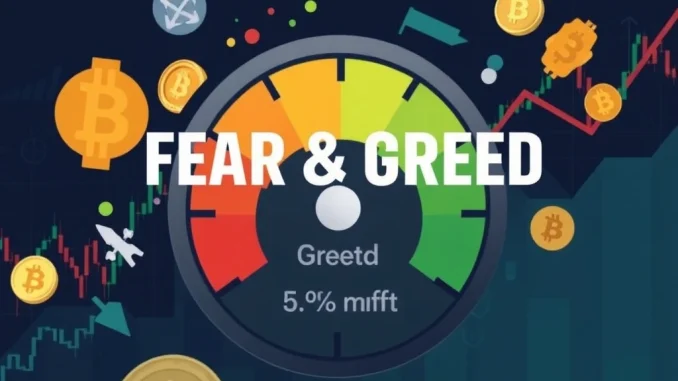
Are you feeling the pulse of the crypto market? For many, the answer lies in the Crypto Fear & Greed Index, a unique sentiment gauge that offers a glimpse into the collective psyche of Bitcoin and broader cryptocurrency investors. As of July 25, 2025, this vital indicator stands at 70, firmly placing us in the ‘Greed’ zone. While this suggests sustained optimism, a subtle shift from 71 to 70 hints at a modest cooling of market fervor. What does this mean for your crypto investing strategy? Let’s dive deep into understanding this powerful tool and how to leverage its insights without succumbing to herd behavior.
What Does the Crypto Fear & Greed Index Really Tell Us?
The Crypto Fear & Greed Index, developed by Alternative, isn’t just a random number; it’s a sophisticated barometer of market sentiment. By synthesizing data from six key factors, it aims to provide a nuanced view of investor psychology. A score above 50 indicates ‘Greed,’ while anything below signals ‘Fear.’ The current reading of 70 means optimism is prevalent, but the slight dip suggests a moment for reflection rather than outright panic.
Here’s how the index is constructed, offering a comprehensive look at the forces shaping investor behavior:
- Volatility (25%): Measures current volatility and maximum drawdowns of Bitcoin, comparing it with average values over 30 and 90 days. High volatility often signals fear.
- Trading Volume & Market Momentum (25%): Analyzes current trading volume and market momentum, comparing it with average values. High buying volumes in a positive market suggest greedy behavior.
- Social Media Sentiment (15%): Scans various social media platforms for keywords related to Bitcoin and other cryptocurrencies, analyzing the sentiment (positive, negative, neutral) of discussions. Increased engagement often points to greedy behavior.
- Bitcoin Dominance (10%): Assesses Bitcoin‘s share of the total cryptocurrency market capitalization. An increase in Bitcoin dominance often indicates fear (as investors move to a perceived safer asset), while a decrease can signal greed (as altcoins gain popularity).
- Google Trends (10%): Examines search queries related to Bitcoin and crypto on Google. Spikes in search terms like ‘Bitcoin price manipulation’ often coincide with fearful markets, while searches for ‘how to buy Bitcoin’ can indicate greed.
- Surveys (15%, currently paused): Historically, this component involved weekly polls of investors to gauge their direct sentiment. While paused, the other components continue to provide robust data.
Navigating the Greed Zone: Strategic Insights for Crypto Investing
With the index firmly in the Greed Zone at 70, it’s a critical time for crypto investing. While sustained optimism can fuel further gains, history teaches us that extreme greed often precedes market corrections. This isn’t a signal for an immediate crash, but rather a cautionary beacon.
For savvy investors, a score of 70 underscores the risks of overconfidence. Here’s how different investor profiles might interpret and act on this:
- Retail Investors: This is a cue to review portfolios, potentially take some profits, and implement risk mitigation strategies. Avoid FOMO (Fear Of Missing Out) and resist impulsive buying.
- Contrarian Traders: Those who thrive on going against the grain might view extreme greed (scores of 75-100) as a potential sell signal, anticipating a market reversal.
- Institutional Players: Large-scale investors might use this data to adjust leverage, rebalance their holdings, or hedge their positions, recognizing the potential for increased volatility.
It’s crucial to remember that the Crypto Fear & Greed Index is a complementary tool. Its effectiveness hinges on pairing its insights with thorough fundamental and technical analyses. It cannot account for sudden macroeconomic shocks, unforeseen regulatory shifts, or black swan events that can drastically alter market dynamics.
Understanding Bitcoin Market Sentiment: More Than Just a Number
While the index is broadly applicable, its inherent Bitcoin-centric bias means that a significant portion of its weight and data sources are tied to the king of cryptocurrencies. This can sometimes misrepresent altcoin-specific dynamics. For instance, a rise in Bitcoin dominance (weighted at 10%) might indicate fear for altcoin holders, even if overall market sentiment appears greedy due to Bitcoin’s strength.
Furthermore, while social media sentiment and Google Trends capture real-time emotions, they can also amplify noise rather than signal actionable insights. The sheer volume of information and rapid shifts in online discourse can make it challenging to distinguish genuine sentiment from fleeting trends or coordinated pumps. Therefore, understanding the broader market sentiment requires a discerning eye, looking beyond just the index’s number.
Historical Echoes: What Can Past Cycles Teach Us?
Looking back at historical context reinforces the utility of the Crypto Fear & Greed Index. During major market events, the index has consistently aligned with significant inflection points:
- The 2021 Bull Run: Throughout this period of unprecedented growth, the index frequently registered extreme greed, often soaring into the 80s and 90s. This prolonged period of euphoria eventually gave way to a market reset, underscoring the cyclical nature of crypto investing psychology.
- The FTX Collapse (Late 2022): In contrast, during the dramatic fallout from the FTX exchange collapse, the index plummeted into single digits, signaling extreme fear. These moments of widespread panic often present opportunistic entry points for contrarian investors.
These episodes highlight how sentiment extremes often precede major corrections or rebounds. However, the index’s predictive power is probabilistic; it identifies patterns rather than certainties. It helps to understand the emotional landscape, but it doesn’t guarantee future price movements. It’s a powerful lens through which to view the emotional tides of the market, guiding decisions rather than dictating them.
Practical Applications and Beyond the Index
The daily updates of the Crypto Fear & Greed Index allow investors to monitor sentiment shifts in real time, making it a valuable tool for short-to-medium term traders. However, its short-term focus makes it less relevant for long-term holders who prioritize adoption trends, technological progress, or fundamental project developments.
The temporary pausing of weekly surveys also reduces its ability to capture direct investor feedback, though the remaining five robust components maintain its core value. For effective crypto investing, consider the index as one piece of a larger puzzle, integrating it with your broader research, risk tolerance, and investment horizon. It’s about informed interpretation, not blind adherence.
In summary, the Crypto Fear & Greed Index is an indispensable tool for navigating the often-turbulent emotional undercurrents of crypto markets. While its current 70-point score reflects ongoing optimism and a presence in the Greed Zone, investors must balance this with a critical assessment of broader market forces, including macroeconomic factors and regulatory landscapes. By contextualizing the index within a diversified analytical framework, traders and investors can harness its insights without succumbing to herd behavior, ultimately making more strategic and resilient decisions in the dynamic world of Bitcoin and cryptocurrencies.
Frequently Asked Questions (FAQs)
What is the Crypto Fear & Greed Index?
The Crypto Fear & Greed Index is a sentiment indicator that measures the prevailing emotional state of the cryptocurrency market. It aggregates data from various sources to provide a score between 0 (Extreme Fear) and 100 (Extreme Greed), helping investors gauge whether the market is overly fearful or overly optimistic.
How is the Crypto Fear & Greed Index calculated?
The index synthesizes data from six key factors: volatility (25%), trading volume and momentum (25%), social media sentiment (15%), Bitcoin dominance (10%), Google Trends (10%), and historical survey data (15%, currently paused). Each component contributes to the overall score, reflecting different aspects of market behavior.
What does a score of 70 (Greed) mean for investors?
A score of 70 indicates that the market is in a state of ‘Greed,’ meaning investors are generally optimistic and eager to buy. While this suggests sustained positive sentiment, it also serves as a cautionary signal. Historically, periods of high greed can precede market corrections, urging investors to review portfolios and consider risk mitigation strategies.
Is the Crypto Fear & Greed Index a reliable standalone tool for crypto investing?
No, the Crypto Fear & Greed Index is not designed to be a standalone decision-making tool. It is a valuable complementary gauge for market sentiment but should always be used in conjunction with fundamental analysis, technical analysis, and an understanding of broader macroeconomic and regulatory factors. Its insights are best applied within a diversified analytical framework.
How does the index relate to Bitcoin’s price?
The index is heavily influenced by Bitcoin’s performance and market activity, as Bitcoin is the largest cryptocurrency. Extreme fear often correlates with price bottoms, while extreme greed can coincide with market tops or periods of overvaluation. However, it indicates market sentiment, not a direct price prediction, and its predictive power is probabilistic.
What are the limitations of the Crypto Fear & Greed Index?
Key limitations include its Bitcoin-centric bias, which might not fully represent altcoin dynamics, and its reliance on short-term data. The pausing of weekly surveys also limits direct investor feedback. Additionally, while social media and Google Trends capture emotion, they can sometimes amplify noise rather than signal actionable insights, making careful interpretation essential.