Are you truly in control of your investments, or are you holding a mere photograph of what you believe to be yours? This provocative question lies at the heart of financial guru Robert Kiyosaki‘s latest admonition to investors. The bestselling author of Rich Dad Poor Dad has once again ignited a critical debate, declaring that Crypto ETFs, particularly those tied to Bitcoin, represent a “dangerous illusion.” His message is clear: true security and wealth preservation come from direct ownership, not paper proxies.
Robert Kiyosaki’s Stance: Why Crypto ETFs Are a ‘Dangerous Illusion’
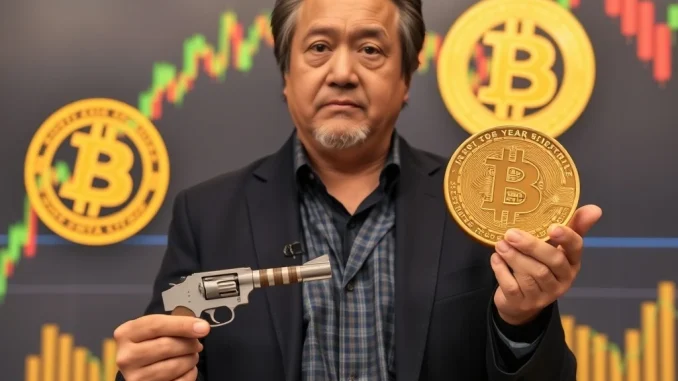
In a recent post, Robert Kiyosaki didn’t mince words, comparing the act of holding a crypto ETF to relying on a photograph of a gun for self-defense. While the image might look functional, it offers no real protection when a crisis strikes. This vivid analogy underscores his core argument: ETFs, despite their convenience, do not confer genuine ownership or the robust security needed during economic turmoil.
Kiyosaki’s skepticism towards these financial instruments is deeply rooted. He has consistently labeled them as “fake,” drawing parallels to fiat currencies and government bonds—assets he views as fundamentally detached from tangible value. His argument hinges on several key points:
- Lack of Direct Ownership: When you buy a crypto ETF, you don’t own the underlying Bitcoin or Ethereum. You own a share in a fund that holds these assets, often through third-party custodians. This creates a layer of abstraction that Kiyosaki believes undermines true security.
- Dependency on Intermediaries: ETFs rely on financial institutions, custodians, and regulatory frameworks. In a systemic crisis, these intermediaries could face liquidity issues, operational failures, or even government intervention, potentially jeopardizing your access to the assets.
- Illusion of Safety: The ease of access and mainstream appeal of ETFs can create a false sense of security. Investors might believe they are protected by the regulated nature of these products, overlooking the inherent risks associated with indirect exposure.
The Power of Direct Ownership: Bitcoin, Gold, and Silver
For Robert Kiyosaki, the antidote to this “dangerous illusion” is straightforward: Direct Ownership. He fervently advocates for holding physical assets like Gold and Silver, alongside self-custodied Bitcoin. This approach, he argues, is the only reliable form of wealth preservation, especially in an era of escalating global debt and economic uncertainty.
Why does Kiyosaki place such a high premium on direct ownership? It boils down to control and resilience:
- Uninterrupted Access: With direct ownership, your assets are not subject to the operational hours, liquidity constraints, or solvency of a third party. You have immediate access to your Bitcoin (via your private keys) or physical gold, regardless of market conditions or banking crises.
- Mitigating Counterparty Risk: By holding your own assets, you eliminate counterparty risk – the risk that the other party in a financial transaction will fail to fulfill their obligations. This is a crucial factor for Kiyosaki, who distrusts centralized financial systems.
- True Wealth Preservation: In his view, only tangible assets or decentralized digital assets like Bitcoin can truly preserve purchasing power against inflation and systemic failures. Paper assets, including ETF shares, are merely promises that can be devalued or manipulated.
This perspective resonates with a growing segment of the crypto community that champions self-custody as a fundamental principle of decentralization. The adage, “Not your keys, not your coins,” perfectly encapsulates Kiyosaki’s philosophy regarding Bitcoin.
Navigating the Evolving Landscape of Crypto ETFs
Despite Robert Kiyosaki’s warnings, the approval of spot Bitcoin and Ethereum ETFs in the U.S. and other regions marks a significant milestone for the cryptocurrency industry. These products have undoubtedly played a role in mainstreaming digital assets, making them accessible to a broader range of traditional investors who might be hesitant to navigate the complexities of direct crypto purchases and self-custody.
However, Kiyosaki’s critique highlights the ongoing debate within the crypto space: the balance between accessibility and control. While ETFs offer convenience and regulatory oversight, they introduce layers of intermediaries and potential points of failure that direct ownership avoids. For instance, in a severe liquidity crunch or a market collapse, the mechanisms by which ETFs redeem shares for underlying assets could be tested, potentially leading to delays or discounts.
Investors should consider:
| Feature | Crypto ETFs | Direct Ownership (Bitcoin/Gold) |
|---|---|---|
| Accessibility | High (via brokerage accounts) | Moderate (requires setting up wallets/storage) |
| Control | Indirect (via fund manager) | Direct (you hold the keys/physical asset) |
| Counterparty Risk | Present (fund, custodian) | Minimal (if self-custodied) |
| Security | Relies on fund’s security & regulation | Your responsibility (cold storage, physical security) |
| Crisis Resilience | Potential for liquidity issues | Immediate access & transferability |
Actionable Insights: What Should Investors Do?
Robert Kiyosaki’s strong advocacy for direct ownership provides a clear pathway for investors seeking genuine security in volatile times. His message is not necessarily to avoid all ETFs, but rather to understand their limitations and prioritize fundamental wealth preservation strategies.
For those inspired by Kiyosaki’s insights, here are some actionable steps:
- Educate Yourself on Self-Custody: If you own Bitcoin through an exchange, learn about hardware wallets and how to securely self-custody your digital assets. This is the digital equivalent of holding physical gold.
- Consider Physical Gold and Silver: Explore options for purchasing and storing physical Gold and Silver. This could involve reputable dealers and secure storage solutions, whether at home or in professional vaults.
- Diversify Wisely: While Kiyosaki emphasizes direct ownership, a balanced portfolio often involves diversification. However, his advice encourages a re-evaluation of what constitutes ‘safe’ diversification, pushing investors towards truly independent assets.
- Question Financial Instruments: Adopt Kiyosaki’s skeptical lens when evaluating any financial product. Ask: “Do I truly own the underlying asset? What are the layers of intermediaries? What are the risks in a systemic crisis?”
His advice challenges the conventional wisdom that often prioritizes convenience over fundamental control. In an increasingly uncertain global economy, the ability to directly access and control one’s assets could prove invaluable.
The Enduring Appeal of Tangible Assets and Bitcoin
Robert Kiyosaki’s consistent message underscores an enduring truth: in times of instability, tangible assets and truly decentralized digital assets like Bitcoin tend to shine. While Crypto ETFs have democratized access to digital currencies, they cannot replicate the fundamental security and control offered by direct ownership.
His warnings serve as a vital reminder for investors to look beyond the convenience and perceived safety of mainstream financial products. In a world where economic landscapes can shift dramatically, prioritizing direct ownership of assets like Bitcoin, gold, and silver may be the most prudent path to genuine wealth preservation and financial independence.
Frequently Asked Questions (FAQs)
Q1: Why does Robert Kiyosaki call Crypto ETFs a “dangerous illusion”?
Robert Kiyosaki argues that Crypto ETFs create a false sense of ownership and security. He compares it to holding a photograph of a gun instead of a real one, implying that while ETFs offer exposure, they don’t provide the direct control and safety of owning the underlying asset (like Bitcoin) itself, especially during a crisis.
Q2: What does Kiyosaki advocate for instead of Crypto ETFs?
Kiyosaki strongly advocates for direct ownership of tangible assets. This includes physical gold and silver, and self-custodied Bitcoin. He believes these assets, held directly by the investor, offer true wealth preservation and protection against systemic financial failures, unlike paper assets or derivatives.
Q3: What are the main risks Kiyosaki associates with Crypto ETFs?
Kiyosaki highlights several risks: lack of true ownership, reliance on third-party custodians and financial intermediaries (counterparty risk), and potential liquidity issues during market collapses. He views them as “fake” financial instruments that abstract value and do not provide the same security as physical holdings.
Q4: How does direct ownership of Bitcoin provide more security than an ETF?
Direct ownership of Bitcoin, typically via a hardware wallet where you control the private keys, means you are not reliant on any third party to access or transfer your funds. This eliminates counterparty risk and ensures immediate access to your assets, a level of control an ETF cannot offer.
Q5: Is Robert Kiyosaki against all forms of cryptocurrency investment?
No, Kiyosaki is not against cryptocurrency investment, specifically Bitcoin. He is a strong proponent of Bitcoin as a form of “hard money” and a hedge against inflation. His skepticism is directed at the *method* of investment through ETFs, not the asset itself. He prefers direct, self-custodied ownership of Bitcoin.