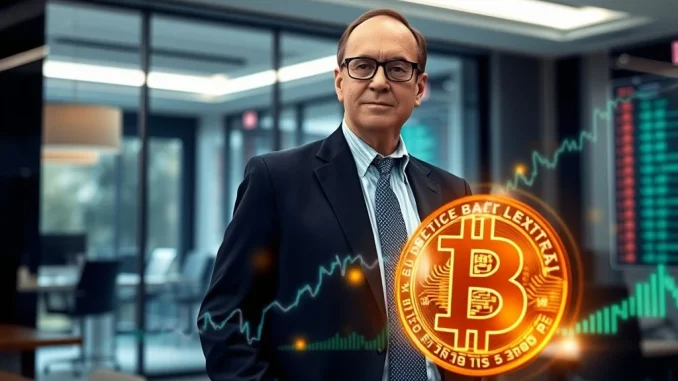
The financial world is abuzz with a seismic shift, signaling a new era for digital assets. The recent endorsement of Bitcoin by BlackRock CEO Larry Fink marks a pivotal moment, fundamentally altering perceptions of this decentralized currency within traditional finance. This isn’t just news; it’s a testament to how far Bitcoin has come, from a niche digital curiosity to a recognized, legitimate financial asset now championed by one of the world’s largest asset managers.
Bitcoin’s Unprecedented Ascent: Larry Fink’s Pivotal Endorsement
For years, many traditional finance leaders viewed Bitcoin with skepticism. However, BlackRock CEO Larry Fink has dramatically reversed his stance, publicly endorsing Bitcoin as a legitimate financial asset. This significant shift, articulated in recent interviews and shareholder addresses, underscores a growing trend of institutional acceptance for cryptocurrencies. Fink’s remarks are not just symbolic; they highlight Bitcoin’s evolving role as a potential hedge against economic uncertainties and currency devaluation. He even asserted that Bitcoin could reach $700,000 per BTC under heightened fears of inflation and systemic risks, signaling its increasing importance in global portfolios. This powerful endorsement from such an influential figure is a game-changer for Bitcoin’s credibility and its path toward mainstream integration.
BlackRock’s Staggering Success: The iShares Bitcoin Trust (IBIT) Phenomenon
BlackRock’s commitment to digital assets extends far beyond mere words. Their aggressive expansion into this space is best exemplified by the remarkable performance of its iShares Bitcoin Trust (IBIT). This ETF has achieved unprecedented success, amassing a staggering $76 billion in assets under management (AUM) within just 350 days. This record growth rate for a traditional ETF launch highlights the immense institutional and retail demand for regulated access to Bitcoin. The momentum of IBIT reflects broader institutional and central bank strategies to diversify reserves, mirroring the accelerated gold purchases by nations like China, India, and Russia. Bitcoin is increasingly viewed as a digital analog for safeguarding value in a shifting monetary landscape, with BlackRock providing a streamlined pathway for this diversification.
Driving Forces Behind Institutional Adoption: Why Bitcoin Matters Now
What’s fueling this surge in institutional adoption? Several factors contribute to the growing interest from major financial players:
- Inflation Hedge: In an era of economic volatility and currency devaluation concerns, Bitcoin is increasingly seen as a robust hedge, comparable to gold. Larry Fink himself has framed it as a strategic reserve asset amid post-Bretton Woods currency realignment.
- Diversification: Institutions are seeking new avenues to diversify their portfolios beyond traditional assets. Bitcoin offers a unique uncorrelated asset class that can potentially enhance overall portfolio resilience.
- Accessibility through ETFs: Products like BlackRock’s IBIT ETF have simplified access to Bitcoin, making it easier for institutions and retail investors to gain exposure without directly managing the underlying cryptocurrency. This mirrors the transformative impact of gold ETFs in the 2000s.
- Maturing Asset Class: Bitcoin’s price surge, reaching an intraday high of $123,091.61 in mid-2025, driven by corporate adoption and ETF liquidity, signals growing confidence in its maturation as an asset class.
This widespread embrace signals a fundamental shift in how global investment strategies are being shaped.
Beyond Bitcoin: BlackRock’s Vision for Digital Assets
BlackRock‘s initiatives are not limited to Bitcoin alone. The firm is actively exploring and investing in a broader spectrum of digital assets and blockchain technology. This includes the tokenization of real-world assets on public blockchains, aiming to bridge traditional markets with digital infrastructure. A prime example is their $2.6 billion BUIDL fund, specifically focused on blockchain innovation. These efforts seek to enhance transparency, reduce costs, and unlock new efficiencies across various financial processes. Fink has also emphasized the broader potential of programmable finance, leveraging smart contracts for asset management to enhance investor protection and mitigate market fragmentation. This holistic approach by BlackRock underscores a belief that digital assets and blockchain infrastructure are integral to modern capital market reforms.
Navigating the Future: Challenges and Opportunities in Crypto Finance
While the outlook for digital assets appears bright, challenges persist. Regulatory scrutiny of crypto assets remains a significant hurdle, as governments worldwide grapple with how to categorize and oversee this rapidly evolving space. The emergence of central bank digital currencies (CBDCs) could also disrupt traditional reserve paradigms, introducing new complexities. However, BlackRock’s strategic moves, including their expansion into tokenized assets and blockchain infrastructure, aim to address these hurdles. By focusing on enhanced investor protection and mitigating market fragmentation through smart contract solutions, they are actively shaping a more robust and transparent digital finance ecosystem. The convergence of physical and digital assets is redefining reserve management, with tokenized assets poised to play a central role in future global investment strategies.
In conclusion, BlackRock’s endorsement and the phenomenal success of its iShares Bitcoin Trust are monumental milestones for Bitcoin and the broader digital asset landscape. Larry Fink’s shift from skepticism to strong advocacy signals a profound change in institutional perception, positioning Bitcoin as a vital component of modern investment portfolios. As traditional finance continues to converge with digital innovation, the groundwork is being laid for a future where digital assets are not just an alternative, but an integral part of the global financial system.
Frequently Asked Questions (FAQs)
1. Why did BlackRock CEO Larry Fink change his stance on Bitcoin?
Larry Fink’s shift from skepticism to endorsing Bitcoin stems from its evolving role as a legitimate financial asset, particularly its potential as a hedge against inflation and economic uncertainty. The growing institutional demand and maturation of the asset class likely contributed to his revised perspective.
2. What is the iShares Bitcoin Trust (IBIT) and why is its growth significant?
The iShares Bitcoin Trust (IBIT) is BlackRock’s spot Bitcoin ETF, which allows investors to gain exposure to Bitcoin without directly holding the cryptocurrency. Its rapid growth to $76 billion in AUM within 350 days is significant because it represents record-breaking adoption for a traditional ETF launch, indicating strong institutional and retail demand for regulated Bitcoin investment products.
3. How does Bitcoin compare to gold as a hedge against inflation?
Both Bitcoin and gold are increasingly viewed as hedges against inflation and currency devaluation. Gold has a long history as a tangible store of value, while Bitcoin is emerging as a ‘digital gold’ due to its decentralized nature, limited supply, and growing acceptance as a strategic reserve asset, particularly in a post-Bretton Woods monetary landscape.
4. What are BlackRock’s other initiatives in the digital asset space?
Beyond the IBIT ETF, BlackRock is actively involved in the tokenization of real-world assets on public blockchains. They have launched funds like the $2.6 billion BUIDL fund, which focuses on blockchain innovation. These initiatives aim to bridge traditional markets with digital infrastructure, enhancing transparency and reducing costs.
5. What challenges does the crypto market still face despite institutional adoption?
Despite significant institutional adoption, the crypto market still faces challenges such as ongoing regulatory scrutiny from governments worldwide, the potential disruption from the emergence of central bank digital currencies (CBDCs), and the need to mitigate market fragmentation to ensure investor protection and a more unified ecosystem.
6. What is the long-term outlook for Bitcoin based on BlackRock’s involvement?
BlackRock’s deep involvement, particularly with Larry Fink’s endorsement and the success of IBIT, suggests a strong long-term outlook for Bitcoin. It indicates a growing consensus that digital assets are integral to modern capital market reforms and global investment strategies, solidifying Bitcoin’s position as a legitimate and increasingly mainstream asset class.