Are you ready for a potentially challenging August in the crypto market? The latest Bitcoin August drop forecast is sounding alarms across the digital asset landscape, suggesting a significant downturn that could impact portfolios globally. As summer progresses, leading analysts are painting a cautious picture for Bitcoin (BTC) and, by extension, the entire altcoin ecosystem. This isn’t just a fleeting prediction; it’s rooted in historical patterns and technical indicators that demand your attention.
The Looming Bitcoin August Drop: What to Expect
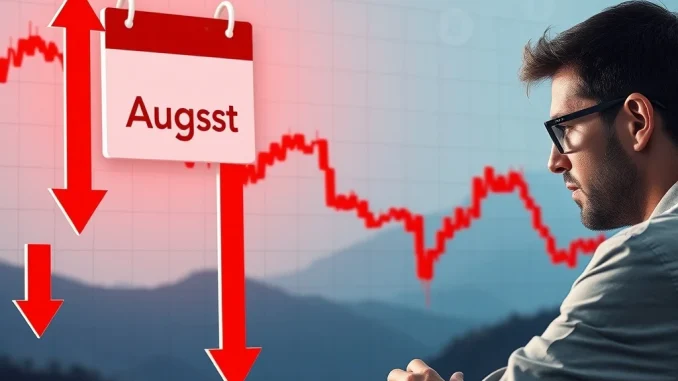
The cryptocurrency market is bracing for a potential storm, with Bitcoin at its epicenter. Renowned analyst Benjamin Cowen has issued a stark warning: Bitcoin (BTC/USD) could face a 12% to 14% decline in August. This projection isn’t pulled from thin air; it’s based on a meticulous analysis of historical seasonal trends and current technical indicators. Historically, August has often presented challenges for Bitcoin, making Cowen’s forecast a significant point of discussion for investors and traders alike.
Cowen’s analysis highlights several key factors contributing to this bearish outlook:
- Seasonal Weakness: August has historically been a less favorable month for Bitcoin’s performance.
- Technical Indicators: Current market signals align with a potential downward trajectory.
- Altcoin Overvaluation: A crucial point of concern is the perceived overvaluation of altcoins relative to Bitcoin.
This anticipated Bitcoin August drop could reshape capital allocation strategies as investors seek safer havens or prepare for potential buying opportunities at lower prices. Understanding these underlying currents is vital for navigating the volatile crypto waters.
Altcoin Underperformance: A Persistent Problem
While Bitcoin’s potential decline grabs headlines, the pressure on altcoins is equally, if not more, intense. Cowen’s metrics, such as “Total3 minus USDT divided by Bitcoin,” strongly suggest further downside for altcoins. He notes that even during Bitcoin’s dominance peak of 60% in October 2024, altcoins were still trading 27% to 28% above their historical lows. This indicates a sustained period of altcoin underperformance, where these assets struggle to keep pace with, let alone outperform, Bitcoin.
The implications for your altcoin portfolio are clear: volatility and potential for significant corrections. While some may view this as a buying opportunity, caution is advised. The market dynamics suggest that capital might continue to flow out of altcoins and into Bitcoin, especially if the dominance narrative plays out as predicted. This trend underscores the importance of a diversified and well-researched portfolio strategy.
Why are Altcoins Lagging?
- Bitcoin Dominance: As Bitcoin strengthens or experiences corrections, capital often flows back to BTC, causing altcoins to bleed.
- Overvaluation: Many altcoins may still be priced above their fundamental value, making them susceptible to sharper corrections.
- Liquidity Concerns: Smaller altcoins often suffer from lower liquidity, exacerbating price drops during market downturns.
Navigating Current Crypto Market Trends
Beyond individual asset performance, understanding the broader crypto market trends is crucial. Bitcoin’s dominance is projected to rise significantly, potentially reaching 66% by late October if altcoins continue to underperform. Cowen further forecasts that the combined dominance of Bitcoin and Ethereum could climb to a staggering 85%, pushing altcoins back to their cycle lows on his custom metric by October.
This shift in dominance means that a larger portion of the total crypto market capitalization will be held by BTC and ETH. For investors, this implies a potential re-evaluation of risk. Assets with stronger fundamentals and proven resilience, like Bitcoin and Ethereum, might become preferred choices during periods of uncertainty. Conversely, highly speculative altcoins could face steeper declines.
Recent data also supports this narrative:
- Bitcoin ETF Inflows: Bitcoin ETFs saw a $227 million net inflow on July 24, reversing a three-day outflow streak. This institutional interest suggests continued confidence in Bitcoin as a long-term asset.
- Altcoin Outflows: In stark contrast, altcoins like Solana and XRP have lost over 5% against Bitcoin’s relatively modest 5% dip, indicating sustained selling pressure.
The Fear and Greed Index, currently at 71 (Greed), suggests lingering optimism among retail investors. However, this optimism often precedes periods of correction, making the current market sentiment a potential contrarian indicator for near-term risks.
Ethereum Stability: A Relative Safe Haven?
Amidst the widespread altcoin pressure, Ethereum (ETH/USD) appears to be holding its ground with a degree of Ethereum stability relative to Bitcoin. While most altcoins have fallen over 42% against ETH since April, Cowen views Ethereum as a lower-risk asset in the current environment. This doesn’t mean ETH is immune to market downturns, but its established ecosystem, ongoing developments, and growing institutional interest provide a stronger foundation.
Ethereum faces critical support levels between $2,000 and $3,000, with resistance at $4,500. Despite potential short-term volatility, significant ETF inflows of $231 million over 15 days underscore continued institutional appetite for Ethereum. This institutional backing could provide a buffer against the broader altcoin market downturns, positioning ETH as a more resilient asset.
Why Ethereum Might Be Different:
- Institutional Interest: Strong ETF inflows demonstrate confidence from traditional finance.
- Layer-1 Dominance: Ethereum remains the leading smart contract platform, with a robust developer community.
- Lower Volatility (Relative): Compared to smaller altcoins, ETH tends to exhibit more stability against Bitcoin.
XRP Price Concerns: A Double Top and Historical Weakness
While Ethereum shows signs of resilience, other major altcoins like Solana (SOL/USD) and XRP (XRP/USD) are under sharper pressure. Solana has dipped below $180, exhibiting bearish momentum across key on-chain metrics. For XRP, the situation is particularly concerning. The formation of a “double top” pattern on its price charts has drawn parallels to Bitcoin’s seasonal weakness, raising fears of a potential crash if crucial support levels fail to hold.
Analysts warn that August has historically been one of the most bearish months for XRP, aligning with the broader market risks. This historical context, combined with current technical patterns, amplifies XRP price concerns for investors. A break below critical support could trigger a cascading effect, leading to significant losses for holders.
It’s essential for XRP holders to monitor these technical indicators closely and consider their risk exposure. The confluence of historical patterns and current chart formations paints a cautious picture for the asset in the coming weeks.
The Path Forward: Resilience and Reassessment
August’s performance will undoubtedly test the crypto market’s resilience. For Bitcoin, a break below the $110,530 support level could accelerate a broader bearish correction. Conversely, a rebound above $123,218 might reignite bullish momentum, offering a glimmer of hope amidst the caution. For Ethereum and the broader altcoin market, the path forward is intricately linked to macroeconomic factors, including interest rate expectations and the continuation of institutional inflows.
Cowen’s forecast underscores August as a pivotal period for assessing the market’s ability to withstand seasonal headwinds. Investors should prepare for increased volatility, re-evaluate their risk tolerance, and consider adjusting their portfolios to align with the evolving market dynamics. While the short-term outlook appears challenging, understanding these trends allows for informed decision-making, potentially mitigating losses or capitalizing on future opportunities.
Key Takeaways for Investors:
- Stay Informed: Keep a close eye on analyst forecasts and market indicators.
- Risk Management: Reassess your portfolio’s risk exposure, especially concerning altcoins.
- Dollar-Cost Averaging: Consider a disciplined approach to buying during dips if you believe in long-term growth.
- Focus on Fundamentals: Prioritize assets with strong use cases and institutional interest.
Frequently Asked Questions (FAQs)
Q1: What is the main projection for Bitcoin in August?
Analysts, particularly Benjamin Cowen, project a potential 12% to 14% drop for Bitcoin (BTC/USD) in August, citing historical seasonal trends and current technical indicators.
Q2: How will altcoins be affected by Bitcoin’s potential drop?
Altcoins are expected to remain under significant pressure and may experience further downside. Metrics suggest they are overvalued relative to Bitcoin, and capital may continue to flow from altcoins into BTC, leading to continued altcoin underperformance.
Q3: Is Ethereum expected to perform differently from other altcoins?
While not immune to market volatility, Ethereum (ETH/USD) is seen as having potentially stabilized against Bitcoin. Benjamin Cowen favors ETH as a lower-risk asset due to its strong ecosystem and significant institutional ETF inflows, suggesting more relative stability compared to other altcoins.
Q4: What are the specific concerns for XRP’s price?
XRP is facing sharper pressure, with analysts pointing to a “double top” formation on its price charts. August has historically been one of the most bearish months for XRP, raising concerns of a potential crash if key support levels fail.
Q5: What does Bitcoin dominance mean for the crypto market?
Bitcoin dominance refers to BTC’s market capitalization as a percentage of the total crypto market. A projected rise in Bitcoin dominance (potentially to 66% by October) indicates that Bitcoin is expected to capture a larger share of the market’s value, often at the expense of altcoins.
Q6: What should investors do given this forecast?
Investors should remain cautious, monitor key support and resistance levels for Bitcoin and altcoins, and reassess their risk exposure. Focusing on assets with strong fundamentals, practicing risk management, and staying informed about macroeconomic factors are crucial strategies during this period.