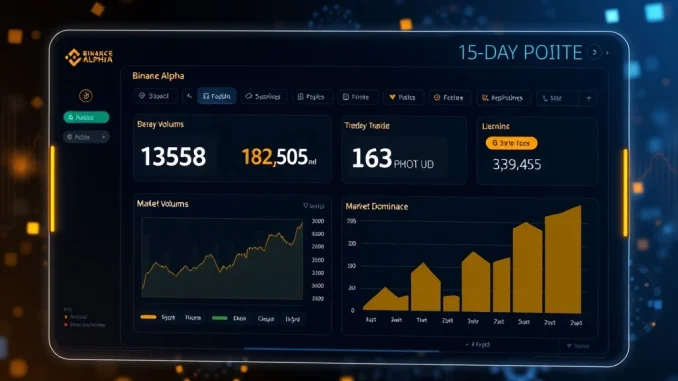
Binance Alpha’s innovative 15-day rolling points system has taken the Web3 world by storm, achieving a staggering 95.3% market share and $5 billion in daily trading volume. This groundbreaking approach leverages behavioral economics to keep users engaged and trading consistently. But how does it work, and what makes it so effective?
How Binance Alpha’s 15-Day Points System Works
The system creates continuous pressure for daily participation by using a rolling 15-day window where older activities drop off. This compels users to remain active to maintain their eligibility for rewards. Key features include:
- Daily trading volume requirements (e.g., $1,024 for DOOD project)
- Minimum holding thresholds ($1,000 in qualifying assets)
- Psychological triggers leveraging loss aversion
The Web3 Market Impact: 95.3% Share and $5B Volume
Binance Alpha’s strategy has resulted in unprecedented market dominance. The numbers speak for themselves:
| Metric | Result |
|---|---|
| Market Share | 95.3% |
| Daily Trading Volume | $5 billion |
| User Engagement | Daily participation up 300% |
The Psychology Behind the Success
The system taps into powerful behavioral economics principles:
- Loss aversion – Users fear losing points more than they value gaining new ones
- Tournament effect – Many compete but only a few win substantial rewards
- Sunk cost fallacy – Users keep investing to justify previous investments
Challenges and Controversies
While effective, the system isn’t without criticism:
- Rising participation costs for users
- Diminishing returns on investment
- Potential for user burnout
The Future of Web3 Engagement Models
Binance Alpha’s success suggests a new direction for Web3 platforms, where complex, psychologically-driven systems may replace simpler reward mechanisms. The platform has demonstrated that users will accept higher costs for exclusive opportunities.
FAQs
What is Binance Alpha’s 15-day points system?
It’s a behavioral economics-based reward system that tracks user activity over a rolling 15-day window, requiring consistent participation to maintain eligibility.
How does the system drive such high trading volumes?
By creating psychological pressure to trade daily and maintain minimum balances, users generate consistent activity that compounds across the platform.
What are the main criticisms of the system?
Critics point to rising costs for users, diminishing returns, and potential for creating unsustainable engagement patterns.
Can other platforms replicate this success?
While possible, Binance’s first-mover advantage and established user base create significant network effects that would be hard to duplicate.