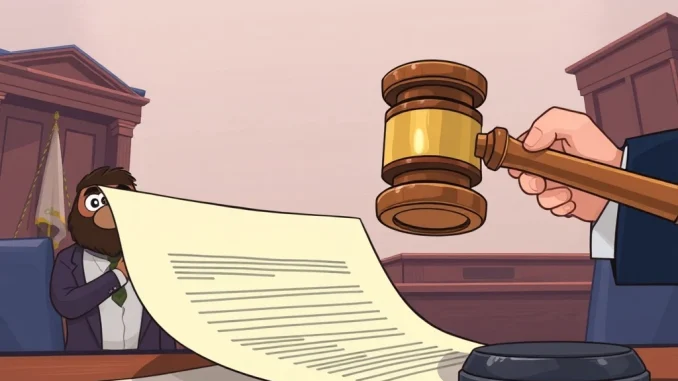
The cryptocurrency world recently witnessed a significant legal development. A California federal judge delivered a crucial ruling regarding the classification of **BAYC NFTs**. This decision could reshape the future of digital collectibles. Investors and creators alike have closely watched this case. The outcome offers much-needed clarity in a rapidly evolving space.
Understanding the Yuga Labs Lawsuit
A California federal judge recently dismissed a class-action lawsuit against Yuga Labs. Yuga Labs is the creator behind the popular **Bored Ape Yacht Club** (BAYC) NFT collection. The lawsuit alleged that Yuga Labs misleadingly promoted BAYC NFTs as unregistered securities. However, the court found insufficient grounds for this claim. This dismissal marks a major victory for Yuga Labs and the broader NFT community.
The plaintiffs in the lawsuit contended that **BAYC NFTs** represented an investment contract. They argued that purchasers expected profits based on Yuga Labs’ efforts. This argument is central to the ‘Howey Test,’ a standard used to determine if something qualifies as a security. The judge’s decision indicates a different interpretation of the facts presented.
- The lawsuit claimed BAYC NFTs were unregistered securities.
- Plaintiffs cited the Howey Test for their arguments.
- The court disagreed with the plaintiffs’ interpretation.
- This ruling favors Yuga Labs significantly.
The Judge’s Decision: NFTs Are Not Securities
The federal judge explicitly ruled that **NFTs as securities** lacked merit in this particular case. This finding has profound implications for the NFT market. It suggests that not all digital assets automatically fall under securities regulations. The ruling focused on the specific characteristics of BAYC NFTs. It also considered how Yuga Labs marketed and sold them.
Furthermore, the court evaluated the ‘investment contract’ element. It determined that purchasers were not primarily investing in Yuga Labs’ enterprise with an expectation of profit solely from the company’s efforts. Instead, the judge likely considered the artistic, collectible, and utility aspects of the NFTs. This distinction is vital for understanding the court’s perspective. It separates NFTs from traditional financial instruments.
Broader Implications for Crypto Regulations
This dismissal represents a significant moment for **crypto regulations** worldwide. It provides a precedent, albeit a non-binding one, in the United States. Many regulatory bodies have struggled with classifying digital assets. This ruling offers a framework for distinguishing NFTs from securities. It could influence future legal challenges and policy decisions.
For one thing, the decision could encourage more innovation within the NFT space. Developers might feel more confident creating new projects. They may worry less about immediate regulatory classification as securities. On the other hand, regulators might refine their approach. They could develop more nuanced guidelines for different types of digital assets. This case underscores the complexity of applying existing laws to novel technologies.
Bored Ape Yacht Club and Its Market Position
The **Bored Ape Yacht Club** (BAYC) collection remains one of the most prominent NFT projects. It features unique digital ape avatars. Each NFT grants owners access to an exclusive community and various perks. This utility aspect played a role in the legal arguments. The collection’s success has also drawn significant attention from celebrities and investors.
This legal victory could bolster BAYC’s market position. It removes a major legal cloud hanging over the project. Potential investors might view BAYC as a safer asset. It is now legally distinct from a security in this jurisdiction. This development might also encourage other NFT projects to emphasize utility and community. They could move away from purely speculative investment narratives.
Looking Ahead: The Future of NFT Legal Landscape
The California judge’s ruling is a landmark event. However, the legal landscape for NFTs is still evolving. Other jurisdictions might adopt different interpretations. Additionally, future projects could be structured differently. These variations might lead to different legal outcomes. Therefore, ongoing vigilance is essential for creators and investors.
Furthermore, this case focused on a specific set of facts. It does not mean all NFTs are immune to securities classification. NFTs that promise direct returns based on a centralized entity’s efforts could still be deemed securities. The distinction often lies in the specific promises made and the expectations created. This ruling provides a vital piece of the puzzle, but it is not the final word.
FAQs on BAYC NFTs and Securities
Q1: What was the main claim in the lawsuit against Yuga Labs?
The lawsuit primarily claimed that Yuga Labs’ **BAYC NFTs** were unregistered securities. Plaintiffs alleged that Yuga Labs misled purchasers into believing they would profit from Yuga Labs’ efforts.
Q2: What is the significance of the judge’s ruling?
The judge’s ruling dismissed the class-action lawsuit, stating that BAYC NFTs are not securities in this context. This provides a crucial precedent for distinguishing certain NFTs from regulated financial instruments.
Q3: Does this ruling mean all NFTs are not securities?
No, this ruling applies specifically to the facts of the Yuga Labs case and its **BAYC NFTs**. Other NFTs, especially those structured as investment contracts with explicit profit expectations based on a centralized entity, could still be classified as securities.
Q4: How might this decision impact the broader NFT market?
This decision could boost confidence in the NFT market. It offers some legal clarity for creators and investors. It might also influence future **crypto regulations** and how new NFT projects are structured.
Q5: What is the ‘Howey Test’ and how does it relate to this case?
The ‘Howey Test’ is a legal framework used to determine if a transaction qualifies as an ‘investment contract’ and thus a security. It considers if there’s an investment of money, in a common enterprise, with an expectation of profits derived solely from the efforts of others. The judge in this case likely found that BAYC NFTs did not meet all criteria for an investment contract.
Q6: What is the Bored Ape Yacht Club?
The **Bored Ape Yacht Club** is a highly popular collection of 10,000 unique NFT avatars. Owners gain access to an exclusive online community and various real-world benefits, contributing to its status as a leading digital collectible project.