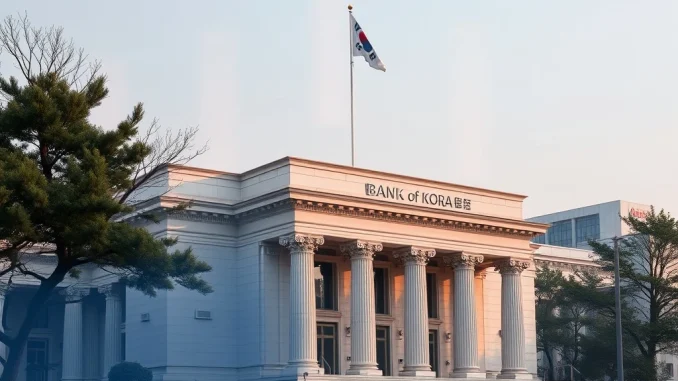
In a move closely watched by investors and analysts alike, the Bank of Korea (BoK) recently announced its decision to maintain the **Bank of Korea interest rate** at a steady 2.50%. This stability sends a clear signal regarding the central bank’s current assessment of economic conditions. Understanding such decisions is crucial, even for those focused on digital assets. Traditional financial policies often ripple through the broader economic landscape, consequently influencing investor sentiment across all asset classes, including cryptocurrencies.
Bank of Korea Maintains Benchmark Interest Rate Decision at 2.50%
On its latest policy review, the Bank of Korea’s Monetary Policy Board voted to hold its **benchmark interest rate decision** at 2.50%. This marks a period of pause following previous adjustments. The decision reflects a cautious approach from the central bank. It indicates a balance between managing inflation and supporting economic growth. Many observers had anticipated this hold, given recent economic data. Furthermore, the central bank aims to provide stability in uncertain times.
Specifically, the BoK considered several key factors:
- Inflationary Pressures: While inflation has shown signs of easing, it remains above the target level.
- Economic Growth: Concerns persist about the pace of global and domestic economic recovery.
- Household Debt: High levels of household debt continue to be a significant domestic risk.
By keeping rates unchanged, the BoK seeks to assess the full impact of its previous tightening measures. This measured stance provides a stable environment for businesses and consumers. It also allows the central bank flexibility for future actions.
Understanding the South Korea Economy Outlook
The **South Korea economy outlook** remains a central focus for the Bank of Korea. The central bank’s decision directly influences various sectors within the nation. A stable interest rate can support business planning and investment. However, it also means borrowing costs remain elevated for consumers. Consequently, this affects household spending and overall economic momentum.
For instance, export-oriented industries, a backbone of South Korea’s economy, are sensitive to global demand. A steady domestic rate might help maintain competitive pricing. However, global economic slowdowns could still impact export volumes significantly. Domestically, the real estate market and household debt levels are under constant scrutiny. Maintaining the rate attempts to prevent further overheating while avoiding a sharp downturn. Analysts are now closely watching upcoming economic indicators. These will offer further insights into the nation’s economic trajectory. Moreover, government fiscal policies will also play a vital role in shaping the outlook.
Decoding Korean Monetary Policy Stance
The Bank of Korea’s latest action provides insight into its broader **Korean monetary policy** stance. It signals a shift towards a more data-dependent approach. The central bank is clearly prioritizing stability and careful assessment over aggressive moves. This strategy aims to navigate complex domestic and international economic headwinds. Moreover, it seeks to anchor inflation expectations without stifling growth.
Historically, Korean monetary policy has often responded to global economic trends. Currently, however, domestic factors like household debt and the real estate market are also critical considerations. The BoK’s cautious posture contrasts with some other major central banks. Some continue aggressive tightening cycles. Others have already begun considering cuts. This nuanced approach allows the BoK to adapt to evolving conditions. It maintains credibility in its inflation-fighting mandate. Furthermore, it supports sustainable economic expansion over the long term. This delicate balancing act defines the current policy direction.
Implications for Global Financial Markets Impact
While a domestic decision, the **global financial markets impact** of the Bank of Korea’s actions cannot be ignored. South Korea is a major global exporter and a significant player in the semiconductor industry. Therefore, its economic health affects global supply chains and investor confidence. A stable interest rate decision from the BoK can signal predictability. This helps reduce uncertainty in broader Asian markets. International investors often look to central bank decisions for cues on regional economic stability. This decision provides such a signal.
Specifically, the decision affects:
- Korean Won (KRW): A steady rate can provide support for the currency, preventing significant depreciation or appreciation.
- Equity Markets: The KOSPI index may experience less volatility, as the rate decision was largely anticipated.
- Bond Yields: Government bond yields might remain relatively stable, reflecting the central bank’s consistent stance.
Moreover, this decision contributes to the broader narrative of global central bank divergence. Different central banks are now pursuing varied policy paths. This creates both opportunities and challenges for international investors. Consequently, market participants must remain vigilant. They must adapt to these differing monetary strategies worldwide.
The Road Ahead for South Korea’s Economy
The Bank of Korea’s decision to hold the **Bank of Korea interest rate** steady at 2.50% reflects a prudent approach. It aims to foster stability amidst ongoing economic uncertainties. The central bank will undoubtedly continue to monitor inflation, growth, and financial stability risks. Future policy decisions will depend heavily on incoming data. This includes consumer price trends and global economic developments. The goal remains to achieve sustainable growth and price stability for the **South Korea economy outlook**. For investors, both traditional and crypto-focused, understanding these macroeconomic undercurrents is vital. They shape the environment in which all assets perform. The BoK’s steady hand provides a moment of calm, allowing markets to absorb previous changes and prepare for what comes next.
Frequently Asked Questions (FAQs)
Q1: What is the Bank of Korea’s benchmark interest rate?
The Bank of Korea’s benchmark interest rate is the base rate at which the central bank lends to commercial banks. It influences other interest rates in the economy, including those for loans, mortgages, and savings. The current rate is 2.50%.
Q2: Why did the Bank of Korea hold its interest rate steady?
The BoK held its **benchmark interest rate decision** steady to balance managing inflation with supporting economic growth. It also considered high household debt and global economic uncertainties, aiming for stability and to assess the impact of previous policy adjustments.
Q3: How does this decision impact the South Korea economy outlook?
A steady interest rate aims to provide stability for businesses and consumers. It influences borrowing costs, investment, and spending. While it helps manage inflation, it also means borrowing remains relatively expensive, which can affect the pace of economic recovery and household debt management.
Q4: What is the significance of Korean monetary policy for global markets?
South Korea is a major global economic player, particularly in exports and technology. The **Korean monetary policy** stance, such as interest rate decisions, can influence regional stability, investor confidence, and global supply chains. It also contributes to the broader narrative of central bank actions worldwide, impacting **global financial markets impact**.
Q5: Will the Bank of Korea raise or lower rates in the near future?
The Bank of Korea has adopted a data-dependent approach. Future rate decisions will rely on incoming economic data, including inflation trends, economic growth indicators, and global economic developments. The central bank has not committed to a specific future path, maintaining flexibility.