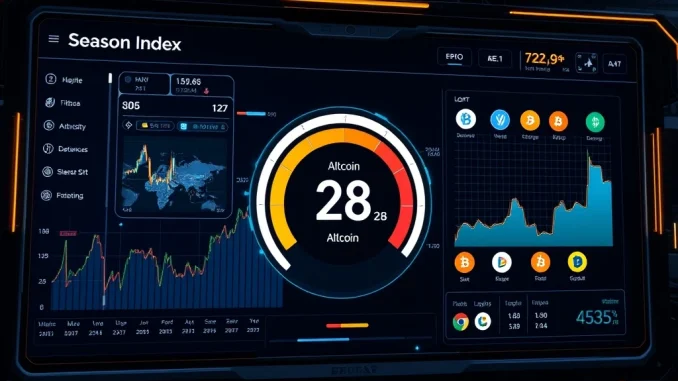
The **Altcoin Season Index** currently sits at a revealing 28, a figure that sends a clear signal across the **cryptocurrency market**. This low score suggests that we are firmly entrenched in a period where Bitcoin is outperforming most alternative cryptocurrencies. Understanding this index is crucial for investors navigating the volatile digital asset landscape. It provides a snapshot of market sentiment and helps to inform strategic decisions.
Understanding the Altcoin Season Index
CoinMarketCap’s **Altcoin Season Index** serves as a vital barometer for the broader crypto market. It measures the relative strength of altcoins compared to Bitcoin. Specifically, the index evaluates the price performance of the top 100 cryptocurrencies by market capitalization. Stablecoins and wrapped tokens are excluded from this calculation. This ensures a focus on genuine market-driven price action among a diverse set of assets.
The index uses a straightforward methodology. It compares how these selected altcoins perform against Bitcoin over the preceding 90 days. Therefore, a higher score indicates stronger altcoin performance. Conversely, a lower score points to Bitcoin’s dominance. The current reading of 28 highlights a significant period where Bitcoin has been the preferred asset for many investors.
What Defines an Altcoin Season?
An official **altcoin season** is declared when a specific condition is met. Specifically, 75% of the top 100 cryptocurrencies (excluding stablecoins and wrapped tokens) must outperform Bitcoin over the previous 90-day period. A score closer to 100 on the index clearly signals an altcoin season. During such times, investors often see substantial gains in a wide array of altcoins. These periods are characterized by broad market rallies beyond just Bitcoin.
Historically, altcoin seasons often follow significant Bitcoin price movements. Bitcoin’s rally sometimes brings new capital into the market. This capital then ‘trickles down’ into altcoins. However, the current score suggests this is not the case. Instead, Bitcoin holds its ground more firmly.
Navigating the Current Bitcoin Season
The index standing at 28 unequivocally indicates a **Bitcoin season**. This means Bitcoin has been the dominant performer over the last three months. Most altcoins have struggled to keep pace or have even seen declines against the leading cryptocurrency. Investors often observe a flight to quality during uncertain times. Bitcoin, as the largest and most established cryptocurrency, frequently benefits from this trend.
A Bitcoin season presents distinct challenges and opportunities. For example, some investors might consolidate their portfolios into Bitcoin. They aim to preserve capital during periods of altcoin underperformance. Others might seek out specific altcoins showing resilience or unique value propositions. However, this requires careful research and a deep understanding of individual projects.
Analyzing Altcoin Performance in a Bearish Trend
The current environment shows subdued **altcoin performance**. Many altcoins are experiencing downward pressure relative to Bitcoin. This trend can be attributed to several factors. Market sentiment plays a huge role. When the overall market is cautious, investors tend to favor less risky assets. Bitcoin often fits this description better than smaller, more volatile altcoins.
Furthermore, capital often flows into Bitcoin first during market upturns. Altcoins may only see significant gains after Bitcoin has established a strong trend. The current index score reflects this dynamic. It suggests that a broad-based altcoin rally is not imminent. Therefore, investors should manage their expectations accordingly.
Broader Implications for the Cryptocurrency Market
The low **Altcoin Season Index** score has wider implications for the entire **cryptocurrency market**. It suggests a period of consolidation or even contraction for many smaller projects. Developers and project teams might face increased pressure to deliver tangible results. Investor capital becomes more discerning during these times. Consequently, projects without strong fundamentals or clear use cases may struggle.
This market phase also influences trading strategies. Traders might focus more on Bitcoin and Ethereum. They may adopt a more selective approach to altcoins. Diversification remains important, but the allocation might shift. More capital could be held in stablecoins or Bitcoin during a prolonged Bitcoin season. This approach aims to minimize risk while awaiting a potential shift in market dynamics.
Factors Influencing Market Shifts
Several key factors can influence a shift from a Bitcoin season to an altcoin season. Significant technological upgrades within major altcoin ecosystems can trigger rallies. For example, successful network upgrades or new product launches often attract investor interest. Regulatory clarity, particularly favorable developments, can also boost confidence in the broader altcoin space. Moreover, a sustained period of Bitcoin price stability or sideways movement might encourage investors to seek higher returns in altcoins.
Macroeconomic conditions also play a part. Global economic stability or a reduction in inflation can increase risk appetite. This environment often benefits altcoins. Conversely, economic uncertainty typically pushes investors towards safer assets like Bitcoin or even traditional safe havens. Monitoring these broader trends is essential for predicting future shifts in the Altcoin Season Index.
Strategies for Investors During a Bitcoin Season
During a period dominated by Bitcoin, investors can adopt several strategies. One common approach is to accumulate Bitcoin. This strategy assumes Bitcoin will continue its strong performance relative to altcoins. Another strategy involves selectively researching and investing in high-conviction altcoins. These are projects with strong fundamentals, active development, and clear market demand. These altcoins might still perform well even when the broader altcoin market struggles.
Furthermore, dollar-cost averaging (DCA) can be effective. This involves investing a fixed amount of money at regular intervals. DCA helps to mitigate risk during volatile periods. It also allows investors to accumulate assets at varying price points. Finally, maintaining a portion of one’s portfolio in stablecoins offers flexibility. This capital can be deployed quickly when market conditions become more favorable for altcoins. Always conduct thorough due diligence before making any investment decisions.
Looking Ahead: When Might Altcoin Season Return?
Predicting the exact return of an **altcoin season** is challenging. However, certain indicators could signal a shift. A sustained period where Bitcoin’s dominance decreases is one such sign. This often means altcoins are beginning to gain ground. Increased trading volume across a wide range of altcoins also suggests growing interest. Furthermore, positive news regarding major altcoin projects or broader regulatory advancements could act as catalysts.
Investors should monitor the **Altcoin Season Index** regularly. A gradual increase towards the 75-mark would indicate a potential shift. Until then, a cautious and informed approach to the **cryptocurrency market** remains prudent. The current score of 28 reinforces the need for strategic portfolio management. It emphasizes the importance of understanding the prevailing market dynamics.
In conclusion, the **Altcoin Season Index** at 28 provides a clear picture of the current market. It indicates a strong **Bitcoin season**. While **altcoin performance** is currently subdued, understanding these cycles is key. Investors can better position themselves for future market movements by staying informed and adopting adaptive strategies. The crypto landscape is ever-changing, requiring constant vigilance and education.
Frequently Asked Questions (FAQs)
Q1: What exactly is the Altcoin Season Index?
The Altcoin Season Index is a metric provided by CoinMarketCap. It tracks the performance of the top 100 cryptocurrencies (excluding stablecoins and wrapped tokens) against Bitcoin over the preceding 90 days. A score closer to 100 indicates an altcoin season, while a lower score suggests a Bitcoin season.
Q2: What does an Altcoin Season Index of 28 signify?
An index score of 28 means that less than 75% of the top 100 altcoins have outperformed Bitcoin over the last 90 days. This clearly indicates that the market is currently in a Bitcoin season, where Bitcoin is generally performing better than most altcoins.
Q3: How is an ‘altcoin season’ officially declared?
An altcoin season is officially declared when 75% or more of the top 100 altcoins (excluding stablecoins and wrapped tokens) outperform Bitcoin during the preceding 90-day period. This threshold suggests a broad-based rally across the altcoin market.
Q4: What are the main differences between a Bitcoin season and an altcoin season?
In a Bitcoin season, Bitcoin’s price appreciation and market dominance are strong, often leading to altcoins underperforming against it. Conversely, an altcoin season sees a wide range of altcoins experiencing significant price increases, often outperforming Bitcoin and showing greater market capitalization growth.
Q5: How should investors adjust their strategies during a Bitcoin season?
During a Bitcoin season, investors might consider increasing their Bitcoin holdings, focusing on high-conviction altcoins with strong fundamentals, or employing dollar-cost averaging. Holding stablecoins can also provide flexibility to capitalize on future altcoin opportunities when the market shifts.
Q6: What factors could trigger the next altcoin season?
Several factors could trigger the next altcoin season, including significant technological advancements in major altcoin projects, favorable regulatory developments, a sustained period of Bitcoin price stability, or an overall increase in global risk appetite due to improving macroeconomic conditions.