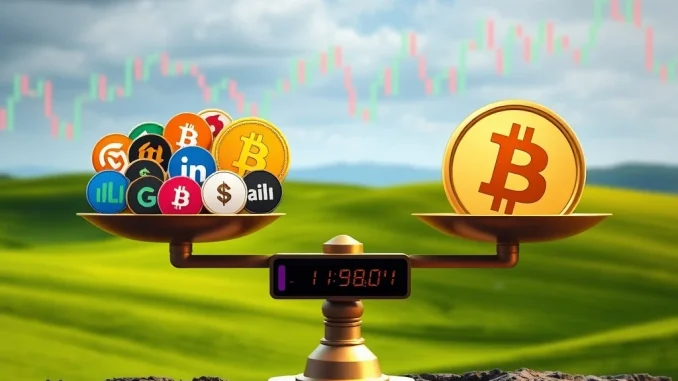
The cryptocurrency landscape is in constant flux, and recent movements signal a notable shift. If you’ve been following the exciting rallies in smaller digital assets, you might be wondering: what’s happening with altcoins? The latest data reveals a significant cooling in altcoin momentum, as the Altcoin Season Index has seen a sharp decline, dropping from 55 to 44 in just one week. This shift isn’t just a minor blip; it places the index squarely in a ‘neutral zone,’ far from the 75 threshold that historically defines a full-blown altcoin season. This pivotal change is prompting investors to re-evaluate their strategies amidst a reassertion of Bitcoin’s market leadership.
Decoding the Altcoin Season Index Drop: What It Means for Your Portfolio?
The Altcoin Season Index serves as a vital barometer for the health and performance of altcoins relative to Bitcoin. A reading above 75 typically indicates that 75% of the top 50 altcoins (excluding stablecoins and wrapped tokens) have outperformed Bitcoin over the past 90 days. The recent drop from 55 to 44 signifies a considerable retreat from this ideal scenario. This decline reflects a broader market trend where capital appears to be rotating away from riskier, smaller-cap tokens and back into the relative safety of Bitcoin.
- Cooling Momentum: The sharp 36.4% drop in the index highlights a significant reduction in altcoin outperformance.
- Neutral Zone: A reading of 44 indicates neither a strong altcoin season nor a clear Bitcoin dominance period, creating uncertainty.
- Capital Rotation: Investors are moving funds from altcoins back to Bitcoin, which has stabilized in the $115,000 range.
This movement suggests a more cautious stance among traders, influenced by prevailing macroeconomic uncertainties and global market volatility. While some analysts view this as a temporary pause after weeks of optimism driven by Ethereum ETF speculation, surging DeFi activity, and meme coin surges, others warn it could be the start of a deeper correction for altcoins.
The Resurgence of Bitcoin Dominance: A Market Reallocation?
Hand-in-hand with the declining Altcoin Season Index, Bitcoin Dominance has been on the rise. After reaching 53% in June, Bitcoin’s market share was reported at 48.2% in mid-July. While this is a slight drop from its peak, it still represents a strong reassertion of Bitcoin’s position compared to earlier periods of altcoin strength. This trend aligns with historical patterns where Bitcoin’s consolidation phases often precede, or coincide with, a re-evaluation of altcoin investments.
The increase in Bitcoin Dominance suggests a significant reallocation of capital. Investors, faced with a volatile global economic landscape, often seek the perceived stability and liquidity of Bitcoin. This flight to quality can put pressure on altcoin prices, as funds that were previously fueling their rallies are now being channeled into BTC. The fluctuating nature of Bitcoin’s market share underscores the unpredictable dynamics of the crypto market, where macroeconomic signals and Bitcoin’s price action remain critical variables for all participants.
Navigating the Current Crypto Market Shift: Challenges and Opportunities
The current crypto market shift presents both challenges and opportunities for investors. On one hand, sustained selling pressure on altcoins could drive the Altcoin Season Index further downward, reinforcing Bitcoin’s dominance and potentially leading to a market-wide correction for smaller tokens. Analysts at Bitfinex and Swissblock have cautioned about this possibility, suggesting that a strong resurgence in Bitcoin’s market share could precipitate broader altcoin weakness.
On the other hand, some argue that the index’s drop to 44 is merely a natural breather after a prolonged altcoin rally. They believe that underlying conditions could still be favorable for smaller tokens to regain traction, especially if key technical levels for major altcoins like Ethereum, Solana, and Chainlink hold strong. A sustained hold above critical support levels for these bellwether altcoins could trigger a rebound in the Altcoin Season Index, pushing it back towards altcoin season territory.
For investors, the key is to adopt a balanced approach:
- Diversification: Spreading investments across different asset classes, including a mix of Bitcoin and carefully selected altcoins, can mitigate risk.
- Risk Management: Setting stop-loss orders and not over-allocating to volatile assets are crucial.
- Monitoring Key Levels: Keep a close eye on the support and resistance levels of your chosen altcoins, as well as Bitcoin’s overall price action.
Beyond the Altcoin Performance: What’s Next for Smaller Tokens?
While the overall altcoin performance has seen a dip, the market is far from monolithic. The index’s mid-July rebound to 43 from an early June low of below 15 highlights the market’s inherent volatility and the potential for rapid rotations. During this period, some high-growth tokens like Bonk (BONK), Quant (QNT), and Dogwifhat (WIF) gained significant traction. These gains were often driven by unique technical patterns, such as Bonk’s golden cross and bullish pennant, or macro-driven narratives, like Quant’s partnerships with Oracle and the European Central Bank highlighting real-world asset tokenization.
These examples underscore that even in a period of broader altcoin cooling, individual projects can still thrive based on their unique fundamentals, community support, or specific catalysts. However, these developments often remain speculative, and market participants must balance optimism with prudence. Leveraging AI-driven analytics, as recommended by platforms like Token Metrics, can help identify early movers and inform disciplined entry and exit strategies in these volatile cycles.
Crucial Bitcoin Price Action and Regulatory Winds
The stability of Bitcoin Price Action in the $115,000 range is a significant factor influencing the broader market. A strong and stable Bitcoin often provides a foundation, but its reassertion of dominance can also curtail altcoin gains if capital flows directly into BTC rather than spilling over into altcoins. Investors are urged to closely monitor Bitcoin’s dominance levels and its price movements, as a sustained reassertion of BTC’s market share could significantly impact altcoin rallies.
Adding another layer of complexity are regulatory developments and ETF-related speculation. While the market has seen excitement around potential Ethereum ETF approvals, new interest has emerged regarding potential meme coin ETF approvals, with firms like Osprey Funds and Rex Shares sparking discussions. These speculative events can create temporary pumps in specific tokens but also introduce significant uncertainty. The growing relevance of real-world asset tokenization, exemplified by Quant’s strategic partnerships, also signals a maturing aspect of the crypto space that could drive future adoption and value.
As the crypto market continues its rapid evolution, the Altcoin Season Index remains a crucial barometer for shifting investor sentiment. While its recent fluctuations suggest a highly dynamic environment, the path forward remains uncertain. Traders and investors are advised to stay agile, prioritizing macroeconomic indicators, Bitcoin’s movements, and regulatory clarity. These factors will ultimately determine whether altcoins can regain their robust momentum or continue to cede ground to Bitcoin in the short to medium term. Disciplined research and adaptive strategies will be key to navigating this complex and exciting landscape.
Frequently Asked Questions (FAQs)
1. What is the Altcoin Season Index?
The Altcoin Season Index is a metric that tracks the performance of altcoins relative to Bitcoin. A reading above 75 typically indicates that 75% of the top 50 altcoins (excluding stablecoins and wrapped tokens) have outperformed Bitcoin over the past 90 days, signaling an ‘altcoin season.’
2. What does a drop in the Altcoin Season Index signify?
A drop in the Altcoin Season Index, such as the recent decline to 44, signifies a cooling in altcoin momentum. It suggests that fewer altcoins are outperforming Bitcoin, and capital may be rotating back into Bitcoin due to market uncertainties or a shift in investor sentiment.
3. Why is Bitcoin dominance rising?
Bitcoin dominance often rises during periods of market uncertainty or when investors seek the relative stability and liquidity of Bitcoin. It can also occur when capital rotates out of altcoins after a significant rally, as investors consolidate gains or reduce risk exposure.
4. Should I sell all my altcoins if the index drops?
Not necessarily. A drop in the index indicates a broader trend, but individual altcoins may still perform well due to specific catalysts or strong fundamentals. It’s crucial to conduct your own research, manage risk through diversification, and monitor key technical levels rather than making decisions based solely on the index.
5. How do macroeconomic factors influence altcoin performance?
Macroeconomic factors like inflation, interest rate changes, geopolitical events, and global market volatility significantly influence investor risk appetite. During periods of uncertainty, investors tend to de-risk, often moving capital from speculative assets like altcoins to more established ones like Bitcoin, or even out of crypto entirely.
6. What are the key indicators investors should monitor now?
Investors should closely monitor the Altcoin Season Index, Bitcoin’s dominance levels, and Bitcoin’s price action. Additionally, keeping an eye on macroeconomic indicators, regulatory developments, and the technical levels of major altcoins (Ethereum, Solana, Chainlink) will provide a more comprehensive view of the market’s direction.