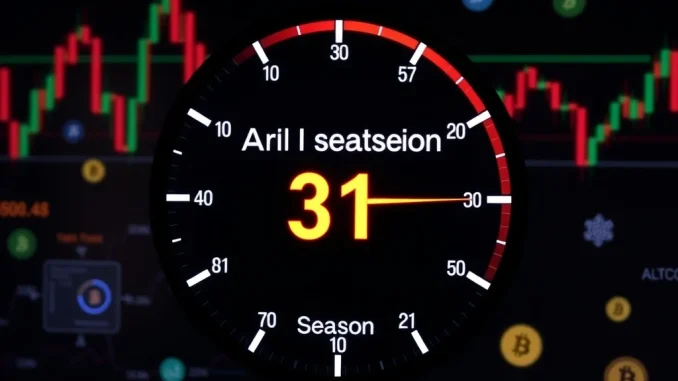
The cryptocurrency market constantly evolves. Therefore, investors closely monitor various indicators. One such crucial metric is the Altcoin Season Index. This index recently experienced a significant fall. It dropped two points from yesterday, now resting at 31. This shift immediately signals a potential change in market dynamics. For many investors, this number holds considerable weight. It suggests a prevailing trend where Bitcoin is currently outperforming altcoins. Understanding this index is key for navigating the volatile crypto landscape.
Understanding the Altcoin Season Index
CoinMarketCap developed the Altcoin Season Index as a barometer for market sentiment. It helps determine whether altcoins are generally outperforming Bitcoin. Specifically, the index measures a key criterion. It checks if 75% of the top 100 cryptocurrencies by market capitalization have surpassed Bitcoin’s performance. Stablecoins and wrapped tokens are intentionally excluded from this calculation. This ensures a clearer picture of speculative asset performance. The measurement period spans the last 90 days. Therefore, it offers a mid-term perspective on market trends.
A higher score on the index indicates an Altcoin Season. A score closer to 100 suggests that altcoins are broadly outperforming Bitcoin. Conversely, a lower score points towards a Bitcoin Season. This means Bitcoin is leading the market. The recent drop to 31 is noteworthy. It places the market firmly in a Bitcoin-dominated phase. Investors often adjust their strategies based on these signals. They consider how their portfolios might be affected. Such an index provides valuable context for investment decisions.
What a Score of 31 Means for the Cryptocurrency Market
The Altcoin Season Index falling to 31 carries significant implications. This low score suggests that Bitcoin has largely outperformed the majority of the top 100 altcoins over the past three months. Consequently, investor capital might be flowing more towards Bitcoin. This often happens during periods of uncertainty. Bitcoin is frequently seen as a safer haven asset within the crypto space. When Bitcoin shows strength, altcoins can sometimes struggle to keep pace. Their volatility is generally higher.
This scenario indicates a prevailing sentiment. The market may favor larger, more established assets. A score of 31 means only a small fraction of altcoins have beaten Bitcoin recently. Therefore, diversified portfolios might feel the impact. Altcoin holders might experience underperformance. Meanwhile, Bitcoin holders could see relative gains. This trend can influence future investment flows. It shapes expectations for the broader cryptocurrency market. Traders pay close attention to these shifts. They look for opportunities or risks.
Factors Influencing Altcoin Performance and Bitcoin’s Dominance
Several factors contribute to shifts in altcoin performance relative to Bitcoin. Macroeconomic conditions play a significant role. Global economic uncertainty often drives investors to less volatile assets. In the crypto world, Bitcoin is typically considered that asset. Interest rate hikes or geopolitical events can prompt this flight to safety. Regulatory developments also impact market sentiment. Stricter regulations can deter investment in smaller, less established altcoins. They might be perceived as riskier.
Furthermore, Bitcoin’s own developments are crucial. Recent Bitcoin ETF approvals, for instance, attracted institutional capital. This increased demand for Bitcoin. Major upgrades or halving events can also boost Bitcoin’s price. When Bitcoin rallies, it sometimes draws liquidity away from altcoins. Altcoins then struggle to maintain their momentum. Conversely, periods of high innovation in specific altcoin sectors can spark an Altcoin Season. Decentralized Finance (DeFi) and Non-Fungible Tokens (NFTs) have done this previously. However, the current index suggests these narratives are not strong enough to challenge Bitcoin’s dominance.
Historical Context: Cycles of Altcoin and Bitcoin Seasons
The cryptocurrency market is famously cyclical. It often alternates between periods of Altcoin Season and Bitcoin Season. Historically, Bitcoin often leads bull runs. It then consolidates, allowing altcoins to catch up. This phenomenon is known as the ‘altcoin pump.’ During an Altcoin Season, many smaller cap tokens experience explosive growth. Investors can see substantial returns. However, these periods are usually followed by a Bitcoin resurgence. Bitcoin reasserts its dominance.
For example, 2017 saw a massive Altcoin Season. Many new projects emerged and gained significant value. Similarly, early 2021 witnessed another strong altcoin rally. Ethereum and other Layer 1 solutions surged. These periods are characterized by high risk appetite. Investors are willing to explore newer, more speculative assets. However, market corrections often push capital back into Bitcoin. The current drop in the Altcoin Season Index aligns with this cyclical pattern. It reinforces Bitcoin’s position as the market’s anchor.
Navigating a Bitcoin Season: Strategies for Investors
During a period dominated by Bitcoin, investors often adjust their approaches. A Bitcoin Season can present different opportunities and risks. Here are some common strategies:
- Focus on Bitcoin: Some investors choose to increase their Bitcoin holdings. They believe Bitcoin offers more stability during these times. Its price action can be less volatile than altcoins.
- Quality Altcoins: Others might consolidate their altcoin portfolios. They might hold only high-quality projects. These projects usually have strong fundamentals and proven utility.
- Risk Management: Reducing exposure to highly speculative altcoins is another strategy. This minimizes potential losses if the broader altcoin market struggles.
- Dollar-Cost Averaging (DCA): Continuing to DCA into preferred assets remains a sound strategy. This approach smooths out entry prices over time.
- Research and Patience: This period can be ideal for in-depth research. Investors can identify promising projects for the next Altcoin Season. Patience is crucial during slower market phases.
Understanding the prevailing market season helps investors make informed decisions. It allows them to align their portfolios with current trends. The recent index drop emphasizes the need for careful consideration.
The Future Outlook for Altcoin Performance
While the Altcoin Season Index currently points to a Bitcoin-dominated market, trends can change. The crypto market is known for its rapid shifts. Several factors could trigger the next Altcoin Season. Innovation in specific blockchain sectors could reignite interest. For example, advancements in Web3 gaming or decentralized AI could attract new capital. Major technological breakthroughs within promising altcoin projects also play a role. These could lead to significant price appreciation.
Furthermore, a sustained period of Bitcoin stability could encourage altcoin growth. Once Bitcoin’s price stabilizes after a strong rally, investors often seek higher returns elsewhere. They then look towards altcoins. This search for alpha can kickstart another altcoin rally. However, for now, the data suggests caution for altcoin investors. The market is consolidating around Bitcoin. Monitoring the Altcoin Season Index will provide ongoing insights. It helps gauge the shifting tides of the cryptocurrency market. Investors should remain vigilant and adaptable.
Conclusion: Adapting to the Shifting Cryptocurrency Market
The recent fall of the Altcoin Season Index to 31 is a clear signal. It indicates that the cryptocurrency market is currently experiencing a Bitcoin Season. Bitcoin has largely outperformed the majority of altcoins over the last 90 days. This shift underscores Bitcoin’s foundational role in the crypto ecosystem. It also highlights the cyclical nature of market dynamics. Investors must therefore adapt their strategies. They should consider the implications of this dominance. Focus on robust projects and diligent risk management remains paramount. While altcoin performance may be subdued now, the market is always evolving. Future innovations and shifts in sentiment could certainly pave the way for the next Altcoin Season. Staying informed about these key indicators is essential for all participants in the digital asset space.
Frequently Asked Questions (FAQs)
Q1: What exactly is the Altcoin Season Index?
The Altcoin Season Index is a metric created by CoinMarketCap. It measures whether 75% of the top 100 cryptocurrencies (excluding stablecoins and wrapped tokens) have outperformed Bitcoin over the past 90 days. A higher score indicates an Altcoin Season, while a lower score points to a Bitcoin Season.
Q2: Why did the Altcoin Season Index fall to 31?
The index fell to 31 because a significant majority of the top 100 altcoins have underperformed Bitcoin over the last three months. This suggests that investor capital has largely favored Bitcoin, possibly due to factors like macroeconomic uncertainty or Bitcoin-specific developments.
Q3: What does a ‘Bitcoin Season’ mean for investors?
A Bitcoin Season indicates that Bitcoin is generally outperforming most altcoins. For investors, this might mean that Bitcoin could offer more stable returns. It also suggests that highly speculative altcoins might experience lower growth or even declines. Investors often consider increasing their Bitcoin exposure or focusing on high-quality altcoins during these times.
Q4: How long do Altcoin Seasons or Bitcoin Seasons typically last?
The duration of Altcoin Seasons and Bitcoin Seasons varies widely. They are part of the cyclical nature of the crypto market. Some can last for several months, while others might be shorter. Market sentiment, macroeconomic factors, and technological developments all influence these cycles.
Q5: Should I sell all my altcoins if it’s a Bitcoin Season?
Not necessarily. While a Bitcoin Season suggests broader altcoin underperformance, individual altcoins with strong fundamentals and ongoing development can still perform well. Many investors choose to rebalance their portfolios, reduce exposure to highly speculative altcoins, or continue dollar-cost averaging into their preferred assets. It’s crucial to conduct your own research and manage risk effectively.
Q6: What could trigger the next Altcoin Season?
The next Altcoin Season could be triggered by several factors. These include significant technological advancements in specific altcoin sectors (e.g., DeFi, gaming, AI), a sustained period of Bitcoin stability, increased institutional adoption of specific altcoins, or a renewed surge in retail investor interest in newer, innovative projects.