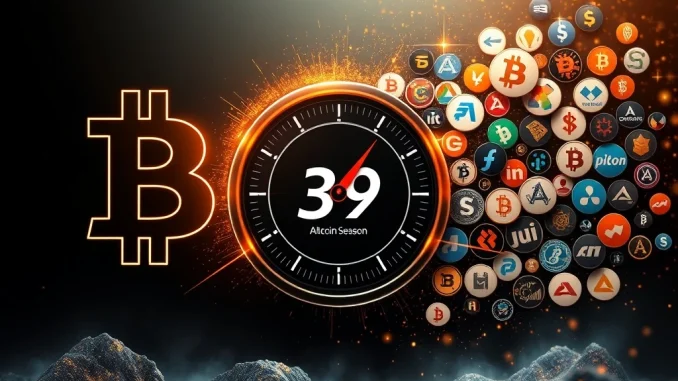
Are you tracking the ebb and flow of the cryptocurrency market? The Altcoin Season Index offers crucial insights. This valuable metric helps investors understand whether altcoins or Bitcoin are currently leading the charge. Right now, the index stands at 39, a figure that carries significant implications for your investment decisions.
Decoding the Altcoin Season Index: What Does 39 Mean?
The Altcoin Season Index, provided by CoinMarketCap, serves as a vital barometer for the broader cryptocurrency market. It measures the collective strength of altcoins against Bitcoin. Specifically, the index evaluates the performance of the top 100 cryptocurrencies by market capitalization. It deliberately excludes stablecoins and wrapped tokens to ensure a pure measure of speculative asset performance. A reading of 39, as we see today, suggests a period of robust Bitcoin dominance. This means that, on average, Bitcoin has outperformed a significant majority of these top altcoins over the past 90 days.
To declare an official Altcoin Season, the index needs to hit 75 or higher. This threshold signifies that at least 75% of the top 100 altcoins have surpassed Bitcoin’s price performance over the same 90-day period. Conversely, a lower number, like our current 39, indicates that Bitcoin is currently the stronger performer. This insight is incredibly important for investors. It helps them adjust their portfolios based on prevailing market trends. Understanding this index can therefore enhance your strategic approach to the volatile crypto landscape.
How the Altcoin Season Index is Calculated
Understanding the methodology behind the Altcoin Season Index clarifies its significance. CoinMarketCap meticulously calculates this index using a clear, consistent approach. They track the price movements of the top 100 cryptocurrencies by market capitalization. This selection excludes stablecoins such as USDT or USDC. It also omits wrapped tokens like WBTC. These exclusions ensure the index accurately reflects the speculative performance of independent crypto assets. The comparison period is always the preceding 90 days.
The core of the calculation involves a direct comparison: has an altcoin performed better than Bitcoin during this 90-day window? Each altcoin that outperforms Bitcoin contributes to the index’s upward movement. If 75 out of the 100 altcoins surpass Bitcoin, the index declares an Altcoin Season. A score closer to 0 indicates strong Bitcoin dominance. A score closer to 100, however, signals an altcoin season. This simple yet powerful metric provides a quick snapshot of market sentiment. Therefore, investors often use it to gauge the overall health and direction of the cryptocurrency market.
Navigating Periods of Bitcoin Dominance: What 39 Implies for Altcoin Performance
An Altcoin Season Index reading of 39 clearly points to a period of Bitcoin dominance. During such times, investors typically observe several key market behaviors. Bitcoin often acts as the primary driver of market sentiment. Its price movements tend to dictate the broader market direction. Many altcoins, consequently, struggle to gain significant traction independently. They may even experience declines while Bitcoin holds steady or rises. This trend highlights a ‘flight to safety’ within the crypto space. Investors often prefer Bitcoin’s relative stability during uncertain periods.
For those holding a diverse portfolio, this environment means that your altcoin performance might lag. Some altcoins may even see their Bitcoin-denominated value decrease. Therefore, strategic adjustments become crucial. Investors might consider rebalancing their portfolios. This could involve increasing Bitcoin holdings or focusing on altcoins with strong fundamentals. These altcoins must possess compelling use cases and active development. Such a careful approach helps mitigate risks associated with weaker altcoin performance. It also positions investors for potential future gains when the market inevitably shifts.
Historical Context: Past Altcoin Seasons and Bitcoin’s Reign
The cryptocurrency market is cyclical, characterized by alternating periods of altcoin surges and Bitcoin dominance. Looking back at historical data provides valuable context for the current Altcoin Season Index of 39. For example, 2017 saw a massive altcoin boom. The index likely soared above 75, as many nascent projects experienced parabolic growth. Similarly, early 2021 witnessed another significant altcoin rally. DeFi and NFT narratives fueled widespread enthusiasm, pushing numerous altcoins to all-time highs. These periods were marked by a high Altcoin Season Index.
Conversely, bear markets or periods of consolidation often bring strong Bitcoin dominance. During these times, the index typically falls to lower numbers, mirroring the current reading. Bitcoin’s resilience and established position often make it the preferred asset. This pattern demonstrates that the index is not static. It constantly reflects the evolving dynamics between Bitcoin and the broader altcoin market. Understanding these historical cycles helps investors anticipate future shifts. It also prepares them for the next potential Altcoin Season, allowing for more informed decision-making.
Factors Influencing the Altcoin Season Index and Future Outlook
Several critical factors influence the movement of the Altcoin Season Index. Bitcoin’s price action is arguably the most significant. A strong Bitcoin rally often draws capital from altcoins, reinforcing Bitcoin dominance. Conversely, if Bitcoin consolidates or trades sideways, altcoins might find room to run. Broader market sentiment also plays a crucial role. Positive news, such as institutional adoption or regulatory clarity, can boost the entire cryptocurrency market. Negative developments, however, can trigger widespread sell-offs, affecting altcoins more severely.
Emerging narratives also drive altcoin performance. The rise of DeFi, NFTs, and AI-related tokens has historically sparked mini-altcoin seasons within specific niches. These narratives attract new capital and investor interest. Regulatory changes can also impact altcoin viability and growth. Looking ahead, a shift from the current 39 reading would require a sustained period where altcoins collectively outperform Bitcoin. This could be triggered by:
- A significant period of Bitcoin price consolidation.
- Major technological breakthroughs or upgrades in leading altcoin projects.
- The emergence of compelling new crypto narratives.
- Increased institutional investment directly into altcoins.
Monitoring these factors is essential for predicting future movements of the index. This proactive approach helps investors prepare for the next potential Altcoin Season.
Strategies for Different Market Cycles: Maximizing Altcoin Performance
Adapting your investment strategy to current market conditions is paramount. When the Altcoin Season Index indicates Bitcoin dominance, like our current reading of 39, a conservative approach often yields better results. During such periods, prioritizing Bitcoin holdings can be wise. Bitcoin tends to be more resilient and may offer a safer haven. Investors might also consider stablecoins to preserve capital. This strategy allows them to wait for more favorable market conditions. Furthermore, careful research into high-conviction altcoins with strong fundamentals remains important. These projects may weather downturns better than others.
Conversely, when the index signals an impending or active Altcoin Season (above 75), shifting focus can be highly profitable. This is the time when aggressive portfolio rebalancing towards promising altcoins can lead to substantial gains. Diversification across various altcoin sectors is advisable. Consider areas like DeFi, gaming, or layer-2 solutions. However, always exercise caution and conduct thorough due diligence. Not all altcoins will perform equally well. A well-thought-out strategy, informed by the Altcoin Season Index, can significantly enhance your long-term success in the volatile cryptocurrency market.
The Altcoin Season Index at 39 provides a clear snapshot of the current crypto landscape. It signifies a period where Bitcoin maintains its dominance over the broader altcoin market. While this may present challenges for immediate altcoin performance, it also offers opportunities for strategic planning and portfolio adjustments. By understanding the mechanics of this index and historical market cycles, investors can make more informed decisions. Staying vigilant and adapting your strategy to these indicators is key to navigating the dynamic world of cryptocurrencies effectively.
Frequently Asked Questions (FAQs)
What exactly is the Altcoin Season Index?
The Altcoin Season Index is a metric from CoinMarketCap. It measures the performance of the top 100 cryptocurrencies (excluding stablecoins and wrapped tokens) against Bitcoin over the past 90 days. It helps indicate whether altcoins or Bitcoin are currently outperforming.
What does an Altcoin Season Index of 39 signify?
An index of 39 indicates a period of Bitcoin dominance. This means that fewer than 39% of the top 100 altcoins have outperformed Bitcoin in the last 90 days. Bitcoin is currently the stronger performer in the cryptocurrency market.
When is an ‘Altcoin Season’ officially declared?
An Altcoin Season is officially declared when the Altcoin Season Index reaches 75 or higher. This signifies that at least 75% of the top 100 altcoins have outperformed Bitcoin over the preceding 90 days.
How does Bitcoin dominance affect altcoin performance?
During Bitcoin dominance, altcoins generally struggle to gain value against Bitcoin. Many altcoins may even see their prices decline in BTC terms. Investors often flock to Bitcoin as a safer asset, leading to capital outflow from altcoins.
What factors can cause the Altcoin Season Index to change?
Key factors include Bitcoin’s price action, overall cryptocurrency market sentiment, the emergence of new crypto narratives (e.g., DeFi, NFTs, AI), and significant technological upgrades in altcoin projects. These elements can shift the balance between Bitcoin and altcoin performance.
Should I sell all my altcoins when the index is low?
Not necessarily. A low index suggests caution and strategic rebalancing. It might be an opportune time to increase Bitcoin holdings or focus on fundamentally strong altcoins. Avoid panic selling. Always conduct your own research and consider your long-term investment goals.