Are you navigating the dynamic world of digital assets? Understanding market cycles is crucial for successful investment. Investors often watch key indicators for insights. Currently, the Altcoin Season Index provides a significant signal. It suggests a prevailing trend in the crypto market.
Understanding the Altcoin Season Index
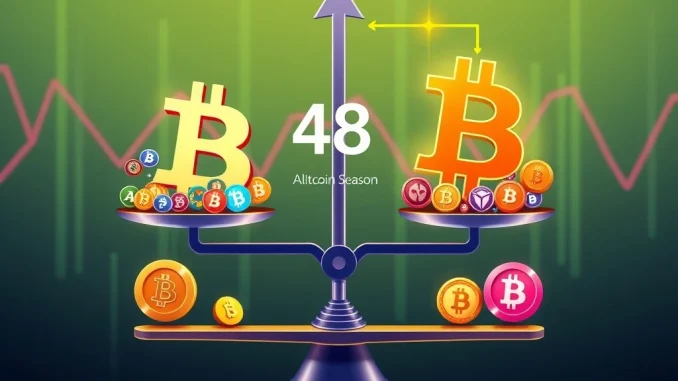
The Altcoin Season Index offers a clear snapshot of market conditions. This vital metric, tracked by CoinMarketCap (CMC), provides valuable insights. It helps determine whether altcoins or Bitcoin are currently leading the charge. As of 00:32 UTC on August 18, the index registered 48. This specific score indicates the market is firmly in a Bitcoin Season. This means Bitcoin is generally outperforming most other digital assets.
Significantly, the index excludes stablecoins and wrapped tokens. This exclusion ensures a focus on organic cryptocurrency performance. It prevents artificial inflation of altcoin dominance. Furthermore, the index evaluates the performance of the top 100 coins on CMC. It specifically measures their performance over the past 90 days. Therefore, this period offers a robust look at recent trends.
How the Index Defines Seasons
The Altcoin Season Index operates on a straightforward principle. It ranges from 1 to 100. A score above 75 signals an Altcoin Season. This occurs when at least 75% of the top 100 altcoins outperform Bitcoin over the 90-day period. Conversely, a score of 25 or below indicates a Bitcoin Season. This happens when 25% or fewer altcoins manage to outperform Bitcoin. Our current index reading of 48 falls squarely within the Bitcoin Season range. This highlights Bitcoin’s recent strength.
What is Bitcoin Season?
When the Altcoin Season Index points to a Bitcoin Season, it signifies a specific market environment. During this period, Bitcoin typically sees stronger gains. It often outperforms most other cryptocurrencies. Capital tends to flow from altcoins into Bitcoin. Investors might seek safety in Bitcoin during uncertain times. Alternatively, they might anticipate a major Bitcoin rally. This shift in capital flow strengthens Bitcoin’s dominance. Consequently, altcoin prices may stagnate or even decline against Bitcoin.
This phase is not uncommon in the crypto market. It often precedes or follows periods of significant market volatility. Bitcoin’s role as the leading cryptocurrency makes it a natural safe haven. Moreover, it acts as a primary entry point for new capital. Thus, its performance heavily influences the overall crypto market sentiment. Understanding Bitcoin Season is crucial. It helps investors adjust their strategies accordingly. For instance, some investors might reduce their altcoin exposure. Instead, they might increase their Bitcoin holdings.
The Dynamics of Altcoin Season
In contrast, an Altcoin Season represents a period of explosive growth for many alternative cryptocurrencies. This exciting phase occurs when a broad range of altcoins significantly outperform Bitcoin. The Altcoin Season Index would register above 75 during such times. This indicates widespread gains across the altcoin spectrum. Factors driving an Altcoin Season are diverse. They often include:
- Technological breakthroughs: New blockchain innovations attract investor interest.
- Major project upgrades: Ethereum’s Merge, for example, boosted many DeFi tokens.
- Emerging narratives: Trends like DeFi, NFTs, or GameFi can spark altcoin rallies.
- Market sentiment shifts: A general increase in risk appetite can fuel altcoin speculation.
During Altcoin Season, investors often see substantial returns. Many smaller projects can experience parabolic growth. This period is highly anticipated by many in the crypto community. It represents a time of diversification and exploration. However, it also carries higher risks. Altcoin volatility is typically much greater than Bitcoin’s. Therefore, understanding the market’s current season is vital. It informs strategic decisions for managing cryptocurrency performance.
Historical Context and Market Cycles
The crypto market is inherently cyclical. Bitcoin and Altcoin Seasons are not new phenomena. Historically, these phases have alternated. For instance, 2017 saw a massive Altcoin Season. Many nascent projects achieved unprecedented gains. Conversely, 2018 largely marked a Bitcoin Season. Bitcoin retained its value better during a bear market. Later, early 2021 also witnessed a significant Altcoin Season. This was driven by the rise of DeFi and NFTs. Recognizing these patterns helps investors. It provides context for current market conditions. The Altcoin Season Index helps to quantify these historical trends. It offers a data-driven perspective on market shifts. Thus, investors can make more informed decisions. They can better anticipate future movements. However, past performance does not guarantee future results. Therefore, careful research remains essential.
Why Does This Matter to Investors?
The Altcoin Season Index serves as a critical tool for investors. It offers a directional guide for portfolio management. When the index signals a Bitcoin Season, investors might consider rebalancing. They may shift more capital into Bitcoin. This could help preserve capital during a downturn. Conversely, an Altcoin Season might prompt diversification. Investors could allocate funds to promising altcoin projects. This allows them to capture potentially higher returns. Furthermore, understanding the index helps manage expectations. It sets realistic goals for cryptocurrency performance. It also aids in identifying opportune moments for entry or exit. Thus, it enhances overall investment strategy. It helps investors adapt to changing market dynamics. Staying informed is key to success in this volatile market.
Factors Influencing the Altcoin Season Index
Several external and internal factors can significantly influence the Altcoin Season Index. These elements often dictate capital flow. They determine whether Bitcoin or altcoins gain dominance. Macroeconomic conditions play a large role. For example, high inflation might drive investors to Bitcoin as a hedge. Regulatory news also has a substantial impact. Clear regulations can boost investor confidence. Unfavorable news can trigger sell-offs. Major Bitcoin events, such as halving cycles, are critical. These events often precede significant price movements. They can initiate new market cycles. Finally, specific altcoin developments matter. Network upgrades or new project launches can attract capital. These factors collectively shape the ongoing crypto market landscape. Monitoring them is essential for predicting shifts in the Altcoin Season Index.
Navigating the Current Bitcoin Season
With the Altcoin Season Index at 48, the market is currently in Bitcoin Season. This period demands a thoughtful approach from investors. It suggests a focus on capital preservation and strategic positioning. Investors might consider accumulating Bitcoin. They could also research strong altcoin projects for future cycles. Dollar-cost averaging (DCA) into Bitcoin can be an effective strategy. This reduces risk associated with market timing. Additionally, investors should exercise caution with highly speculative altcoins. Their cryptocurrency performance might lag significantly. This season is an opportunity for consolidation. It allows investors to refine their portfolios. Moreover, it is a time to prepare for the eventual return of an Altcoin Season. Patience and disciplined execution are paramount during this phase. Always conduct thorough due diligence before making any investment decisions.
Outlook and Future Possibilities for the Altcoin Season
The current Bitcoin Season will not last forever. The crypto market is cyclical by nature. Therefore, an Altcoin Season is likely to return. Predicting its exact timing is challenging. However, certain indicators can signal its approach. A sustained period of Bitcoin stability often precedes an altcoin surge. Increased developer activity on altcoin networks can be another sign. Furthermore, new narratives emerging in the crypto space might spark interest. For instance, breakthroughs in Layer 2 solutions or Web3 gaming could ignite fresh altcoin rallies. Investors should monitor these developments closely. They should also track the Altcoin Season Index for early signals. A gradual increase towards 75 would indicate a shift. This shift would mark the beginning of a new period. This new period would favor altcoin cryptocurrency performance. Ultimately, adaptability remains key in the ever-evolving digital asset landscape.
In conclusion, the Altcoin Season Index provides a crucial lens. It helps understand the current dynamics of the crypto market. With the index at 48, we are firmly in a Bitcoin Season. This phase prioritizes Bitcoin’s dominance. It also presents unique challenges and opportunities for investors. By understanding the underlying mechanics and historical patterns, investors can navigate these cycles more effectively. Always remember to conduct your own research. Make informed decisions based on your financial goals. The crypto market continues to evolve rapidly. Staying informed about metrics like the Altcoin Season Index is vital for success.
Frequently Asked Questions (FAQs)
Q1: What is the Altcoin Season Index?
The Altcoin Season Index is a metric from CoinMarketCap. It tracks the performance of the top 100 cryptocurrencies (excluding stablecoins and wrapped tokens) against Bitcoin over the past 90 days. It helps determine if the market is in an Altcoin Season or Bitcoin Season.
Q2: How is Altcoin Season defined by the index?
An Altcoin Season is defined when at least 75% of the top 100 altcoins outperform Bitcoin over a 90-day period. The Altcoin Season Index would typically register above 75 in such a scenario.
Q3: What does ‘Bitcoin Season’ mean for investors?
Bitcoin Season means Bitcoin is generally outperforming most altcoins. Capital often flows into Bitcoin, making it a relatively safer bet. Investors might consider increasing their Bitcoin holdings or preparing for future altcoin opportunities during this phase.
Q4: How often do Altcoin and Bitcoin Seasons occur?
These seasons occur cyclically within the cryptocurrency market. They do not follow a fixed schedule. Their occurrence depends on various factors, including market sentiment, technological advancements, macroeconomic conditions, and major events like Bitcoin halvings.
Q5: Can the Altcoin Season Index predict future market movements?
The Altcoin Season Index is a backward-looking indicator. It reflects past performance over 90 days. While it doesn’t predict the future, it offers valuable insight into current market sentiment and dominance trends. Investors use it to inform their strategies, not as a definitive forecast.
Q6: What factors influence the Altcoin Season Index’s score?
The index’s score is influenced by the collective performance of the top 100 altcoins relative to Bitcoin. Key factors include new project launches, major network upgrades, overall crypto market sentiment, regulatory news, and broader economic conditions affecting investor risk appetite.