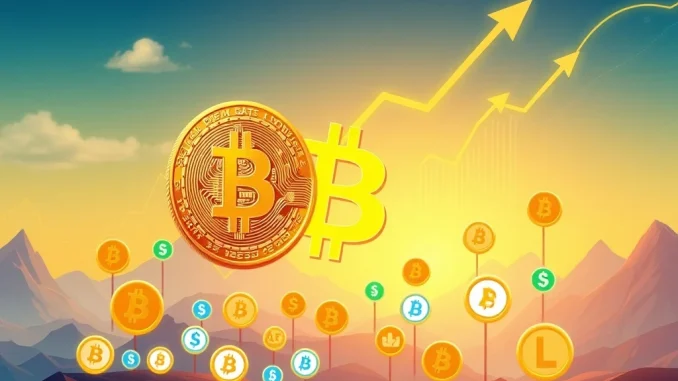
The cryptocurrency market is buzzing with excitement, showing early signs of a significant structural shift. Investors are increasingly redirecting capital from Bitcoin to alternative coins, a trend analysts are calling the onset of an “early rotation phase.” This dynamic period is marked by accelerating altcoin gains, signaling a potential new chapter for the digital asset landscape. If you’ve been watching the charts, you’re likely noticing that the market’s heartbeat is shifting, creating both opportunities and challenges for investors.
Understanding the Crypto Market Shift and Bitcoin Dominance
One of the most telling indicators of this evolving market dynamic is the noticeable decline in Bitcoin Dominance. Historically, Bitcoin has held the lion’s share of the total cryptocurrency market capitalization, often dictating the overall market sentiment. However, recent weeks have seen Bitcoin’s dominance—the percentage of the total crypto market cap it holds—decline from over 65% to 61% since early July. This 4% drop, while seemingly small, represents a substantial redistribution of funds. It suggests that a significant portion of capital is moving away from the leading cryptocurrency and flowing into mid-cap and smaller altcoins.
This phenomenon is precisely what analysts refer to as Capital Rotation. It’s a natural cycle in the crypto market where, after a period of Bitcoin-led rallies, investors start looking for higher returns in altcoins, which often have greater upside potential due to their smaller market caps. This current shift is not just speculative; it’s underscored by rising retail and institutional interest, favorable on-chain metrics, and even some positive regulatory developments. The market is maturing, and this capital reallocation is a testament to the growing confidence in the broader altcoin ecosystem.
The Surge in Altcoin Gains: A Closer Look
The evidence for accelerating altcoin gains is compelling. Several key altcoins have significantly outperformed Bitcoin in recent weeks, drawing considerable attention:
- Ethereum (ETH): The second-largest cryptocurrency by market cap, ETH has recently surged by 21%. This robust performance is largely driven by its pivotal role in the decentralized finance (DeFi) ecosystem and the booming non-fungible token (NFT) market. As the backbone for countless dApps, Ethereum continues to attract developers and users, fueling its demand.
- Solana (SOL): Known for its high throughput and low transaction costs, Solana has climbed an impressive 40% over the past month. Its growing ecosystem of DeFi projects, GameFi applications, and NFT marketplaces continues to attract capital looking for scalable and efficient blockchain solutions.
- XRP (Ripple): Ripple’s XRP token reached a multi-year high of $3.64. This remarkable ascent has been buoyed by significant regulatory clarity following recent legal developments and its continued adoption for cross-border payments. The demand for efficient global remittance solutions positions XRP uniquely in the market.
This outperformance isn’t just a flash in the pan. Retail and institutional activity is amplifying these trends. Google Trends data revealed a record high score of 100 for “altcoin” searches on July 18, 2025, reflecting a palpable increase in public interest. Anush Jafer, Lead Analyst at Mudrex, aptly noted that the altcoin space is showing “very, very interesting” signs, advising investors to closely monitor key indicators to anticipate the full shift. This surge in public curiosity, combined with strategic institutional moves, paints a promising picture for the broader Crypto Market Shift.
Is it Altcoin Season? Navigating the Indicators
The question on everyone’s mind is: Are we officially in Altcoin Season? While the signs are certainly pointing in that direction, the full confirmation threshold has not yet been met. The Altcoin Season Index (ASI), a key metric that measures the percentage of the top 50 altcoins outperforming Bitcoin, climbed to 59 on July 21. This is a sharp increase from 12 in June, indicating a strong momentum shift. However, a full altseason is typically confirmed when the ASI crosses the 75 threshold. So, while we are undoubtedly in an “early rotation phase,” a full-blown altseason is still on the horizon.
Another crucial indicator supporting this market shift is the TOTAL2 chart, which represents the total market capitalization of all cryptocurrencies excluding Bitcoin. On July 21, the TOTAL2 chart successfully broke through a significant $1.6 trillion resistance level. This breakout aligns with a multi-year Cup and Handle pattern, a bullish technical formation often signaling a strong upward trend. Furthermore, the reduced leverage in altcoin perpetual futures suggests that the current demand is primarily spot-driven rather than speculative borrowing. This indicates healthier, more sustainable growth, as it reflects genuine buying interest rather than highly leveraged positions that can easily unravel during market volatility.
Understanding the nuances of these indicators is vital for investors. While the excitement around altcoin gains is palpable, it’s crucial to differentiate between an early rotation and a confirmed altseason. This current phase allows for strategic positioning before the market potentially enters a more explosive growth period for altcoins.
Strategic Capital Rotation: What Investors Need to Know
For investors, recognizing and participating in Capital Rotation effectively is key to maximizing returns in a dynamic crypto market. As Bitcoin’s dominance softens, capital naturally seeks out opportunities in other digital assets. This doesn’t mean Bitcoin is losing its importance; rather, it signifies a maturing ecosystem where altcoins play an increasingly vital role.
While the focus is on altcoins, it’s worth noting broader market developments. For instance, Trump Media’s recent $2 billion investment in Bitcoin and Bitcoin-linked assets, constituting two-thirds of its $3 billion asset base, underscores the evolving landscape of institutional engagement. While this specific investment is in Bitcoin, it highlights how major entities are leveraging crypto as both a reserve asset and a component of future products, including potential utility tokens. This broader acceptance and integration of digital assets, especially with the recent passage of the GENIUS Act (the first federal framework for dollar-backed stablecoins), creates a more robust environment where altcoins can thrive.
To navigate this period of accelerating altcoin gains, investors should consider:
- Diversification: While altcoins offer high potential, diversification across a range of fundamentally strong projects can mitigate risk.
- Due Diligence: Not all altcoins will perform equally. Focus on projects with strong use cases, active development, solid communities, and clear roadmaps.
- Risk Management: The crypto market remains volatile. Invest only what you can afford to lose and consider setting stop-loss orders.
- Monitoring Key Metrics: Keep an eye on Bitcoin Dominance, the Altcoin Season Index, and TOTAL2 charts to gauge market sentiment and potential shifts.
Historical patterns reinforce the potential for significant altcoin gains during periods of Bitcoin dominance dips. Experts advise focusing on fundamentally strong altcoins to navigate these market shifts, as past trends indicate substantial returns for well-positioned assets as market dynamics evolve. This strategic approach to Capital Rotation can be highly rewarding.
Macroeconomic Headwinds and the Future of Altcoin Season
Despite the promising signs for Altcoin Season, caution persists, largely due to external macroeconomic factors. Bitcoin remains the primary momentum driver for the entire crypto market, and its performance is often influenced by broader economic conditions. The Altcoin Season Index (ASI) being sub-75 indicates that while strong, altcoin strength is currently concentrated in high-profile tokens like Ethereum, Solana, and Cardano (ADA), while smaller projects might still be lagging.
Analysts caution that the sustainability of this rotation hinges significantly on macroeconomic conditions and broader market sentiment. A critical variable on the horizon is the Federal Reserve’s upcoming July 30 meeting. Investors will be scrutinizing any hints of rate cuts, as monetary policy has a profound impact on risk assets like cryptocurrencies. While some prominent figures, including Donald Trump, have advocated for reductions, current market pricing suggests a cut is unlikely in the immediate term. Federal Reserve Chair Jerome Powell’s remarks at a policy forum could further shape investor behavior and potentially influence the trajectory of this Crypto Market Shift.
In a landscape where regulatory and macroeconomic uncertainties persist, the volatility of crypto markets necessitates rigorous due diligence. While the potential for substantial altcoin gains is evident, understanding the broader economic context is paramount for making informed investment decisions and navigating potential headwinds.
Conclusion: Navigating the Evolving Crypto Landscape
The cryptocurrency market is undoubtedly in a fascinating phase, characterized by a significant Crypto Market Shift. The accelerating altcoin gains and the decline in Bitcoin Dominance signal an early, but potent, phase of Capital Rotation. While not yet a full-blown Altcoin Season, the increasing retail and institutional interest, coupled with bullish technical indicators, suggests a broadening of the market’s focus beyond just Bitcoin.
Investors are advised to remain vigilant, conducting thorough due diligence on altcoin projects and closely monitoring macroeconomic developments, particularly the Federal Reserve’s actions. This dynamic period offers immense opportunities for those who understand the underlying market mechanics and are prepared to adapt their strategies. As the digital asset space continues to evolve, staying informed and making calculated decisions will be key to capitalizing on the exciting potential of altcoins.
Frequently Asked Questions (FAQs)
Q1: What is Capital Rotation in the crypto market?
Capital Rotation is a market phenomenon where investors move funds from one asset class or cryptocurrency to another, typically from a dominant asset like Bitcoin into altcoins, seeking higher returns. It often occurs after a significant rally in the leading asset, as investors look for opportunities in assets with more growth potential.
Q2: How does Bitcoin Dominance relate to Altcoin Season?
Bitcoin Dominance measures Bitcoin’s share of the total crypto market cap. When Bitcoin Dominance falls, it often indicates that capital is flowing into altcoins, suggesting an “Altcoin Season” is either underway or approaching. A sustained drop in Bitcoin Dominance is a key indicator that altcoins are gaining strength relative to Bitcoin.
Q3: What is the Altcoin Season Index (ASI) and what does it indicate?
The Altcoin Season Index (ASI) measures the percentage of the top 50 altcoins that have outperformed Bitcoin over a specific period (usually 90 days). An ASI reading above 75 typically confirms a full-blown “Altcoin Season,” indicating that a majority of altcoins are performing better than Bitcoin.
Q4: Which altcoins are showing strong Altcoin Gains currently?
Currently, prominent altcoins showing significant Altcoin Gains include Ethereum (ETH), Solana (SOL), and XRP. Their performance is driven by factors like strong ecosystem development (DeFi, NFTs), scalability, and positive regulatory developments.
Q5: What are the risks associated with investing during a Crypto Market Shift towards altcoins?
While Altcoin Gains can be substantial, risks include higher volatility compared to Bitcoin, the speculative nature of many smaller altcoins, regulatory uncertainties, and the impact of broader macroeconomic conditions. Due diligence and risk management are crucial.
Q6: How do macroeconomic factors, like Federal Reserve meetings, affect the crypto market?
Macroeconomic factors, particularly decisions by central banks like the Federal Reserve on interest rates, significantly impact risk assets like cryptocurrencies. Higher interest rates can make traditional investments more attractive, potentially drawing capital away from crypto, while hints of rate cuts can encourage investment in riskier assets, including altcoins.