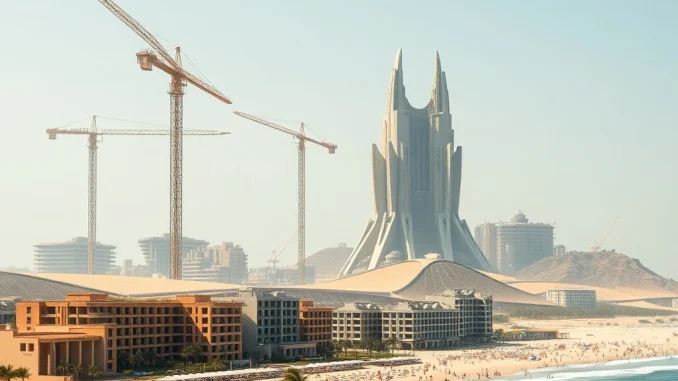
Remember the buzz around Akon City? The ambitious, multi-billion dollar crypto-powered utopia envisioned by global music star Akon in Senegal? For years, it captured headlines, promising a ‘real-life Wakanda’ fueled by the Akoin cryptocurrency. However, after seven years of grand promises and minimal progress, that futuristic dream has officially dissolved. Senegal has now made a decisive pivot, abandoning the sprawling crypto city project in favor of a more grounded, economically viable tourism hub.
Akon City’s Grand Vision: What Went Wrong?
Launched with much fanfare in 2018, Akon City was pitched as a revolutionary smart city, entirely powered by renewable energy and built on the foundation of Akon’s own digital currency, Akoin. The initial blueprint was nothing short of spectacular, promising:
- Solar-powered infrastructure
- A state-of-the-art hospital and university
- A vibrant marina and entertainment facilities
- Akoin as the exclusive medium of exchange for all transactions
Senegal even allocated a significant 136 acres of land near the village of Mbodiène in 2020 for this ambitious endeavor. Yet, despite the high-profile promotions and celebrity backing, tangible progress remained elusive. Years passed, and the ‘real-life Wakanda’ largely remained a concept. Construction delays became a recurring theme, and critical financial commitments were reportedly unmet. Ultimately, the grand vision for Akon City never materialized beyond a few modest structures like a youth center, a basketball court, and a small welcome facility. The gap between promise and reality grew too wide to ignore.
Why Did Senegal Abandon the Crypto Project?
The decision by Senegal to terminate the Senegal crypto project was not sudden but the culmination of years of frustration. The national tourism development agency, SAPCO, confirmed in 2024 that ‘The Akon City project no longer exists.’ This cancellation followed repeated construction delays, missed payments, and a final ultimatum issued to the project developers.
Senegal’s economic realities played a significant role in this pragmatic shift. The nation faces considerable economic pressures, including a state audit that revealed $7 billion in hidden liabilities under the previous administration. This has strained access to international credit and led to a freeze in IMF funding. In such a climate, a speculative, high-risk venture with little to show for its seven-year existence became untenable.
The contrast between the initial proposal and Senegal’s new direction is stark:
| Feature | Original Akon City Project | Revised Tourism Hub Plan |
|---|---|---|
| Project Value | $6 Billion | $1.2 Billion |
| Primary Focus | Crypto-powered smart city, Wakanda theme | Hotels, apartments, promenade, job creation |
| Funding Model | Relied on Akoin and speculative investment | Prioritizes private investment |
| Expected Impact | Futuristic living, blockchain innovation | 15,000 jobs (Phase 1), practical economic growth |
| Status | Terminated | Under development |
The Akoin Enigma: A Digital Currency’s Role in a Failed Utopia
At the heart of Akon’s ambitious city was Akoin, his proprietary cryptocurrency, intended to be the sole transactional currency within the city’s economy. The vision was for Akoin to empower Africans, provide financial inclusion, and facilitate seamless cross-border transactions. However, the token faced significant challenges from the outset.
- Limited Adoption: Despite promotional efforts, Akoin failed to gain widespread adoption or utility beyond its theoretical use within Akon City.
- Investor Skepticism: Early investors, drawn by the promise of a revolutionary project, have since voiced demands for refunds, reflecting a lack of confidence in the token’s future.
- Local Doubts: Residents near the proposed site expressed skepticism about unfulfilled promises, further highlighting the disconnect between the digital vision and ground-level realities.
The failure of Akoin to establish itself as a viable economic backbone for the project underscores a critical lesson: even with celebrity endorsement, a cryptocurrency’s success hinges on its practical utility, adoption, and a robust, deliverable ecosystem, not just speculative hype.
Lessons from a Crypto City Failure: What Can We Learn?
The collapse of this high-profile crypto city failure offers crucial insights for anyone interested in the intersection of blockchain technology, large-scale development, and national policy. It serves as a cautionary tale, highlighting several key challenges:
- Over-reliance on Unproven Technology: Basing a multi-billion dollar national development project on a nascent and unproven cryptocurrency, like Akoin, carries immense risk.
- Speculation vs. Sustainability: The project’s heavy reliance on speculative crypto ventures proved unsustainable in a resource-constrained environment. Real-world development requires tangible funding and a clear path to profitability, not just token appreciation.
- The Celebrity Factor: While celebrity backing can generate initial buzz, it doesn’t guarantee execution or long-term viability. Tangible progress and sound project management are paramount.
- Economic Realities: National development strategies must align with a country’s economic pressures and priorities. Senegal’s shift reflects a global trend of reevaluating high-risk infrastructure projects that lack concrete progress.
This outcome underscores the importance of due diligence, realistic timelines, and robust financial planning over grandiose, technology-driven visions that lack a solid foundation.
Senegal’s New Horizon: A Practical Tourism Hub Emerges
With the crypto city failure behind it, Senegal is now channeling its efforts into a more practical and immediate solution: a $1.2 billion tourism hub. This revised plan aims to transform the same site near Mbodiène into a bustling destination for visitors, focusing on established industries and tangible job creation.
The new initiative prioritizes private investment and is designed to generate significant employment opportunities. In its first phase alone, the project aims to create 15,000 jobs, offering a much-needed boost to the local economy. The blueprint includes:
- Modern hotels and apartment complexes
- A scenic promenade linked to a nearby lagoon
- Infrastructure designed to support a thriving tourism sector
Akon will retain 8 hectares of the original land for a scaled-down development, but the dream of a crypto-powered utopia has faded. This pivot highlights Senegal’s pragmatic approach, prioritizing localized, job-creating initiatives over ambitious, celebrity-driven schemes that failed to deliver.
The abandonment of Akon City marks a significant moment for the intersection of cryptocurrency and large-scale development. It serves as a stark reminder that while blockchain technology holds immense promise, real-world projects require more than just a bold vision and a celebrity endorsement. They demand concrete execution, financial prudence, and an alignment with national economic realities. Senegal’s shift to a tourism-focused model demonstrates a clear preference for practical, job-creating initiatives that offer immediate and tangible benefits to its citizens. The dream of a crypto utopia in Mbodiène may be over, but a new, more grounded future is now firmly in sight.
Frequently Asked Questions (FAQs)
What was Akon City?
Akon City was a proposed $6 billion futuristic, cryptocurrency-powered city in Senegal, envisioned by singer Akon. It aimed to be a sustainable smart city using Akoin as its primary currency, often dubbed a ‘real-life Wakanda.’
Why was Akon City canceled?
The project was canceled after seven years of significant delays, unmet construction commitments, and missed payments. Senegal’s government also cited economic challenges and the infeasibility of the speculative crypto-centric model as key reasons.
What is Akoin, and how was it related to Akon City?
Akoin (AKN) is a cryptocurrency created by Akon, intended to be the backbone of Akon City’s economy. It was designed to facilitate transactions within the city and empower financial inclusion in Africa, but it failed to gain widespread adoption or utility.
What will replace the Akon City project in Senegal?
The Senegalese government is transforming the site into a $1.2 billion tourism hub. This new plan will focus on building hotels, apartments, and a promenade, aiming to create 15,000 jobs in its first phase through private investment.
What lessons can be learned from the failure of Akon City?
The failure highlights the challenges of integrating speculative crypto ventures into national development strategies. It underscores the risks of over-reliance on unproven technologies, the importance of practical execution over celebrity hype, and the need for projects to align with a nation’s economic realities and job creation priorities.