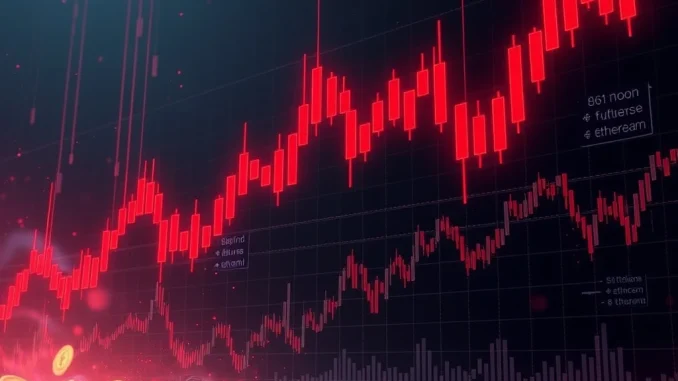
The cryptocurrency market experienced a dramatic event recently. Traders witnessed a staggering **crypto futures liquidations** total of $166 million within a mere 24-hour period. This significant sum reflects forced closures of leveraged positions across major digital assets. Such occurrences highlight the inherent risks and rapid shifts within the volatile crypto landscape. Therefore, understanding these market dynamics becomes crucial for every participant.
Understanding Crypto Futures Liquidations
Before delving into the specifics of this event, it is essential to grasp what **crypto futures liquidations** entail. Futures contracts allow traders to speculate on the future price of an asset. Perpetual futures, a popular type in crypto, do not have an expiry date. Traders use leverage, borrowing funds to amplify their potential gains. However, leverage also magnifies potential losses.
A liquidation occurs when a trader’s margin balance falls below the maintenance margin requirement. This happens due to adverse price movements against their position. Exchanges automatically close these positions to prevent further losses. Consequently, this protects both the trader and the exchange. These forced closures can trigger further price drops, creating a cascading effect.
There are two main types of liquidations:
- Long Liquidations: These occur when traders bet on a price increase (going long) but the asset’s price falls significantly.
- Short Liquidations: These happen when traders bet on a price decrease (going short) but the asset’s price rises unexpectedly.
The recent $166 million event involved both types, impacting a wide range of traders.
Bitcoin Liquidations Lead the Charge
During the recent 24-hour period, **bitcoin liquidations** constituted a substantial portion of the total. Specifically, BTC positions accounted for $73.64 million in forced closures. This figure represents a significant sum for the leading cryptocurrency. Furthermore, short positions comprised 56.64% of these Bitcoin liquidations. This means a majority of traders betting on a BTC price decline faced forced closure. Many anticipated a downward trend, but market movements proved otherwise. Therefore, these traders saw their positions automatically closed, leading to substantial losses. Such a large volume of liquidations often signals unexpected price reversals or heightened market uncertainty.
Ethereum and ZEC Face Significant Liquidations in the Perpetual Futures Market
Beyond Bitcoin, other major cryptocurrencies also experienced considerable liquidations. **Ethereum liquidations** reached $68.95 million. Interestingly, 58.58% of these were long positions. This indicates that a greater number of traders betting on an ETH price increase were liquidated. The price movement likely went against their bullish outlook. ETH, as the second-largest cryptocurrency, often mirrors BTC’s volatility but can also exhibit independent price action.
Zcash (ZEC) also saw a notable volume of liquidations, totaling $23.55 million. A striking 74.4% of ZEC liquidations were long positions. This suggests a strong bullish sentiment among ZEC futures traders that was abruptly challenged. The high percentage of long liquidations in both ETH and ZEC points to a market environment where upward bets faced significant pressure. This activity highlights the dynamic and often unpredictable nature of the **perpetual futures market**. Traders must remain vigilant, as sudden price shifts can rapidly erode leveraged positions.
Triggers Behind the Sudden Crypto Market Volatility
Several factors can contribute to such widespread **crypto futures liquidations**. Typically, a sudden price movement in the underlying assets triggers these events. This particular period likely saw unexpected market shifts. Macroeconomic news, regulatory announcements, or even large whale movements can initiate such volatility. For instance, a major sell-off could cascade, pushing prices lower and triggering long liquidations. Conversely, a rapid price pump could trigger short liquidations.
The interconnected nature of the crypto market means that a price change in one asset can affect others. This creates a domino effect across the **perpetual futures market**. When liquidations start, they can add selling pressure (for long liquidations) or buying pressure (for short liquidations). This further exacerbates price swings. Ultimately, this feedback loop can amplify initial market movements, leading to even more forced closures. Traders must therefore consider broader market sentiment and technical indicators.
The Broader Impact on Traders and Market Sentiment
These massive **crypto futures liquidations** have significant consequences. Individual traders who face liquidation often suffer substantial financial losses. This can erode their capital and deter future participation. Furthermore, such events can impact overall market sentiment. A large liquidation event often signals increased risk and uncertainty. This may lead to a more cautious approach from other traders and investors. Therefore, market participants might reduce their leverage or even exit positions.
The incident also serves as a stark reminder of the dangers of excessive leverage. While leverage offers the potential for high returns, it carries equally high risks. Prudent risk management strategies become paramount in such a volatile environment. Traders should always use stop-loss orders and manage their position sizes carefully. This helps mitigate potential losses during unforeseen market shifts.
Navigating the Future: Risk and Opportunity in Crypto Futures
The recent $166 million in **crypto futures liquidations** underscores the need for caution. The **perpetual futures market** remains an attractive venue for speculation. However, it demands a disciplined approach. Traders must conduct thorough research and understand the mechanisms of leveraged trading. Developing robust risk management protocols is not merely advisable; it is essential. This includes setting clear entry and exit strategies.
While such volatility presents risks, it also creates opportunities for experienced traders. Sharp price movements can lead to profitable trades for those who anticipate them correctly. However, predicting market turns is notoriously difficult. Consequently, a balanced strategy combining technical analysis with a keen awareness of market fundamentals is crucial. The market will undoubtedly continue its dynamic evolution, presenting both challenges and rewards.
The recent surge in **crypto futures liquidations** serves as a powerful reminder of the inherent risks in highly leveraged trading. With $166 million wiped out in just 24 hours, the event impacted thousands of traders across Bitcoin, Ethereum, and Zcash. While the **perpetual futures market** offers significant opportunities, it demands respect for its volatility. Traders must prioritize risk management and informed decision-making to navigate these turbulent waters successfully. Staying updated on market trends and employing disciplined strategies are key to enduring such dramatic market shifts.
Frequently Asked Questions (FAQs)
What are crypto futures liquidations?
Crypto futures liquidations occur when a trader’s leveraged position in a futures contract is automatically closed by an exchange. This happens because their margin balance falls below the required maintenance level, usually due to unfavorable price movements against their bet.
Why did $166 million in liquidations occur recently?
The $166 million in liquidations resulted from significant and rapid price movements in the cryptocurrency market over a 24-hour period. These unexpected shifts caused many leveraged long and short positions to become unprofitable, triggering automatic closures across various exchanges.
What is the difference between long and short liquidations?
Long liquidations happen when traders betting on a price increase (long position) face losses as the asset’s price drops. Short liquidations occur when traders betting on a price decrease (short position) are forced to close as the asset’s price unexpectedly rises.
How do these liquidations impact the broader crypto market?
Large liquidation events can intensify market volatility. They often add further selling pressure (from long liquidations) or buying pressure (from short liquidations), amplifying initial price movements. This can lead to increased market uncertainty and a more cautious sentiment among traders.
How can traders avoid liquidation in the perpetual futures market?
Traders can reduce the risk of liquidation by using lower leverage, setting stop-loss orders, maintaining sufficient margin in their accounts, and implementing sound risk management strategies. Diversifying portfolios and avoiding over-exposure to single assets also helps.
Which cryptocurrencies were most affected by these liquidations?
During this particular 24-hour period, Bitcoin (BTC) experienced the largest share of liquidations at $73.64 million, followed closely by Ethereum (ETH) with $68.95 million. Zcash (ZEC) also saw significant liquidations totaling $23.55 million.