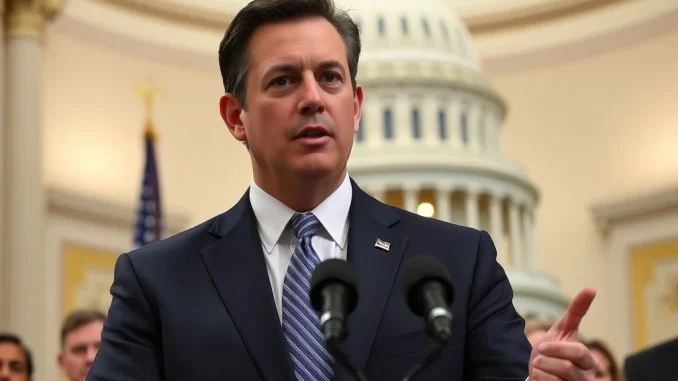
In a significant development for global financial markets, including the often-volatile cryptocurrency sector, **US House Speaker** Mike Johnson has announced a crucial breakthrough. He believes he has secured the necessary votes to pass a **stopgap funding bill**. This **legislative action** aims to avert an imminent **government shutdown**, a scenario that could introduce considerable uncertainty across various asset classes, including digital currencies. While not directly tied to crypto regulations, the stability of traditional financial systems often creates ripple effects, influencing investor sentiment and overall **market stability**.
US House Speaker Johnson’s Breakthrough Announcement
On a pivotal day in Washington D.C., **US House Speaker** Mike Johnson delivered a key statement. The top Republican in Congress expressed confidence in garnering sufficient support for a critical spending measure. This stopgap funding bill is designed to keep federal agencies operating beyond the current deadline. Consequently, this move signals a potential resolution to ongoing budget disputes. The Speaker’s declaration provides a moment of relief amid heightened concerns about federal appropriations. It demonstrates a strategic effort to navigate complex political divisions within the House of Representatives. This positive outlook from the Speaker suggests a path forward for federal operations.
Understanding the Stopgap Funding Bill
A **stopgap funding bill** serves as a temporary measure. It prevents a **government shutdown** when a full-year budget has not been approved. Such bills typically extend current funding levels for a short period. This allows lawmakers more time to negotiate a comprehensive budget agreement. Without this interim funding, many non-essential government services would cease. Federal employees could face furloughs. The current proposal seeks to maintain operations until a specified future date. This provides a buffer for further negotiations. It is a common tool used by Congress to avoid fiscal cliffs. Furthermore, it buys valuable time for bipartisan discussions.
Averting a Government Shutdown: Key Implications
The potential for a **government shutdown** looms large whenever budget deadlines approach. A shutdown can have widespread consequences. These include disruptions to federal services, economic uncertainty, and a potential loss of public trust. For financial markets, a shutdown often translates into increased volatility. Businesses might face delays in permits or contracts. Consumer confidence could also decline. The Speaker’s efforts to pass this **stopgap funding bill** are therefore critical. They aim to prevent these negative impacts. Such stability is generally viewed favorably by investors. It helps maintain predictable economic conditions. This, in turn, contributes to broader **market stability**.
Mike Johnson’s Leadership in Action
**Mike Johnson**, as the newly appointed **US House Speaker**, faces significant challenges. His ability to unite his caucus and secure votes is under constant scrutiny. This announcement marks an important test of his leadership. It demonstrates his capacity to navigate difficult legislative terrain. Johnson’s focus on securing these votes highlights his commitment. He aims to ensure government continuity. This move also reflects the intense pressure on congressional leaders. They must deliver results and avoid fiscal crises. His strategic maneuvering is essential for the legislative process. It sets a precedent for future budget negotiations.
Impact on Broader Market Stability
The successful passage of the **stopgap funding bill** directly contributes to overall **market stability**. Financial markets typically react negatively to political uncertainty. Avoiding a **government shutdown** removes a significant source of this uncertainty. This can reassure investors across various sectors. While direct impacts on cryptocurrency are often debated, general market sentiment plays a role. When traditional markets feel stable, investors might show more confidence. This confidence can sometimes spill over into riskier assets like crypto. Conversely, major economic disruptions can lead to a flight to safety. This often means selling off more volatile holdings. Therefore, a stable political environment indirectly supports a more predictable investment climate.
Legislative Action and Future Fiscal Debates
This latest **legislative action** is not an end in itself. Instead, it is a temporary solution. It sets the stage for future, more comprehensive fiscal debates. Congress will still need to pass full-year appropriations bills. These discussions will likely involve contentious issues. Disagreements over spending levels and policy riders are common. The current stopgap simply pushes these larger battles down the road. It provides a brief window for continued negotiation. Lawmakers must now leverage this time effectively. Their goal is to forge lasting budget agreements. The Speaker’s success with this bill offers momentum. However, significant work remains ahead for both parties.
The Cryptocurrency Connection: Indirect Effects
For cryptocurrency enthusiasts, political stability in major economies like the U.S. holds indirect but significant weight. A smooth-running government, free from the threat of shutdowns, fosters a general sense of economic predictability. This predictability is vital for institutional investors considering crypto allocations. Furthermore, continuous government operations mean regulatory bodies remain active. Agencies like the SEC and CFTC can continue their work. This includes developing frameworks for digital assets. Any disruption to these functions could introduce regulatory uncertainty. Such uncertainty can deter investment and innovation in the crypto space. Therefore, while not a direct crypto bill, this **legislative action** under **US House Speaker** Johnson contributes to an environment conducive to broader market health, which indirectly benefits crypto.
What Lies Ahead for Congress and the Budget
With the immediate crisis potentially averted by the **stopgap funding bill**, Congress now faces the larger task. They must finalize the full 12 annual appropriations bills. This process is complex and time-consuming. It involves numerous committees and intense negotiations. Lawmakers will need to reconcile differing priorities. These include defense spending, social programs, and infrastructure projects. The current agreement merely extends the deadline. It does not resolve underlying disagreements. The leadership of **US House Speaker** Mike Johnson will be crucial in guiding these future discussions. His ability to maintain bipartisan cooperation will be key. The outcomes will shape federal spending for the fiscal year.
Preventing Economic Headwinds: A Broader Perspective
Preventing a **government shutdown** goes beyond just federal services. It also prevents significant economic headwinds. Economists have repeatedly warned about the negative impacts. These include reduced GDP growth and job losses. The private sector relies on government functions. These range from data collection to contract processing. Disruptions can ripple through the economy. By securing votes for the **stopgap funding bill**, the **US House Speaker** helps mitigate these risks. This proactive **legislative action** supports a more stable economic outlook. It fosters an environment where businesses can plan with greater certainty. This positive economic climate is beneficial for all financial markets, including digital assets.
The announcement from **US House Speaker** Mike Johnson marks a pivotal moment. His confidence in passing a **stopgap funding bill** offers a sigh of relief. This crucial **legislative action** aims to prevent a damaging **government shutdown**. While the direct impact on cryptocurrency markets is indirect, the broader implications for **market stability** are undeniable. A stable political and economic environment generally fosters investor confidence. This can create favorable conditions for all asset classes, including digital currencies. As Congress moves forward, the focus will shift to securing long-term budget agreements. The ongoing efforts of the Speaker will remain central to these critical fiscal discussions.
Frequently Asked Questions (FAQs)
What is a stopgap funding bill?
A stopgap funding bill is a temporary measure passed by Congress. It provides short-term funding for federal government operations. This prevents a government shutdown when a full annual budget has not been approved by the deadline.
Who is US House Speaker Mike Johnson?
Mike Johnson is the current Speaker of the U.S. House of Representatives. He is the top Republican in Congress and plays a crucial role in legislative processes, including budget negotiations.
What are the immediate next steps after this vote?
If the stopgap funding bill passes, it will then move to the Senate for approval. Upon Senate passage and presidential signature, it will become law. This will extend government funding for a specified period, allowing more time for a comprehensive budget agreement.
How does government funding impact financial markets?
Government funding and the threat of a shutdown significantly impact financial markets. Uncertainty from potential shutdowns can lead to increased market volatility. Conversely, stable government operations contribute to investor confidence and overall market stability, benefiting various asset classes.
Could a government shutdown affect cryptocurrency markets?
While not directly affected, a government shutdown can indirectly impact cryptocurrency markets. It creates broader economic uncertainty and can lead to a ‘risk-off’ sentiment among investors. This sentiment often causes a sell-off in volatile assets, including cryptocurrencies, as investors seek safer havens.
Why is legislative action on the budget important for the economy?
Timely legislative action on the budget is vital for economic stability. It ensures essential government services continue, maintains economic predictability, and supports business operations. Avoiding shutdowns prevents economic disruptions like reduced GDP growth and job losses, fostering a healthier overall economy.