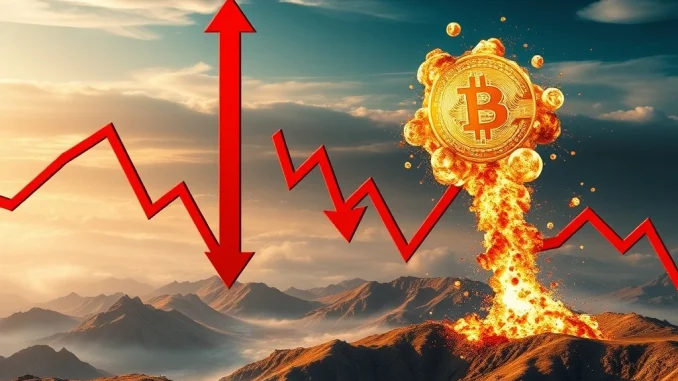
The cryptocurrency market often delivers unexpected turns. Recently, it delivered a powerful one. A **massive crypto futures liquidation** event just unfolded. Over the past 24 hours, the perpetual futures market saw staggering liquidations exceeding $220 million. This dramatic episode predominantly impacted traders holding short positions, catching many off guard.
Understanding the Massive Crypto Futures Liquidation
Liquidations are a common, albeit often painful, occurrence in the volatile world of crypto futures trading. They happen when a trader’s margin balance falls below the maintenance margin requirement. This forces the exchange to close the position. This prevents further losses. In this recent event, the sheer scale was notable. Over $220 million in leveraged positions were forcibly closed. This figure highlights significant **crypto market volatility**.
Moreover, the overwhelming majority of these liquidations were short positions. This indicates a sudden upward price movement or an unexpected surge against bearish bets. Traders who bet on falling prices faced severe consequences. This forced closure mechanism protects exchanges from credit risk. It also serves as a stark reminder of the risks involved in high-leverage trading.
Bitcoin Liquidation Leads the Charge
Unsurprisingly, **Bitcoin liquidation** accounted for the largest share of the total. BTC liquidations reached approximately $115 million within the 24-hour window. A staggering 91.35% of these were short positions. This suggests a strong, rapid price appreciation for Bitcoin. Many traders had positioned themselves for a downturn. The market, however, moved decisively in the opposite direction. This left many short-sellers vulnerable. This sudden shift often creates a cascade effect. It forces more shorts to close, further fueling the price rally. Bitcoin’s dominance in this liquidation event underscores its role as the market’s primary mover.
Indeed, Bitcoin’s price action can significantly influence altcoins. Therefore, a large Bitcoin liquidation often foreshadows broader market movements. Investors keenly watch these metrics. They offer insights into prevailing market sentiment and potential price reversals. This specific event demonstrates a strong bullish counter-move. It overwhelmed bearish sentiment in the short term.
Ethereum Liquidation: A Significant Contributor
Following Bitcoin, **Ethereum liquidation** figures were also substantial. ETH liquidations totaled $91.42 million. Similar to Bitcoin, 86.27% of these were short positions. Ethereum, as the second-largest cryptocurrency by market capitalization, often mirrors Bitcoin’s trends. However, its own ecosystem developments and specific catalysts can also drive its price. This significant liquidation volume indicates that many ETH traders also anticipated a price drop. They were similarly caught off guard by an upward price swing. Ethereum’s robust DeFi ecosystem and upcoming upgrades frequently contribute to its unique volatility profile. This event highlights that even established assets are subject to rapid price changes. It emphasizes the need for careful risk management.
Furthermore, the high percentage of short liquidations for both BTC and ETH points to a broader market misjudgment. Many traders were positioned bearishly. This collective bearish outlook proved incorrect. The market instead moved upwards, creating significant pressure on these leveraged bets. Such events are crucial for understanding market dynamics. They show where collective sentiment might be leaning, and how quickly it can be overturned.
Zcash and Other Altcoins Experience Short Squeeze
Beyond the major players, Zcash (ZEC) also experienced considerable liquidation activity. ZEC saw $14.47 million liquidated. Of this, 68.53% were short positions. While smaller in absolute terms compared to BTC and ETH, this figure is significant for Zcash. It reflects similar market dynamics affecting a broader range of cryptocurrencies. These smaller market cap assets can exhibit even greater volatility. They are more susceptible to large price swings. This is due to lower liquidity. The fact that shorts dominated here too suggests a widespread, albeit perhaps less coordinated, bearish sentiment across various digital assets. This sentiment was then swiftly challenged by market movements.
This widespread short liquidation across multiple assets suggests a ‘short squeeze’ scenario. A short squeeze occurs when a sudden price increase forces short sellers to buy back the asset. This covers their positions. This buying activity further pushes the price up. It then triggers more short liquidations. This creates a positive feedback loop. It can lead to rapid and significant price rallies. These events are often thrilling for long position holders. They are devastating for those on the wrong side of the trade.
The Mechanics of Short Positions and Liquidations
To fully grasp the impact of these events, understanding **short positions** is essential. When a trader opens a short position, they borrow an asset and sell it. They do this with the expectation that its price will fall. They plan to buy it back later at a lower price. Then they return the borrowed asset. The difference is their profit. However, if the price rises instead, the trader incurs losses. If these losses deplete their margin, the exchange liquidates their position. This is a forced sale to prevent further losses. The high percentage of short liquidations in this instance indicates that the market moved sharply against these bearish bets. Traders were caught off guard. This led to significant financial consequences for many.
Perpetual futures contracts are particularly prone to these events. Unlike traditional futures, they have no expiry date. This allows traders to hold positions indefinitely. However, they are subject to funding rates. They also face frequent margin calls. These factors, combined with leverage, amplify both potential gains and losses. This inherent structure contributes to periods of intense **crypto market volatility**. It creates an environment where liquidations can cascade rapidly. This is especially true during unexpected price movements.
Navigating Crypto Market Volatility
The recent liquidation event serves as a powerful reminder of the inherent **crypto market volatility**. While exciting, this volatility demands a robust risk management strategy. Traders often use leverage to amplify returns. However, leverage also amplifies losses. Therefore, understanding margin requirements and setting stop-loss orders are crucial. Diversifying portfolios can also mitigate risks. Avoiding over-leveraging is perhaps the most important lesson. This prevents sudden, forced liquidations. Market participants should also stay informed. Keep track of fundamental developments and technical indicators. This helps make more informed trading decisions. These strategies help navigate the unpredictable nature of digital asset markets.
Moreover, emotional discipline plays a vital role. The allure of quick profits can lead to irrational decisions. Panic selling or buying into hype can be detrimental. Successful traders often adhere to a predefined trading plan. They manage their emotions effectively. They recognize that market events like these liquidations are part of the landscape. They learn from them without succumbing to fear or greed. Ultimately, a cautious and well-informed approach is paramount in these dynamic markets.
The Broader Implications for the Crypto Market
This **crypto futures liquidation** event carries broader implications. It indicates a strong underlying demand. This demand pushed prices higher, despite prevailing bearish sentiment. Such events can sometimes signal a temporary bottom. Or they might precede a period of sustained recovery. The market effectively ‘cleaned out’ over-leveraged short positions. This could create a healthier, more stable environment for upward movement. However, it also highlights the speculative nature of derivatives trading. It reminds us that significant capital can be wiped out very quickly. This influences overall investor confidence and market perception. The resilience of Bitcoin and Ethereum in absorbing these liquidations is also noteworthy. It demonstrates their continued market dominance and liquidity.
Looking ahead, market participants will be watching for follow-through price action. Will the market sustain these gains? Or will it revert to previous trends? The answers will depend on various factors. These include macroeconomic conditions, regulatory developments, and institutional adoption. Regardless, this event will be analyzed closely. It provides valuable data points for future trading strategies. It reinforces the need for vigilance and adaptability in the fast-evolving crypto landscape.
In conclusion, the recent $220 million **crypto futures liquidation** event, dominated by **short positions** in Bitcoin, Ethereum, and Zcash, underscores the intense **crypto market volatility**. It highlights the inherent risks and rewards of leveraged trading. While painful for many, these events are integral to the market’s natural cycles. They offer crucial lessons in risk management and market dynamics for all participants.
Frequently Asked Questions (FAQs)
What is a crypto futures liquidation?
A crypto futures liquidation occurs when an exchange forcibly closes a trader’s leveraged position. This happens because their margin balance falls below the required maintenance margin. This prevents further losses. It also protects the exchange from potential credit risk.
Why did short positions dominate these liquidations?
Short positions dominated because the market experienced an unexpected upward price movement. Traders betting on falling prices (shorts) were caught off guard. As prices rose, their losses mounted. This triggered forced closures of their leveraged positions.
What does this event tell us about crypto market volatility?
This event strongly emphasizes the high crypto market volatility. It shows how quickly prices can change. It also demonstrates how rapidly large amounts of capital can be wiped out. This is especially true for leveraged positions.
How can traders avoid liquidation in crypto futures?
Traders can avoid liquidation by using proper risk management. This includes not over-leveraging, setting stop-loss orders, and maintaining sufficient margin. Diversifying investments and staying informed about market conditions also helps.
Is this liquidation event a sign of a market bottom?
While a large short liquidation can sometimes precede a price recovery by ‘cleaning out’ bearish bets, it is not a definitive sign of a market bottom. Further market analysis and other factors are needed to confirm such a trend.
What is the difference between Bitcoin and Ethereum liquidation in this context?
Both Bitcoin and Ethereum experienced significant liquidations, primarily from short positions. Bitcoin had the largest absolute volume at $115 million, while Ethereum followed with $91.42 million. Both illustrate similar market dynamics affecting major cryptocurrencies.