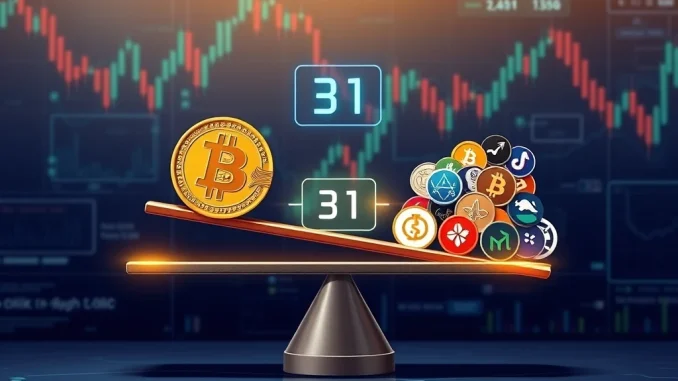
Understanding the dynamics of the cryptocurrency market is crucial for any investor. Currently, the Altcoin Season Index, a key metric for gauging market sentiment and asset performance, stands at 31. This figure offers a clear snapshot of prevailing crypto market trends, indicating that Bitcoin is presently outperforming the broader altcoin market. Consequently, this signals a ‘Bitcoin Season’ rather than an ‘Altcoin Season’ is in effect. Let’s delve into what this index means for cryptocurrency performance and what investors should consider.
Decoding the Altcoin Season Index
The Altcoin Season Index, provided by crypto data aggregator CoinMarketCap, serves as a vital barometer for the health of the altcoin market relative to Bitcoin. It offers an objective look at which segment of the crypto market holds the upper hand. The index meticulously compares the price performance of the top 100 cryptocurrencies, carefully excluding stablecoins and wrapped tokens to ensure a pure assessment. This comparison is conducted over a preceding 90-day period. Therefore, it provides a recent and relevant perspective on market shifts.
To qualify as an official “altcoin season,” a significant threshold must be met. Specifically, 75% of these top 100 altcoins must outperform Bitcoin during that 90-day timeframe. A score closer to 100 on the index clearly indicates a robust and widespread altcoin season. Conversely, a lower score, like the current 31, suggests a prevailing “Bitcoin Season.” This means Bitcoin is generally leading the market in terms of price gains.
What Does an Index of 31 Signify for Altcoins?
With the Altcoin Season Index currently at 31, the data points towards a period where Bitcoin’s dominance is more pronounced. This specific number is well below the 75-point threshold required to declare an official altcoin season. Thus, it confirms that most altcoins are not outperforming Bitcoin in recent months. Instead, Bitcoin is likely seeing stronger price appreciation or demonstrating greater stability compared to the broader altcoin market.
This situation typically arises due to several factors. For instance, institutional money often flows into Bitcoin first during periods of uncertainty or as a foundational investment. Also, Bitcoin’s established market position and larger market capitalization can make it a more attractive safe haven asset. Therefore, a score of 31 suggests investors are favoring Bitcoin. This preference impacts the overall cryptocurrency performance across the market. Consequently, many altcoins may experience stagnation or even declines while Bitcoin holds steady or gains value.
Understanding the Dynamics of Bitcoin Season vs. Altcoin Season
The crypto market often cycles between periods of Bitcoin dominance and altcoin outperformance. These cycles are commonly referred to as “Bitcoin Season” and “Altcoin Season.” Understanding these distinctions is fundamental for strategic investment decisions. A Bitcoin Season typically sees Bitcoin’s price surge, often drawing capital away from altcoins. During such times, altcoins may struggle to gain traction, and their prices might even decline against Bitcoin.
On the other hand, an Altcoin Season marks a period of widespread growth across various alternative cryptocurrencies. This usually occurs after Bitcoin has made significant gains and investors start seeking higher returns in smaller, more volatile assets. When 75% or more of the top 100 altcoins outperform Bitcoin over 90 days, we enter an Altcoin Season. This indicates a broad market rally for alternative digital assets. Therefore, the current index of 31 clearly positions the market in a Bitcoin-dominated phase. This phase can influence many investment decisions.
Factors Influencing Crypto Market Trends and Performance
Several critical factors can influence crypto market trends and shift the balance between Bitcoin and altcoins. Macroeconomic conditions play a significant role. For example, interest rate changes or global economic instability can push investors towards perceived safer assets like Bitcoin. Furthermore, regulatory news can have a profound impact. Positive regulatory developments often benefit the entire market, while negative news can cause widespread corrections.
Technological advancements and network upgrades within specific altcoin ecosystems can also trigger individual rallies. However, these are often isolated events. Broader market sentiment, often driven by fear or greed, also dictates investor behavior. Bitcoin’s halving events, occurring approximately every four years, historically precede bull markets, which eventually trickle down to altcoins. Therefore, observing these macro and micro factors helps predict shifts in the Altcoin Season Index.
Navigating the Current Bitcoin Season: Strategies for Investors
Given the current Altcoin Season Index reading of 31, investors might consider adjusting their strategies. During a prevailing Bitcoin Season, focusing on Bitcoin itself can be a prudent approach. Bitcoin often acts as a store of value and can offer more stability compared to the volatile altcoin market. Investors might also look for altcoins with strong fundamentals and unique use cases that could potentially weather a Bitcoin-dominated period. These projects often demonstrate resilience.
Diversification remains important, but the allocation might shift. For example, a higher percentage of a portfolio could be in Bitcoin, with a smaller, carefully selected portion in altcoins. Furthermore, dollar-cost averaging into promising altcoin projects can mitigate risk. This strategy involves investing a fixed amount regularly, regardless of price fluctuations. Staying informed about the latest crypto market trends and being patient are key virtues during these phases.
Looking Ahead: Potential Shifts in Cryptocurrency Performance
The cryptocurrency market is known for its rapid and often unpredictable shifts. While the Altcoin Season Index currently indicates a Bitcoin Season, this can change swiftly. Historically, periods of Bitcoin dominance are often followed by an eventual rotation of capital into altcoins. This rotation can trigger a new Altcoin Season. Key indicators to watch include Bitcoin’s price consolidation after a significant rally, increasing trading volumes in altcoin pairs against Bitcoin, and a general improvement in global economic conditions.
Investors should monitor fundamental developments within various altcoin projects. Breakthroughs in technology, increased adoption, or new partnerships could act as catalysts. Ultimately, the market remains dynamic. Therefore, continuous research and adaptability are essential for capitalizing on future shifts in cryptocurrency performance. The index provides a current view, but the future remains open to change. Thus, remaining vigilant is paramount.
Conclusion: The Altcoin Season Index as a Market Compass
The Altcoin Season Index, standing at 31, provides a clear and current perspective on the state of the crypto market. It confirms that we are currently in a “Bitcoin Season,” where Bitcoin’s performance generally outpaces that of most altcoins. This valuable metric, derived from the performance of the top 100 cryptocurrencies against Bitcoin over 90 days, acts as an essential compass for investors. Understanding its implications allows market participants to make more informed decisions. By staying aware of these overarching crypto market trends, investors can better navigate the complexities of digital asset investments. Ultimately, this leads to more strategic portfolio management. While the current score favors Bitcoin, the cyclical nature of the market suggests that an Altcoin Season will eventually return, making continuous monitoring vital.
Frequently Asked Questions (FAQs)
What is the Altcoin Season Index?
The Altcoin Season Index is a metric from CoinMarketCap that compares the price performance of the top 100 cryptocurrencies (excluding stablecoins and wrapped tokens) against Bitcoin over the preceding 90 days. It helps determine whether altcoins or Bitcoin are currently dominating the market.
How is an “Altcoin Season” declared?
An “Altcoin Season” is officially declared when 75% or more of the top 100 altcoins outperform Bitcoin in price performance over a 90-day period. A score closer to 100 on the index indicates a stronger altcoin season.
What does an Altcoin Season Index of 31 mean?
An index score of 31 means that less than 75% of the top 100 altcoins have outperformed Bitcoin in the last 90 days. This indicates a “Bitcoin Season,” where Bitcoin is generally showing stronger performance or stability compared to the broader altcoin market.
How do Bitcoin Season and Altcoin Season differ?
During a Bitcoin Season, Bitcoin’s price typically rises significantly, often drawing capital away from altcoins. In contrast, an Altcoin Season sees a widespread rally across many alternative cryptocurrencies, with most altcoins outperforming Bitcoin.
How should investors react to a low Altcoin Season Index?
In a period with a low Altcoin Season Index, investors might consider focusing more on Bitcoin for potential stability and growth. They may also seek out altcoins with strong fundamentals, unique use cases, and solid development roadmaps, while potentially reducing exposure to highly speculative altcoins. Diversification and dollar-cost averaging remain important strategies.