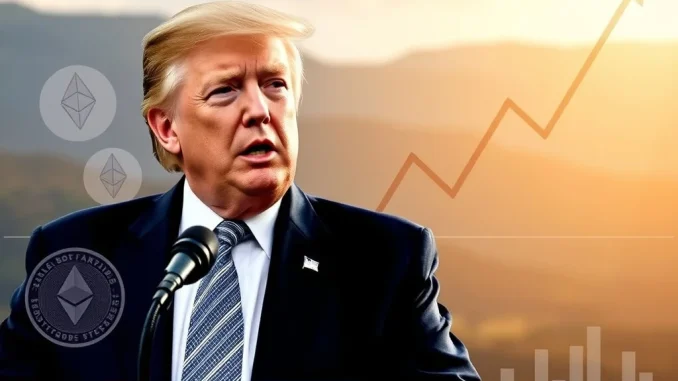
A significant statement from former President Donald Trump has recently captured the attention of financial markets and digital asset enthusiasts alike. He suggested that **cryptocurrency** could help ease pressure on the **US dollar**. This assertion marks a notable evolution in the discourse surrounding digital currencies and their potential role in global finance. It prompts a deeper examination of how **digital assets** might influence the traditional economic landscape, especially concerning the world’s reserve currency.
Understanding Trump’s Stance on **Trump Cryptocurrency** Views
President Trump’s recent comments represent a shift from his previously skeptical stance on digital currencies. Historically, he expressed concerns about their volatility and perceived lack of regulation. However, his latest remarks suggest a more nuanced understanding or at least an acknowledgment of their growing influence. This change in perspective is crucial. It brings the conversation about **Trump cryptocurrency** into mainstream political discourse with renewed vigor. His statement indicates a recognition that digital currencies are not merely a niche financial instrument but a factor with potential macroeconomic implications.
During his presidency, Trump’s administration often focused on strengthening the **US dollar**’s position globally. Therefore, any suggestion from him that an external force, like cryptocurrency, could ‘ease pressure’ on the dollar is noteworthy. It implies a potential recognition of underlying challenges facing the dollar or an acceptance of new financial paradigms. This statement has sparked considerable debate among economists and crypto proponents. Many observers now ponder the exact mechanisms through which digital assets could exert such an influence.
The Enduring Dominance of the **US Dollar** and Emerging Challenges
For decades, the **US dollar** has stood as the world’s primary reserve currency. Its stability, liquidity, and the strength of the American economy underpin this status. Most international trade, commodity pricing, and foreign exchange reserves are denominated in dollars. This dominance provides the United States with significant economic and geopolitical advantages. However, various factors have begun to introduce new complexities. Geopolitical shifts, global economic realignments, and the rise of alternative financial technologies contribute to these pressures.
Economists often discuss the ‘exorbitant privilege’ the dollar enjoys. This allows the U.S. to borrow more cheaply and exert greater influence over global finance. Nevertheless, this privilege also comes with responsibilities and vulnerabilities. High national debt, inflation concerns, and the weaponization of the dollar through sanctions have led some nations to seek alternatives. Consequently, the search for diversification from a dollar-centric system has gained traction. This context makes Trump’s comments about easing pressure particularly resonant.
How **Cryptocurrency Impact** Could Alleviate Financial Strain
The notion that cryptocurrency can ease pressure on the **US dollar** stems from several potential avenues of **cryptocurrency impact**. Firstly, digital assets offer alternative payment rails. They facilitate cross-border transactions without relying on traditional banking intermediaries. This can reduce transaction costs and processing times, particularly in international trade and remittances. Such efficiency could lessen the demand for the dollar in specific payment flows, thereby indirectly reducing some pressure.
Secondly, cryptocurrencies, especially stablecoins pegged to other assets or currencies, provide a hedge against inflation or currency devaluation in certain economies. In countries experiencing high inflation or political instability, citizens often turn to digital assets as a store of value. This reduces their reliance on local fiat currencies, and by extension, sometimes lessens the direct need for the dollar as the only alternative. Furthermore, the decentralized nature of many cryptocurrencies means they operate outside the direct control of any single government or central bank. This characteristic appeals to those seeking financial autonomy. It also introduces a new dimension to global financial stability. The **cryptocurrency impact** on financial autonomy is a key aspect.
The Role of **Digital Assets** in Global Diversification
The increasing acceptance of **digital assets** by institutional investors and corporations further illustrates their growing significance. Companies now hold Bitcoin on their balance sheets, and investment funds offer exposure to various cryptocurrencies. This institutional adoption signals a maturation of the market. It also suggests that digital assets are becoming a legitimate component of diversified investment portfolios. As more capital flows into these assets, they become more intertwined with the broader financial system. This diversification can naturally spread financial risk. It moves some reliance away from a singular dominant currency like the dollar.
Moreover, the development of Central Bank Digital Currencies (CBDCs) by various nations indicates a global move towards digitized national currencies. While distinct from decentralized cryptocurrencies, CBDCs reflect a broader trend of digitizing money. They could eventually compete with the dollar in international transactions. This competitive landscape, partly spurred by the innovation seen in private **digital assets**, could redistribute global financial influence. Consequently, it might contribute to easing the dollar’s singular burden as the world’s unchallenged reserve currency.
Examining the Broader **Economic Pressure** and Crypto’s Role
The term ‘easing pressure’ on the **US dollar** implies that the dollar currently faces certain **economic pressure**. This pressure can manifest in various forms. It includes concerns about inflation, geopolitical tensions leading to de-dollarization efforts, or the sheer scale of the U.S. national debt. Cryptocurrencies, while volatile, offer an alternative that, for some, represents a hedge against these traditional financial risks. For instance, in times of high inflation, some investors turn to Bitcoin as ‘digital gold.’ They perceive it as a store of value with a limited supply, unlike fiat currencies.
However, it is also important to acknowledge that the market capitalization of the entire cryptocurrency ecosystem remains a fraction of the global financial markets. Therefore, its immediate ability to significantly ease broad **economic pressure** on the dollar is debatable for some analysts. Nevertheless, the psychological impact and the long-term trend of adoption cannot be ignored. The mere existence and growth of a viable alternative financial system can subtly influence global economic dynamics. It encourages a more diversified and potentially resilient global financial architecture.
Future Outlook: The Interplay of Fiat and Digital Currencies
The future relationship between traditional fiat currencies and **digital assets** will likely be one of increasing integration and competition. Regulatory frameworks are evolving globally to accommodate these new technologies. Governments and central banks are exploring how to harness the benefits of blockchain technology while mitigating risks. This includes everything from consumer protection to financial stability concerns. Trump’s comments, therefore, add another layer to this complex and ongoing discussion. They highlight the growing recognition among political figures of cryptocurrency’s undeniable presence and potential impact.
Experts hold varied opinions on the extent of cryptocurrency’s influence. Some believe digital assets will fundamentally reshape global finance, gradually eroding the dollar’s dominance. Others argue that the dollar’s foundational strengths, such as the rule of law, military power, and economic size, will ensure its long-term supremacy. Regardless, the conversation initiated by figures like Trump signals a pivotal moment. It indicates that digital currencies have moved beyond the fringes. They are now a serious consideration in high-level economic and political discussions. This evolving narrative underscores the dynamic nature of global finance. It also emphasizes the transformative potential of blockchain technology.
President Donald Trump’s assertion that cryptocurrency can ease pressure on the **US dollar** is a significant development. It underscores the growing importance of **digital assets** in the global financial landscape. While the **US dollar** maintains its robust position, the rise of cryptocurrencies introduces new dynamics and potential avenues for diversification. This perspective suggests a future where digital currencies play an increasingly integrated role in global economics, influencing everything from trade to monetary policy. The ongoing discussion surrounding **Trump cryptocurrency** views and their broader **economic impact** will undoubtedly continue to shape financial discourse for years to come.
Frequently Asked Questions (FAQs)
Q1: What exactly did Donald Trump say about cryptocurrency and the US dollar?
A1: President Donald Trump stated that cryptocurrency helps to ease pressure on the U.S. dollar. This comment signifies a potential shift in his public stance on digital assets, acknowledging their growing influence in global finance.
Q2: How could cryptocurrency ease pressure on the US dollar?
A2: Cryptocurrency could ease pressure by offering alternative global payment systems, reducing reliance on dollar-denominated transactions. It also provides a potential hedge against inflation in some economies and diversifies global financial portfolios away from a sole reliance on the dollar.
Q3: Is this a change from Trump’s previous views on digital assets?
A3: Yes, this statement appears to be a notable evolution from his earlier skepticism. Previously, Trump expressed concerns about cryptocurrency’s volatility and lack of regulation. His latest remarks suggest a more accepting or at least acknowledging perspective on their role.
Q4: What is the US dollar’s current status in the global economy?
A4: The US dollar remains the world’s dominant reserve currency. It is widely used in international trade, commodity pricing, and as a primary component of foreign exchange reserves globally. Its strength is backed by the U.S. economy and financial system.
Q5: What are the broader implications of cryptocurrency’s growth for global finance?
A5: The growth of cryptocurrency implies a more diversified and potentially decentralized global financial system. It encourages innovation, challenges traditional banking structures, and could lead to a redistribution of financial influence among different currencies and digital assets over the long term.