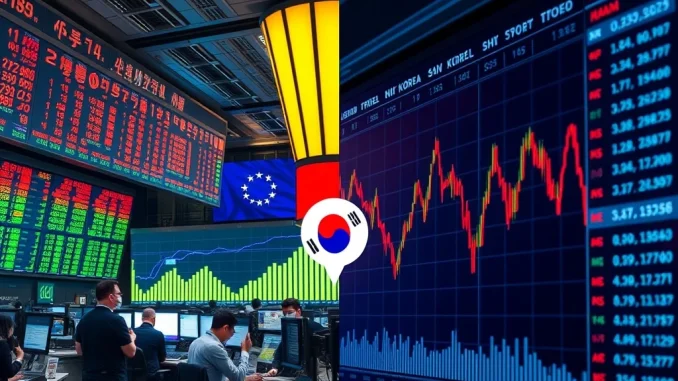
A stark contrast has emerged within South Korean financial markets. While the nation’s main stock index, the KOSPI, has seen its trading volume more than triple this year, the cryptocurrency market has experienced a significant downturn. This dramatic divergence highlights shifting investor sentiment Korea and presents a compelling case study in market dynamics.
The KOSPI Market Performance: A Surging Tide
Data from the Korea Exchange reveals a robust performance for the KOSPI. On November 3rd, the daily trading volume on the KOSPI reached an impressive 34.039 trillion won ($24.67 billion). This figure represents a staggering 207.57% surge from the 11.0669 trillion won ($8.02 billion) recorded on January 2nd, the first trading day of the year. Clearly, the **KOSPI market performance** has captured considerable investor interest. Investors are actively engaging with traditional equities, indicating a renewed confidence in established financial instruments.
Several factors likely contribute to this significant increase in **KOSPI volume**. Globally, economic recovery efforts have gained momentum. South Korea, a major exporter, benefits from improved global trade conditions. Government policies aimed at stimulating the economy may also play a role. Furthermore, specific sectors within the KOSPI, such as technology and manufacturing, have shown strong growth. These factors collectively draw in both institutional and retail investors, fueling the surge in trading activity.
South Korea Crypto Trading Volume: A Steep Decline
In stark contrast, the **South Korea crypto trading volume** has faced a substantial reduction. According to CoinGecko data, the combined 24-hour trading volume for the five largest South Korean cryptocurrency exchanges—Upbit, Bithumb, Coinone, Korbit, and Gopax—stood at 5.5724 trillion won ($4.04 billion) on November 3rd. This figure represents a 44.93% decline over the same period, illustrating a significant **crypto market decline South Korea**. The current crypto market’s trading volume is now equivalent to just 16.37% of the KOSPI’s, a remarkable shift in market dominance.
This substantial drop raises questions about the future trajectory of the **Korean crypto market**. Once a global hotspot for cryptocurrency trading, South Korea now observes a notable cooling off. The enthusiasm that once characterized the market has seemingly diminished. This trend suggests a broader re-evaluation among investors regarding digital assets. Consequently, many are shifting their focus to more traditional avenues.
Understanding the Divergence in Korean Financial Markets Trends
The stark difference in **Korean financial markets trends** can be attributed to several intertwined factors. On one hand, the traditional stock market often benefits from perceived stability and established regulatory frameworks. Investors may view equities as a safer bet during times of economic uncertainty or when seeking long-term growth. Moreover, companies listed on the KOSPI often have clear business models and tangible assets, which can instill greater confidence.
Conversely, the cryptocurrency market has faced significant headwinds. Regulatory uncertainty continues to plague the sector globally, and South Korea is no exception. While authorities aim to create a safer environment, evolving regulations can deter some investors. Furthermore, the global crypto bear market, characterized by price volatility and high-profile exchange failures like FTX, has eroded trust. These events have undoubtedly contributed to the **crypto trading volume decline** and a cautious approach from investors.
Impact on Investor Sentiment Korea
The change in **investor sentiment Korea** is palpable. Many retail investors who flocked to cryptocurrencies during the bull runs of previous years may have experienced significant losses. This experience can lead to fatigue and a preference for less volatile assets. Institutional adoption, while growing globally, has not yet provided the sustained catalyst needed to reinvigorate the South Korean crypto market to its former peaks. Investors are now prioritizing capital preservation and consistent returns, which traditional markets often provide.
Furthermore, access to sophisticated financial products in the traditional market has improved. This gives investors more options beyond speculative digital assets. As a result, capital is flowing back into conventional assets. This trend highlights a maturing financial landscape where diversification and risk management are becoming paramount for the average Korean investor.
The Road Ahead for South Korea’s Financial Landscape
What does this divergence mean for the future of **South Korean financial markets**? The KOSPI’s strong performance indicates a healthy appetite for traditional investments. This could lead to further capital inflows and potentially attract more foreign investment. For the **Korean crypto market**, the path forward seems more challenging. A sustained recovery might require clearer regulatory frameworks, innovative product offerings, and a renewed global bull market.
The current situation serves as a critical reminder of market cycles and the distinct risk profiles of different asset classes. While the **South Korea crypto trading volume** has significantly decreased, the underlying technology of blockchain continues to evolve. However, investor confidence in speculative assets requires time to rebuild. Regulators and industry participants must work together to foster a secure and transparent environment to regain trust and encourage sustainable growth in the digital asset space.
Ultimately, the contrasting fortunes of the KOSPI and the cryptocurrency market reflect a period of recalibration for investors in South Korea. They are carefully weighing risk versus reward in a dynamic global economic climate. This period of adjustment will likely shape the country’s financial landscape for years to come.
Frequently Asked Questions (FAQs)
Q1: What is the main reason for the decline in South Korea crypto trading volume?
The primary reasons include a global cryptocurrency bear market, increased regulatory uncertainty within South Korea, and a shift in investor sentiment away from high-risk speculative assets towards more traditional, stable investments.
Q2: Why has KOSPI market performance tripled this year?
The KOSPI’s surge is likely due to several factors: global economic recovery hopes, supportive government policies, strong performance in key South Korean export sectors like technology and manufacturing, and increased retail investor participation in traditional equities.
Q3: How significant is the crypto market decline in South Korea compared to the KOSPI?
On November 3rd, the combined 24-hour trading volume for South Korea’s top five crypto exchanges was just 16.37% of the KOSPI’s daily trading volume, highlighting a dramatic and significant disparity.
Q4: What are the implications of these Korean financial markets trends for investors?
These trends suggest that investors in South Korea are currently favoring traditional assets for stability and perceived safety. It indicates a more cautious approach to risk, potentially leading to greater capital allocation towards established stock markets over volatile digital assets.
Q5: Will the South Korea crypto trading volume recover in the near future?
A recovery in South Korea crypto trading volume depends on various factors, including a global rebound in cryptocurrency prices, clearer and more favorable regulatory frameworks, and renewed investor confidence. The timing of such a recovery remains uncertain.