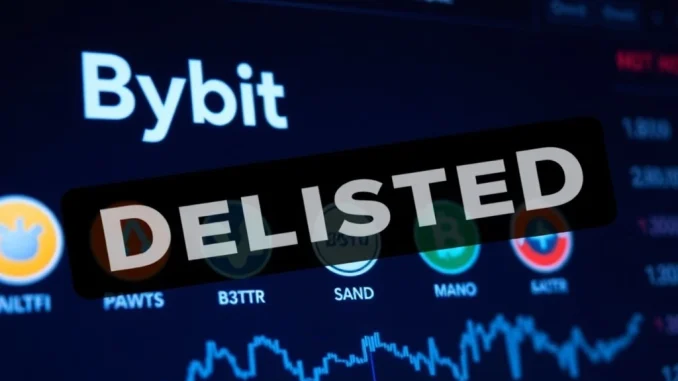
Cryptocurrency exchange Bybit has announced a significant update for its users. The platform will delist seven specific spot trading pairs, impacting a range of digital assets. This move, a common practice in the dynamic crypto market, requires immediate attention from traders holding these particular tokens. The effective date for this Bybit delisting is November 7, 2023, at 8:00 a.m. UTC.
Bybit Delisting Details Revealed
Bybit’s decision affects several assets, prompting traders to review their portfolios. The exchange aims to maintain a healthy and efficient trading environment. Consequently, certain pairs no longer meet the platform’s listing criteria. Therefore, they face removal from the spot market. Traders should mark their calendars for the specified delisting time.
The following pairs are scheduled for delisting:
- GALFT/USDT
- PIXFI/USDT
- PAWS/USDT
- B3TR/USDT
- B3TR/USDC
- SAND/BTC
- MANA/BTC
This comprehensive list includes both USDT-denominated and BTC-denominated pairs. Thus, a broad spectrum of traders will experience direct effects. The announcement serves as a critical piece of Bybit news for anyone involved with these tokens.
Impact on Spot Trading Pairs
A delisting directly impacts the liquidity and accessibility of the affected assets. When a spot trading pair is removed, users can no longer buy or sell those assets against each other on Bybit’s spot market. This change necessitates prompt action. Traders holding these assets must decide whether to sell them before the deadline or withdraw them to another platform.
The immediate consequence is reduced trading options. Furthermore, the market price of these assets might experience volatility as the delisting date approaches. This often occurs due to increased selling pressure. Traders should closely monitor their holdings and plan their next steps carefully. Understanding these implications is vital for managing crypto portfolios effectively.
Understanding Crypto Delisting Decisions
Exchanges perform a crypto delisting for various reasons. These decisions are rarely arbitrary. Instead, they typically follow a thorough review process. Several factors influence an exchange’s choice to remove a trading pair. Maintaining a secure and efficient trading environment remains a top priority.
Common reasons for delisting include:
- Low Liquidity: Pairs with insufficient trading volume can create poor user experience and make price discovery difficult.
- Project Viability: If a project shows signs of abandonment, technical issues, or fails to meet development milestones, it may be delisted.
- Regulatory Concerns: Changes in regulatory landscapes can force exchanges to delist assets that no longer comply with local laws.
- Security Issues: Vulnerabilities in smart contracts or network security can lead to a delisting to protect users.
- Community Feedback: Sometimes, negative community sentiment or reports of fraudulent activity can trigger a review.
Bybit, like other major exchanges, regularly assesses its listed assets. This ensures a high standard for its trading offerings. Therefore, such announcements are part of routine market adjustments.
What This Means for GALFT USDT Holders
Specifically, users holding GALFT USDT, PIXFI, PAWS, B3TR, SAND, and MANA on Bybit must act. While spot trading ceases, withdrawals typically remain available for a period. Bybit usually provides a grace period for users to transfer their delisted assets. However, this period is finite.
Users should check Bybit’s official announcement for precise withdrawal deadlines. If you hold these tokens, you have a few options:
- Sell before the deadline: Convert your delisted assets into other cryptocurrencies or stablecoins on Bybit’s spot market before November 7.
- Withdraw to another exchange: Transfer your tokens to a different exchange that still lists the specific trading pair.
- Withdraw to a private wallet: Move your assets to a personal hardware or software wallet for safekeeping.
Acting promptly avoids potential complications or loss of access to your funds. Always verify wallet addresses and network compatibility during transfers.
Navigating Bybit News and Future Trading
Staying informed about Bybit news and broader market developments is crucial for all traders. Exchange announcements often contain vital information that directly impacts investment strategies. Regularly checking official channels, such as the Bybit announcement page or their social media, is highly recommended. This proactive approach helps traders adapt to market changes efficiently.
Furthermore, this delisting highlights the importance of diversification. Relying too heavily on a single asset or exchange can expose traders to unnecessary risks. A well-diversified portfolio helps mitigate the impact of individual asset delistings. Always conduct thorough research before investing in any cryptocurrency. Understanding the project’s fundamentals and liquidity across various exchanges is key to making informed decisions.
In conclusion, Bybit’s upcoming delisting of seven spot trading pairs marks an important operational adjustment. Traders holding GALFT/USDT, PIXFI/USDT, PAWS/USDT, B3TR/USDT, B3TR/USDC, SAND/BTC, and MANA/BTC must take action before November 7, 2023. Understanding the reasons behind a crypto delisting and knowing how to respond ensures minimal disruption to your trading activities. Stay vigilant and prioritize the security of your assets.
Frequently Asked Questions (FAQs)
Q1: When exactly will Bybit delist these spot trading pairs?
The delisting will occur on November 7, 2023, at 8:00 a.m. UTC. After this time, trading for the affected pairs will cease on Bybit’s spot market.
Q2: Which specific pairs are affected by this Bybit delisting?
The seven affected pairs are GALFT/USDT, PIXFI/USDT, PAWS/USDT, B3TR/USDT, B3TR/USDC, SAND/BTC, and MANA/BTC.
Q3: What should I do if I hold GALFT USDT or other delisted assets on Bybit?
You have two main options: sell your assets on Bybit before the delisting deadline, or withdraw them to another exchange or a private wallet. Ensure you check Bybit’s official announcement for specific withdrawal deadlines.
Q4: Why do cryptocurrency exchanges like Bybit perform a crypto delisting?
Exchanges delist assets for various reasons, including low trading volume and liquidity, concerns about the project’s development or viability, regulatory compliance issues, or security vulnerabilities.
Q5: Will I still be able to withdraw my delisted tokens after November 7?
Typically, Bybit provides a grace period for withdrawals after a delisting. However, this period is limited. Always refer to the official Bybit announcement for the exact withdrawal window and any specific instructions.
Q6: How can I stay informed about future Bybit news and updates?
You can stay informed by regularly checking Bybit’s official announcement page, their blog, and their official social media channels. Subscribing to their newsletters can also provide timely updates.