Global financial markets constantly react to geopolitical shifts. Indeed, major policy decisions can create significant ripple effects across various asset classes, including cryptocurrencies. A recent development involving the Trump administration highlights this interconnectedness. This move impacts international commerce and, consequently, the broader economic landscape that digital assets navigate.
Trump Administration Pauses Expansion of China Sanctions
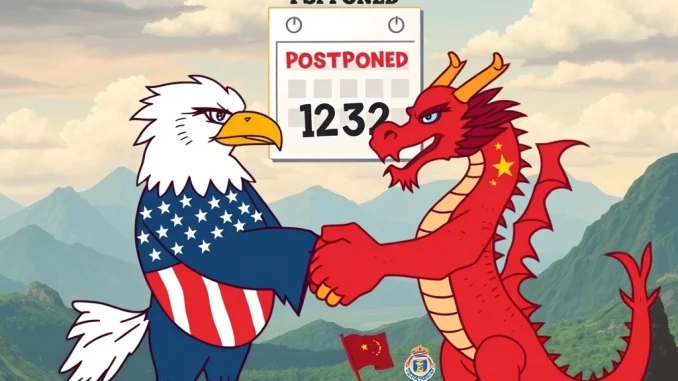
The **Trump administration** recently agreed to postpone a significant rule. This rule would have expanded the list of Chinese companies subject to Commerce Department sanctions. Walter Bloomberg reported this delay, confirming the one-year extension. Consequently, this decision offers a temporary reprieve in the ongoing complex **US-China trade** dynamics. Such a pause provides breathing room for various stakeholders involved in international business.
This delay directly affects numerous Chinese entities. These companies would have faced stricter controls on their access to American technology and markets. Furthermore, the Commerce Department’s Entity List identifies foreign entities. These entities are deemed to pose a national security risk or foreign policy concern. Inclusion on this list restricts their ability to purchase certain U.S. goods and technologies. Therefore, delaying this expansion carries considerable weight for bilateral **trade relations**.
Understanding the Scope of China Sanctions
The existing framework of **China sanctions** targets specific companies. These often operate in strategic sectors like technology, telecommunications, and defense. Historically, these measures aim to address concerns about intellectual property theft, human rights, and national security. The proposed expansion would have added more firms to this restrictive list. This would tighten the economic pressure on Beijing significantly. Instead, the one-year delay offers a different path.
The Commerce Department plays a pivotal role in implementing these restrictions. It assesses potential threats and enforces compliance. Moreover, these sanctions are not merely symbolic. They have tangible effects on supply chains and global commerce. Many companies must reassess their operations and partnerships. Thus, the delay allows businesses to prepare for potential future changes. It also provides time for diplomatic engagement.
Implications for US-China Trade and Global Markets
This decision by the **Trump administration** carries substantial implications for **US-China trade**. First, it temporarily eases tensions. This could foster a more stable environment for negotiations. Second, it offers certainty to companies operating in both countries. They can plan with less immediate threat of new restrictions. Conversely, some critics might view the delay as a missed opportunity to exert pressure. However, it also prevents immediate escalation.
Global markets often react sensitively to US-China relations. Positive developments or de-escalations can boost investor confidence. Conversely, increased tensions often lead to market volatility. The delay could be interpreted as a step towards stability. It potentially signals a desire for continued dialogue. Businesses across various sectors, including technology and manufacturing, closely watch these developments. Their supply chains often span both nations.
Broader Economic Policy Considerations
The decision reflects broader **economic policy** considerations within the administration. Officials must balance national security interests with economic stability. Imposing widespread sanctions can disrupt global supply chains. They can also harm American businesses reliant on Chinese markets or components. Therefore, a delay might indicate a strategic recalibration. It suggests a careful weighing of costs and benefits.
Furthermore, international diplomacy often influences such decisions. Allies of the United States might have expressed concerns about the impact of expanded sanctions. Coordinated international approaches are often more effective. Unilateral actions can sometimes isolate a country. This delay might represent an effort to build consensus or manage international partnerships more effectively. Ultimately, the administration seeks to achieve its objectives through various means.
The Future of Trade Relations and Geopolitics
Looking ahead, the one-year delay reshapes the immediate future of **trade relations** between the U.S. and China. It opens a window for further negotiations. Both nations can use this time to address outstanding issues. These issues include trade imbalances, market access, and intellectual property protections. However, the underlying tensions remain. The delay does not resolve fundamental disagreements.
Analysts will closely monitor how this period is utilized. Will it lead to substantive progress in trade talks? Or will it merely push difficult decisions further down the road? The geopolitical landscape remains dynamic. Future actions from both Washington and Beijing will determine the long-term trajectory. This includes the potential for new rounds of **China sanctions** or other trade measures. The global economy, including the cryptocurrency sector, thrives on predictability. Therefore, these developments warrant careful observation.
In conclusion, the Trump administration’s decision to delay expanding China sanctions marks a significant, albeit temporary, pause. It offers a period of reduced immediate pressure in the complex US-China relationship. This move influences not only direct trade but also broader global economic stability. Market participants across all sectors, including the burgeoning digital asset space, should continue monitoring these evolving geopolitical and economic dynamics closely.
Frequently Asked Questions (FAQs)
What is the main news about the Trump administration and China sanctions?
The Trump administration has agreed to delay for one year the implementation of a rule that would expand the list of Chinese companies subject to Commerce Department sanctions.
Which companies are affected by these China sanctions?
The sanctions primarily target Chinese companies deemed to pose national security risks or foreign policy concerns by the U.S. Commerce Department. The delayed rule would have added more firms to this existing list.
Why did the Trump administration delay the expansion of sanctions?
The exact reasons are not fully disclosed, but such delays often stem from a desire to ease diplomatic tensions, allow for further negotiations on **US-China trade**, or weigh the broader implications for global **economic policy** and supply chains.
How does this delay impact US-China trade relations?
The delay offers a temporary reprieve, potentially easing immediate tensions and providing more stability for businesses involved in **US-China trade**. It creates a window for further dialogue rather than immediate escalation of restrictive measures.
What are the broader implications for the global economy?
This decision can contribute to global market stability by reducing immediate uncertainty in **trade relations** between two major economic powers. It allows businesses and investors to plan with less immediate risk of new trade barriers, indirectly influencing global asset markets.
Will these China sanctions eventually be expanded?
The delay is for one year, meaning the expansion could still occur after this period. The future of these **China sanctions** will depend on ongoing geopolitical developments and the state of **trade relations** between the U.S. and China.