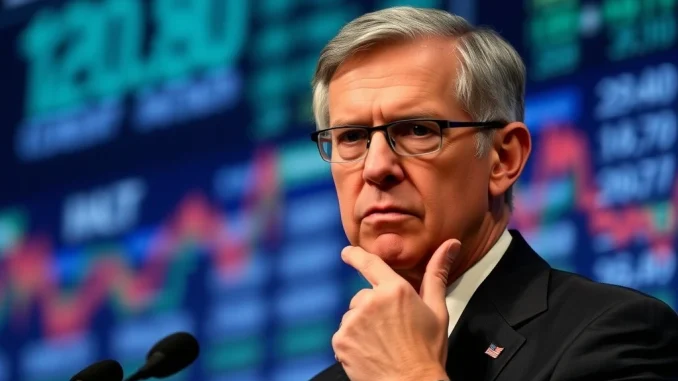
Cryptocurrency investors, like all market participants, closely monitor macroeconomic signals. Specifically, actions from the Federal Reserve significantly influence global financial markets. Recent statements from Federal Reserve Chair Jerome Powell highlight a crucial challenge. He indicated that a scarcity of reliable economic data could compel the central bank to slow its planned policy adjustments. This news carries weight for anyone tracking market stability and future financial trends.
Federal Reserve Policy: Powell Signals Potential Delays
Federal Reserve Chair Jerome Powell recently addressed the implications of insufficient information. He stated that a lack of critical economic indicators, such as comprehensive employment figures, might force the central bank to adjust its approach. This situation stems largely from disruptions like government shutdowns, which impede the collection and release of vital statistics. Consequently, the Fed faces a dilemma: how to make informed decisions without a complete picture. Powell expressed hope for more robust and comprehensive economic data by December, which would allow for clearer policy direction.
Moreover, the pace of future Federal Reserve policy adjustments could be directly affected. These adjustments typically involve changes to interest rates and other monetary tools. A slowdown implies a period of heightened uncertainty for markets. Investors, therefore, watch these developments closely. They seek clarity on how the Fed will navigate this data vacuum. This ongoing situation underscores the importance of timely and accurate economic reporting.
The Critical Role of Economic Data
Why is economic data so important for the Federal Reserve? The Fed relies on a broad range of statistics to gauge the health of the economy. Key indicators include:
- Employment figures: These show job creation, unemployment rates, and wage growth.
- Inflation reports: These measure price stability and the purchasing power of the dollar.
- GDP growth: This indicates overall economic output and expansion.
- Consumer spending: This reflects household demand and confidence.
Without this information, the Fed operates with blind spots. It becomes harder to assess economic strengths or weaknesses accurately. For example, if employment data is missing, the Fed cannot properly evaluate labor market conditions. This directly impacts decisions regarding monetary policy. Thus, the absence of reliable data can lead to more cautious and potentially delayed actions by the central bank. This cautious approach can ripple through various financial sectors.
Jerome Powell’s Stance on Monetary Policy
Jerome Powell consistently emphasizes a data-dependent approach to monetary policy. The Federal Reserve’s dual mandate involves two primary goals: maximizing employment and maintaining price stability. To achieve these, the Fed must have a clear understanding of current economic conditions. Powell’s recent remarks underscore the difficulty of fulfilling this mandate when essential information is unavailable. He suggests that prudence dictates a slower pace of action until the economic landscape becomes clearer.
Furthermore, this cautious stance aims to prevent missteps. Premature policy changes based on incomplete data could have unintended consequences. Such actions might either stifle economic growth or allow inflation to accelerate. Therefore, the Fed prioritizes waiting for robust data. This ensures that any adjustments to interest rates or other tools are well-informed and targeted. Market participants understand this rationale, yet they still crave certainty.
Understanding Future Interest Rates and Market Impact
The discussion around policy adjustments often centers on interest rates. The federal funds rate influences borrowing costs across the economy. Changes to this rate impact everything from mortgage rates to business loans. If the Fed slows its pace of adjustments, it means potential stability in current interest rates for a longer period. However, it also signifies underlying uncertainty about the economy’s true direction.
This prolonged uncertainty can affect investor sentiment. Markets generally prefer predictability. When the future path of monetary policy is unclear, investors may become more hesitant. This hesitancy can lead to reduced trading volumes or increased volatility across asset classes, including digital assets. Therefore, while a slower pace might prevent abrupt shifts, it also extends the period of ‘wait and see’ for many. Everyone awaits the comprehensive economic data Powell hopes to receive.
In conclusion, Federal Reserve Chair Jerome Powell’s comments highlight a significant challenge. The absence of comprehensive economic data due to external factors could indeed slow the pace of Federal Reserve policy adjustments. This situation creates a period of caution for the central bank. It also introduces uncertainty for financial markets, impacting future expectations for interest rates and broader economic stability. All eyes remain on upcoming data releases to provide the clarity needed for the Fed’s next steps.
Frequently Asked Questions (FAQs)
Q1: What is the primary concern raised by Jerome Powell?
A1: Jerome Powell’s main concern is that a lack of comprehensive economic data, such as employment indicators, could force the Federal Reserve to slow the pace of its policy adjustments, leading to greater uncertainty.
Q2: Why is economic data so important for the Federal Reserve?
A2: The Federal Reserve relies on robust economic data (like employment, inflation, and GDP) to make informed decisions about monetary policy. This data helps them assess economic health and achieve their dual mandate of maximum employment and price stability.
Q3: How might a slowdown in Federal Reserve policy adjustments impact interest rates?
A3: A slowdown in policy adjustments means that current interest rates might remain stable for a longer period. However, it also indicates underlying economic uncertainty, which can affect future expectations and market sentiment.
Q4: What does “policy adjustments” mean in this context?
A4: In this context, “policy adjustments” primarily refers to changes the Federal Reserve makes to its monetary policy tools, most notably the federal funds rate, which influences borrowing costs throughout the economy.
Q5: When does Jerome Powell hope to have more comprehensive data?
A5: Jerome Powell expressed hope that the Federal Reserve would have more comprehensive economic data available by December to guide its future policy decisions.