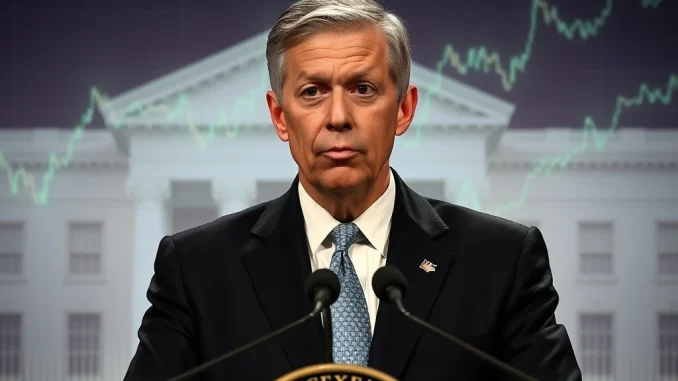
The highly anticipated press conference featuring **Fed Chair Powell** has concluded, leaving financial markets, including the dynamic cryptocurrency sector, to digest the implications. Investors and analysts across the globe intently monitored his remarks for signals regarding the future direction of monetary policy. This address often provides critical insights into the Federal Reserve’s economic strategy. Consequently, understanding these statements is vital for predicting market movements.
Fed Chair Powell Concludes Press Conference: Key Takeaways
During the recent press conference, **Fed Chair Powell** articulated the Federal Reserve’s latest economic assessments and future intentions. He emphasized the Fed’s commitment to achieving its dual mandate: maximum employment and price stability. Furthermore, his statements clarified the central bank’s perspective on current economic conditions. Key areas of discussion included the trajectory of inflation, the strength of the labor market, and the overall health of the U.S. economy. Analysts were particularly keen on any shifts in rhetoric. Thus, these remarks carry significant weight for market participants.
Understanding the Federal Reserve Policy Stance
The **Federal Reserve policy** continues to adapt to evolving economic data. Powell reiterated the data-dependent approach guiding decisions on interest rates and quantitative easing. The central bank evaluates a broad range of indicators, including consumer spending, business investment, and international economic developments. This comprehensive assessment informs their strategic direction. Therefore, investors carefully analyze these signals. The Fed aims to navigate economic challenges while fostering sustainable growth. Their policy choices directly influence lending costs and investment sentiment.
Here are the primary components influencing current Federal Reserve policy:
- Inflation Targets: The Fed targets 2% inflation over the longer run, considering both supply and demand factors.
- Employment Levels: Full employment remains a key objective, measured by various labor market metrics.
- Economic Growth: The committee assesses GDP growth and its sustainability.
- Global Conditions: International economic trends also inform domestic policy decisions.
The Shifting Interest Rate Outlook
A central theme of the press conference revolved around the **interest rate outlook**. Powell provided guidance on the potential path for the federal funds rate, a benchmark for borrowing costs throughout the economy. While the Fed seeks to manage inflation, it also aims to avoid stifling economic activity. His comments suggested a cautious approach, balancing these competing objectives. Consequently, market participants adjusted their expectations for future rate hikes or cuts. This sensitivity highlights the importance of Fed communications. Changes in interest rates directly affect everything from mortgages to corporate loans.
Moreover, the ‘dot plot,’ which illustrates individual FOMC members’ projections for the federal funds rate, offers further insight. This visual representation helps to gauge the committee’s collective thinking. Investors closely scrutinize any deviations from previous projections. Therefore, the **interest rate outlook** remains a critical determinant of market sentiment. A hawkish stance typically implies higher rates, while a dovish one suggests lower rates or a pause.
Navigating Inflation Forecasts and Economic Projections
The **inflation forecast** was another critical element of Powell’s address. He discussed the Fed’s updated projections for consumer price increases and their confidence in bringing inflation back to the 2% target. Supply chain issues, geopolitical events, and domestic demand all contribute to inflationary pressures. The Fed acknowledges these complexities. Their projections often include a timeline for achieving price stability. This forward guidance helps businesses and consumers plan. Thus, understanding the Fed’s inflation outlook is crucial for long-term financial planning.
Powell also shared broader economic projections, including GDP growth and unemployment rates. These forecasts provide a comprehensive picture of the Fed’s economic assessment. Stronger growth and lower unemployment typically indicate a healthy economy. However, persistent inflation can complicate this picture. Therefore, the interplay between growth, employment, and inflation dictates the Fed’s strategic responses. These projections serve as a roadmap for monetary policy adjustments.
Cryptocurrency Reaction: Immediate and Long-Term Impact
The **cryptocurrency reaction** to **Fed Chair Powell**’s statements is often swift and significant. Digital assets, particularly Bitcoin and Ethereum, are sensitive to macroeconomic shifts. When the Fed signals a tighter monetary policy, such as higher interest rates, it typically leads to a ‘risk-off’ sentiment. This means investors may move away from speculative assets like cryptocurrencies. Conversely, a more accommodative stance can fuel ‘risk-on’ behavior, potentially boosting crypto prices. Therefore, the correlation between traditional financial policy and crypto markets is undeniable.
Many investors view Bitcoin as a hedge against inflation. However, in periods of aggressive rate hikes, its price can still suffer. This is because higher interest rates increase the attractiveness of less risky assets, like bonds. Furthermore, the cost of borrowing increases, impacting liquidity across all markets. Consequently, the **cryptocurrency reaction** to these macro signals requires careful observation. Digital asset traders constantly monitor these announcements for potential market volatility.
What Powell’s Remarks Mean for Digital Assets
Powell’s comments on the **interest rate outlook** and **inflation forecast** directly influence the perceived value of digital assets. If the Fed maintains a hawkish posture, indicating further rate increases, it could sustain downward pressure on crypto valuations. This environment makes it more expensive to hold non-yielding assets. On the other hand, any indication of a dovish pivot, such as a pause or future rate cuts, could signal renewed enthusiasm for risk assets. This shift might then catalyze a positive **cryptocurrency reaction**.
Moreover, the broader economic projections shared by the Fed affect investor confidence. A strong, stable economic outlook could provide a more favorable backdrop for crypto adoption and growth. Conversely, fears of a recession, often influenced by Fed policy, might lead to reduced investment in speculative markets. Therefore, the overall economic narrative presented by **Fed Chair Powell** is a critical input for crypto market analysis. Traders and long-term holders alike consider these factors when making investment decisions.
In conclusion, **Fed Chair Powell**’s press conference provides essential guidance for navigating the complex financial landscape. His remarks on **Federal Reserve policy**, the **interest rate outlook**, and the **inflation forecast** reverberate across all asset classes. The **cryptocurrency reaction** serves as a clear indicator of how these macroeconomic factors influence the digital asset ecosystem. Investors must remain vigilant, adapting their strategies to the evolving economic environment shaped by the Federal Reserve’s decisions.
Frequently Asked Questions (FAQs)
Q1: What is the primary role of Fed Chair Powell’s press conference?
A1: The press conference serves to explain the Federal Reserve’s monetary policy decisions, economic outlook, and future strategies. It provides transparency and guidance to financial markets and the public regarding interest rates, inflation, and economic growth.
Q2: How do interest rate changes impact the cryptocurrency market?
A2: Higher interest rates generally make traditional, less risky investments more attractive, potentially drawing capital away from speculative assets like cryptocurrencies. Conversely, lower rates can encourage ‘risk-on’ sentiment, potentially boosting crypto prices.
Q3: What does the term “inflation forecast” mean in the context of the Fed?
A3: The inflation forecast refers to the Federal Reserve’s projection of future price increases for goods and services. The Fed aims to keep inflation around 2% over the long run, and its forecast guides its decisions on monetary policy to achieve this target.
Q4: Why is the Federal Reserve policy important for global markets?
A4: The Federal Reserve is the central bank of the world’s largest economy. Its policy decisions on interest rates and money supply have significant ripple effects, influencing global capital flows, currency valuations, and overall market sentiment, including in emerging and cryptocurrency markets.
Q5: How should crypto investors interpret statements from Fed Chair Powell?
A5: Crypto investors should interpret Powell’s statements as key indicators of macroeconomic trends. Pay close attention to signals about interest rate changes, inflation expectations, and economic growth. These factors can significantly influence investor appetite for risk assets like cryptocurrencies.