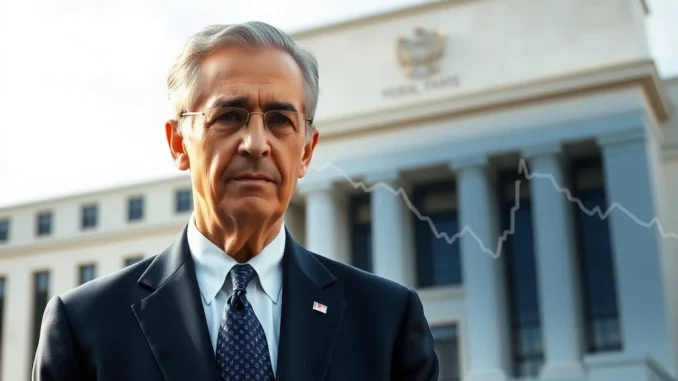
Federal Reserve Chair Jerome Powell’s recent comments about the **labor market cooling** are sending significant ripples across global financial markets. For cryptocurrency investors, understanding these macroeconomic shifts is crucial. Powell confirmed that current data suggests no dramatic change in the broader economic outlook. Importantly, he noted a gradual easing in the labor market. This development holds key implications for monetary policy, interest rates, and ultimately, the valuations of digital assets like Bitcoin and Ethereum.
Understanding the Gradual **Labor Market Cooling**
Federal Reserve Chair Jerome Powell recently articulated a significant observation about the U.S. economy. He stated that the labor market appears to be gradually cooling. This phrase refers to a slowdown in the pace of job creation and an easing of wage growth pressures. Such trends are often seen as positive indicators in the fight against inflation. Historically, a tight labor market, characterized by abundant job openings and rising wages, can contribute to inflationary pressures. Therefore, a gradual cooling suggests that some of the economic heat is dissipating.
Furthermore, this cooling is not perceived as an abrupt decline. Instead, it represents a more sustainable rebalancing. Businesses might find it easier to hire. Workers might see slightly less rapid wage increases. This adjustment helps bring demand and supply in the labor market into better alignment. Consequently, the Fed views this as a step towards achieving its dual mandate of maximum employment and price stability. It is a critical piece of the puzzle for the overall **economic outlook**.
Implications for **Jerome Powell Fed** Policy
Jerome Powell’s statements provide clear insight into the Federal Reserve’s current thinking. The Fed has consistently emphasized a data-dependent approach to monetary policy. The observed **labor market cooling** directly informs their decisions. If the labor market cools gradually, it suggests that previous aggressive interest rate hikes are having their intended effect without causing a sharp economic downturn. This scenario could allow the Fed to adopt a less aggressive stance moving forward.
Conversely, if the labor market remained stubbornly hot, the Fed might feel compelled to continue raising interest rates. This would aim to further slow down economic activity and curb inflation. Powell’s cautious optimism indicates that the current path is broadly aligned with their goals. Therefore, future monetary policy decisions, including any potential rate adjustments, will heavily rely on continued observations of the labor market and inflation data. The market closely watches every word from the **Jerome Powell Fed** for clues on upcoming policy shifts.
Navigating the Shifting **Economic Outlook**
The **economic outlook** is a complex tapestry woven from various data points. Jerome Powell’s assessment of a gradually cooling labor market contributes significantly to this broader picture. It suggests that the economy might be achieving a ‘soft landing.’ This term describes a scenario where inflation decreases without triggering a severe recession. A gradual slowdown is generally preferable to a sharp contraction. Many economists feared that aggressive rate hikes could plunge the economy into a deep downturn. Powell’s comments offer some reassurance against the most pessimistic scenarios.
However, risks remain. Global economic uncertainties persist. Geopolitical tensions, supply chain disruptions, and commodity price volatility could still impact the trajectory. Consumers and businesses continue to adapt to higher borrowing costs. The Fed’s primary goal remains bringing inflation back to its 2% target. A cooling labor market is a positive step towards this goal. It supports the idea that the economy can normalize without excessive pain. This evolving landscape requires constant monitoring by investors across all asset classes, including digital currencies.
The Influence of **Federal Reserve Policy** on Digital Assets
The actions and statements of the Federal Reserve directly influence the broader financial environment. Consequently, **Federal Reserve policy** significantly impacts cryptocurrency markets. When the Fed adopts a hawkish stance, raising interest rates and tightening liquidity, riskier assets tend to suffer. Cryptocurrencies, often viewed as speculative or growth assets, typically fall into this category. Higher interest rates make traditional, safer investments, like bonds, more attractive. This draws capital away from more volatile sectors.
Conversely, a dovish Fed, characterized by lower rates and looser monetary policy, generally supports crypto valuations. Abundant liquidity encourages investors to seek higher returns in riskier assets. Therefore, the observed **labor market cooling** could signal a potential shift towards a less aggressive Fed. This might alleviate some selling pressure on digital assets. Crypto investors meticulously analyze Fed communications. They seek any indication of future policy direction. These policies directly affect the cost of capital and overall market sentiment for Bitcoin and other cryptocurrencies.
Potential **Interest Rates Impact** on Crypto Markets
The connection between **interest rates impact** and cryptocurrency markets is profound. Higher interest rates increase the cost of borrowing. This reduces the incentive for speculative investments. Furthermore, they make it more expensive for companies to expand. This affects tech stocks and, by extension, cryptocurrencies. Many crypto projects are tied to growth narratives, similar to tech companies. When rates are high, investors demand a higher discount rate for future earnings. This lowers the present value of growth-oriented assets.
A gradually cooling labor market, as described by Powell, could lead the Fed to pause or even cut rates in the future. Such a shift would generally be bullish for crypto. Lower rates mean cheaper capital. This encourages investment in risk assets. It also increases liquidity in the financial system. This liquidity often flows into high-growth sectors, including digital assets. Therefore, the prospect of stable or declining interest rates could provide a significant tailwind for the crypto market. Investors must remain vigilant for any shifts in the Fed’s stance on interest rates, as these movements directly influence their portfolios.
In conclusion, Federal Reserve Chair Jerome Powell’s assessment of a gradually cooling **labor market cooling** is a pivotal piece of economic news. It suggests that the Fed’s efforts to combat inflation are yielding results. This could pave the way for a less aggressive monetary policy. Such a shift carries profound implications for the **economic outlook** and, crucially, for cryptocurrency markets. Investors should closely monitor upcoming economic data and future statements from the **Jerome Powell Fed**. The direction of **Federal Reserve policy** and its subsequent **interest rates impact** will remain key determinants of crypto market performance in the months ahead. Adapting investment strategies to these macroeconomic signals will be vital for navigating the evolving digital asset landscape.
Frequently Asked Questions (FAQs)
Q1: What does “labor market cooling” mean for the economy?
A1: “Labor market cooling” refers to a slowdown in job growth and an easing of wage pressures. It suggests the supply and demand for labor are rebalancing. This helps to reduce inflationary pressures without necessarily causing a severe economic downturn. It indicates a more sustainable economic environment.
Q2: How does a cooling labor market affect Federal Reserve policy?
A2: A cooling labor market typically allows the Federal Reserve to be less aggressive with its monetary tightening policies. It suggests that previous interest rate hikes are working. This could lead to a pause in rate increases or even future rate cuts, as the Fed aims to achieve its inflation target.
Q3: What is the potential impact of these economic trends on interest rates?
A3: If the labor market continues to cool gradually, it increases the likelihood that the Federal Reserve will either hold interest rates steady or begin to lower them in the future. Conversely, a re-acceleration of the labor market could prompt the Fed to consider further rate hikes to combat inflation.
Q4: How do these macroeconomic developments influence cryptocurrency markets?
A4: Macroeconomic developments, especially Federal Reserve policy and interest rate movements, significantly impact cryptocurrency markets. Lower interest rates and abundant liquidity generally favor riskier assets like cryptocurrencies. Higher rates make traditional assets more attractive, often drawing capital away from crypto.
Q5: What should crypto investors monitor next regarding the economic outlook?
A5: Crypto investors should closely monitor upcoming economic data releases. Key indicators include inflation reports (CPI, PCE), further labor market data (jobless claims, unemployment rate), and any future statements or speeches from Federal Reserve officials. These will provide crucial insights into the Fed’s next steps and the broader economic trajectory.
Q6: Is a recession more or less likely with a cooling labor market?
A6: A gradual cooling of the labor market is generally seen as a positive sign for avoiding a severe recession. It suggests the economy is rebalancing rather than collapsing. However, a rapid or sudden cooling could indicate a deeper slowdown, increasing recession risks. The Fed aims for a ‘soft landing,’ where inflation is controlled without a significant downturn.