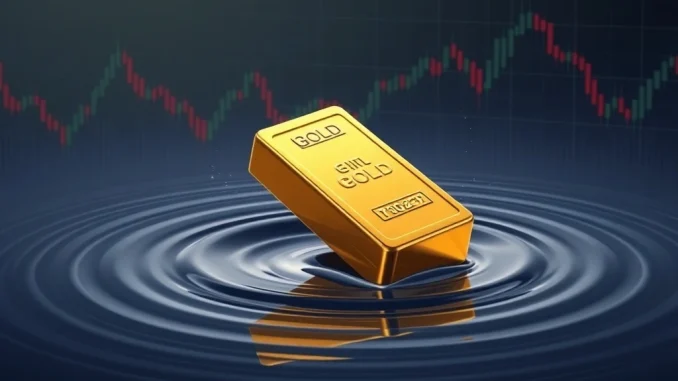
The financial world is abuzz. Spot gold, long considered a steadfast safe-haven asset, has experienced a stunning decline. For the first time since October 10, its gold price has plummeted below the critical $4,000 per ounce mark. This significant event sends ripples across global markets, prompting investors to reassess their strategies. Furthermore, it highlights the increasing market volatility impacting traditional commodities. Many are now questioning the stability of established investment paradigms.
Understanding the Gold Price Drop: A Closer Look at Spot Gold
The recent dip in the spot gold price is more than just a numerical adjustment. It signifies a profound shift in investor sentiment and broader economic forces. Gold’s role as a hedge against inflation and economic uncertainty has been a cornerstone of portfolio diversification for decades. However, this sharp fall suggests a potential recalibration of its perceived value. Investors are closely monitoring the situation. They seek to understand the underlying causes and future implications of this unprecedented movement. The market reacts to a confluence of factors, both global and localized.
Key Factors Driving Market Volatility
Several macroeconomic indicators likely contributed to gold’s sudden descent. First, a strengthening US dollar often pressures gold prices. A stronger dollar makes dollar-denominated assets, like gold, more expensive for international buyers. Consequently, demand can decrease. Second, rising real interest rates can make non-yielding assets, such as gold, less attractive. Investors might shift towards bonds or other interest-bearing instruments. Third, evolving inflation expectations play a crucial role. If market participants anticipate lower inflation, the perceived need for gold as an inflation hedge diminishes. Finally, geopolitical developments and shifts in central bank policies also exert considerable influence. These factors collectively create a complex environment for precious metals.
- Strengthening US Dollar: Makes gold more costly for non-dollar holders.
- Rising Real Interest Rates: Increases the opportunity cost of holding gold.
- Shifting Inflation Expectations: Reduces demand for gold as a hedge.
- Central Bank Policies: Monetary tightening can divert capital from commodities.
The Shifting Landscape of Safe-Haven Assets
The decline in gold price prompts a vital discussion about safe-haven assets. Traditionally, gold has been the go-to asset during times of crisis. Its historical performance as a store of value is undeniable. However, the emergence of digital assets like Bitcoin challenges this long-held perception. Bitcoin, often dubbed ‘digital gold,’ has gained traction as an alternative. It offers unique characteristics, including decentralization and scarcity. This comparison becomes particularly relevant when traditional safe havens show unexpected weakness. Therefore, investors are increasingly evaluating both gold and Bitcoin. They consider their respective roles in a diversified portfolio. The narrative around what constitutes a truly ‘safe’ asset is clearly evolving.
Gold vs. Bitcoin: A New Investment Paradigm?
While gold’s recent performance has been concerning, Bitcoin has often exhibited its own brand of volatility. Yet, its appeal as a hedge against fiat currency devaluation continues to grow. When gold falters, some investors may consider digital alternatives. Bitcoin’s fixed supply contrasts with the potential for new gold discoveries. This fundamental difference attracts a new generation of investors. Consequently, the dynamics between these two assets are worth watching. The market is witnessing a fascinating interplay between old and new financial instruments. Each offers distinct advantages and risks in the current economic climate.
Navigating Current Investment Trends
This significant drop in the spot gold price undoubtedly influences broader investment trends. Investors are now scrutinizing their portfolios. They are looking for resilience in uncertain times. Diversification remains a key strategy. However, the composition of diversified portfolios may change. The move away from traditional safe havens could signal a broader shift in capital allocation. Furthermore, this event underscores the importance of staying informed. Market analysis becomes crucial. Understanding the forces at play helps investors make sound decisions. The current environment demands adaptability and a keen eye on global economic indicators. Therefore, informed decisions are paramount.
Expert Outlook and Future Projections for Gold
Market analysts offer varied perspectives on gold’s future trajectory. Some predict a rebound, citing its long-term historical resilience. They believe the current dip is a temporary correction. Others suggest a more prolonged period of consolidation or even further declines. They point to persistent macroeconomic headwinds. Technical analysis often indicates critical support levels. Breaking these levels can trigger further selling pressure. Conversely, a strong recovery could signal renewed investor confidence. Ultimately, the future gold price will depend on a complex interplay of economic data, geopolitical stability, and investor psychology. Watching for shifts in these areas is essential.
The fall of spot gold below $4,000 per ounce marks a pivotal moment. It challenges established notions of stability and safe havens. While traditional assets face headwinds, the financial landscape continues to evolve. Investors must remain agile. They need to adapt their strategies to navigate this dynamic environment successfully. Understanding both the risks and opportunities is crucial for sustained success. The interplay between traditional commodities and emerging digital assets will define future investment trends.
Frequently Asked Questions (FAQs)
Q1: What does the fall of gold below $4,000 per ounce signify?
A1: The fall signifies a significant shift in market sentiment and potentially underlying economic conditions. It challenges gold’s traditional role as a stable safe-haven asset, indicating increased market volatility and investor uncertainty regarding its short-term value.
Q2: What factors contributed to this sudden drop in gold price?
A2: Key factors include a strengthening US dollar, which makes gold more expensive for international buyers, rising real interest rates, and evolving expectations about inflation. Additionally, shifts in central bank monetary policies and global geopolitical developments can influence gold prices.
Q3: How does this gold price drop compare to Bitcoin or other cryptocurrencies?
A3: While gold has historically been a safe haven, its recent decline prompts comparisons with Bitcoin, often called ‘digital gold.’ Bitcoin offers decentralization and scarcity, attracting investors looking for alternative hedges. This event highlights the ongoing debate about which asset class provides better protection against economic instability.
Q4: What are the implications for investors holding gold or considering new investments?
A4: For existing gold holders, this drop may necessitate a re-evaluation of portfolio allocation and risk exposure. For new investors, it underscores the importance of thorough research, diversification across different asset classes, and understanding market dynamics. Staying informed about economic indicators and global trends is crucial.
Q5: Is gold still considered a safe-haven asset after this decline?
A5: Gold’s status as a safe-haven asset is being re-examined. While it has historically performed well during crises, this recent significant drop raises questions about its immediate reliability. Its long-term value proposition might remain, but short-term market volatility suggests investors should approach it with caution and consider a broader range of safe-haven assets.
Q6: What is the outlook for the gold market in the near future?
A6: The near-term outlook for gold remains uncertain. Analysts are divided, with some anticipating a rebound based on historical resilience, while others foresee further consolidation due to ongoing macroeconomic pressures. Future investment trends will largely depend on global economic data, interest rate policies, and geopolitical stability.