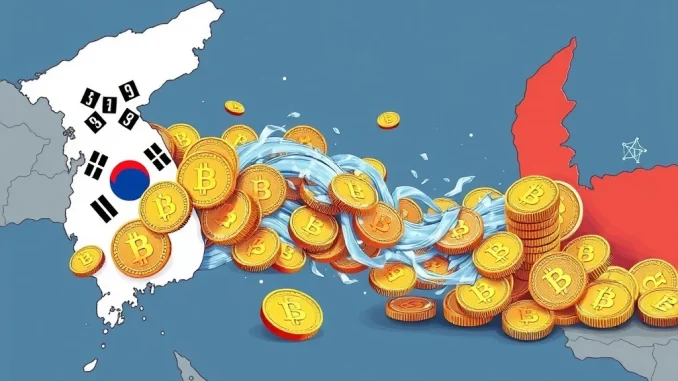
A remarkable increase in cross-border cryptocurrency activity has recently come to light. Specifically, crypto transfers between South Korean and Cambodian exchanges have experienced an astonishing surge. This dramatic rise, reported by the Seoul Shinmun, involves dollar stablecoin transactions. It underscores growing financial flows between these two nations. Observers are now scrutinizing the implications of this significant increase.
Unpacking the Alarming Surge in Cross-Border Crypto Transfers
Dollar stablecoin transactions between South Korea and Cambodia have seen an unprecedented spike. Last year, these transactions surged nearly 1,400-fold. This significant increase raises immediate questions about its underlying causes and potential consequences. The data, reported on October 27 by the Seoul Shinmun, highlights a critical development in the global crypto landscape. Cambodia has been described as a hotbed for criminal activity. This context adds another layer of concern to the soaring transaction volumes.
Data from South Korea’s Financial Supervisory Service (FSS) confirms this dramatic trend. Representative Lee Yang-soo of the People Power Party, a member of the National Assembly’s Political Affairs Committee, obtained these figures. The total volume of coin inflows and outflows between the countries’ exchanges reached 12.81 billion won in 2024. This amount equates to approximately $9.28 million. Such a figure represents a substantial leap from previous years.
To put this into perspective, the recorded volume in 2023 was only 9.22 million won. This translated to about $6,680. Therefore, the 2024 figures show a nearly 1,400-fold increase. This expansion is truly remarkable. The data specifically covers transactions between South Korea’s five largest crypto exchanges. These include **Upbit, Bithumb, Coinone, Korbit, and Gopax**. On the Cambodian side, the transactions involved **Huione Guarantee**. The sheer scale of this increase demands careful examination.
The Role of Stablecoin Transactions in the Surge
The surge primarily involves dollar stablecoin transactions. Stablecoins are cryptocurrencies designed to maintain a stable value. They are typically pegged to a fiat currency, like the US dollar. This stability makes them attractive for cross-border transfers. They offer a faster and often cheaper alternative to traditional banking channels. Therefore, their use in international remittances and trade has grown significantly. However, their pseudonymous nature can also attract illicit activities. This dual potential makes stablecoins a focal point for regulators.
Furthermore, stablecoins facilitate quick and efficient value transfer across borders. This efficiency bypasses some of the delays and costs associated with conventional financial systems. Consequently, they have become popular tools for individuals and businesses. Yet, the anonymity inherent in many crypto transactions presents challenges. It complicates efforts to track the origin and destination of funds. This complexity becomes particularly relevant when dealing with such large volumes.
The reported increase in **South Korea Cambodia crypto** transfers underscores this challenge. The use of stablecoins allows for rapid movement of capital. This speed can outpace regulatory oversight. As a result, authorities must adapt quickly. They need new strategies to monitor these evolving financial landscapes. Understanding the mechanics of stablecoin transfers is crucial for effective regulation.
Regulatory Scrutiny: Insights from the FSS Report
The data originating from the FSS report provides critical insights. South Korea’s Financial Supervisory Service is a key regulatory body. Its role involves overseeing financial markets and institutions. The FSS’s collection of this data signals a heightened awareness. Regulators are paying closer attention to cryptocurrency flows. Representative Lee Yang-soo’s involvement further emphasizes this legislative interest. Lawmakers are seeking to understand the scope and implications of these digital asset movements.
This scrutiny is not unique to South Korea. Governments worldwide are grappling with crypto regulation. They aim to balance innovation with financial stability and crime prevention. The FSS data serves as a stark reminder. Crypto transactions are becoming increasingly significant in global finance. Therefore, comprehensive regulatory frameworks are essential. These frameworks must address the unique characteristics of digital assets.
The report’s details about the specific exchanges involved are also important. The inclusion of **Upbit, Bithumb, Coinone, Korbit, and Gopax** shows the breadth of participation from major South Korean platforms. On the Cambodian side, **Huione Guarantee** is highlighted. Identifying these entities allows regulators to pinpoint specific channels. This information helps in assessing risks and implementing targeted controls. Such transparency is vital for maintaining market integrity.
Cambodia’s Context and Potential Concerns
The report’s mention of Cambodia as a “hotbed for criminal activity” adds a serious dimension. This description suggests a heightened risk profile. Jurisdictions with weaker financial regulations can become attractive. They may draw individuals seeking to launder money or finance illicit operations. Large, unexplained surges in financial transfers often trigger red flags for authorities. This is particularly true when involving such regions.
The massive increase in **crypto transfers** between the two nations thus raises legitimate concerns. It could indicate an exploitation of digital asset channels. Criminal organizations might use stablecoins to move funds undetected. This potential risk necessitates a thorough investigation. International cooperation becomes paramount in such scenarios. Authorities must collaborate to combat financial crime effectively.
Moreover, the reputation of a country impacts its financial relationships. Cambodia’s designation suggests existing vulnerabilities. These weaknesses could be exploited by illicit actors. Therefore, the surge calls for increased vigilance. Both South Korean and Cambodian authorities must enhance their monitoring capabilities. They must work together to prevent misuse of financial systems. This proactive approach protects the integrity of global finance.
The Mechanics of Huione Guarantee and Cross-Border Flows
The involvement of **Huione Guarantee** on the Cambodian side is notable. Understanding its role is key to deciphering these cross-border flows. While specific details about Huione Guarantee’s operations were not provided in the initial report, its designation as an exchange facilitating these transactions makes it a crucial entity. Exchanges act as gateways between traditional finance and the crypto world. They are therefore critical points for regulatory oversight.
The sheer volume of transactions through this specific entity is striking. It implies a significant operational capacity. Furthermore, it suggests a growing demand for crypto services in Cambodia. This demand could stem from various sources. It might be legitimate commercial activity. Alternatively, it could be driven by individuals seeking to move funds discreetly. Distinguishing between these motives is a primary challenge for regulators.
Any large-scale **South Korea Cambodia crypto** transfer involving a single foreign entity warrants close inspection. It allows authorities to focus their investigative efforts. They can analyze transaction patterns and user data. This targeted approach helps identify potential irregularities. The aim is always to ensure compliance with anti-money laundering (AML) and counter-terrorist financing (CTF) regulations. Thus, the spotlight on Huione Guarantee is well-deserved given the context.
Implications for Global Financial Oversight and Future Regulations
This dramatic surge in **stablecoin transactions** carries significant implications for global financial oversight. Regulators worldwide are already struggling to keep pace. The rapid evolution of cryptocurrency technology presents ongoing challenges. This particular case highlights the need for stronger international collaboration. Coordinated efforts are essential to monitor and regulate cross-border crypto movements effectively.
Furthermore, the incident may accelerate regulatory reforms. South Korea, known for its proactive stance on crypto, might introduce stricter measures. These could include enhanced reporting requirements for exchanges. They might also involve more stringent know-your-customer (KYC) and AML procedures. Similar actions could be considered in Cambodia. This would help address the reported concerns about illicit activities.
The long-term impact on trust in crypto markets is also a factor. Incidents involving potential criminal activity can erode public confidence. Therefore, effective regulatory responses are crucial. They demonstrate a commitment to maintaining market integrity. Ultimately, this ensures the sustainable growth of the digital asset ecosystem. The **FSS report** serves as a vital signal for these necessary changes.
Conclusion: Navigating the Complexities of Cross-Border Crypto Flows
The nearly 1,400-fold surge in **crypto transfers** between South Korean and Cambodian exchanges is a development demanding serious attention. It represents a significant increase in financial activity. The involvement of dollar stablecoins and entities like **Huione Guarantee** highlights the evolving landscape of digital finance. While cryptocurrencies offer innovative solutions for cross-border transactions, they also present unique challenges for regulators.
The concerns about Cambodia’s potential role in illicit activities, coupled with the sheer volume of transactions, underscore the urgency. Financial supervisory bodies, such as South Korea’s FSS, must continue their diligent oversight. International cooperation will be vital. Only through collaborative efforts can authorities ensure the integrity of the global financial system. This prevents the misuse of digital assets while fostering legitimate innovation.
Frequently Asked Questions (FAQs)
Q1: What exactly are dollar stablecoins and why are they used for international transfers?
A1: Dollar stablecoins are cryptocurrencies pegged to the value of the US dollar. This pegging makes their price stable, unlike volatile cryptocurrencies like Bitcoin. They are popular for international transfers because they offer faster, cheaper, and often more accessible ways to move value across borders compared to traditional banking systems. They minimize exchange rate risks due to their stable value.
Q2: Which South Korean exchanges were involved in these crypto transfers?
A2: The data from South Korea’s Financial Supervisory Service (FSS) specifically covered transactions involving the country’s five largest crypto exchanges: Upbit, Bithumb, Coinone, Korbit, and Gopax. These platforms are major players in the South Korean digital asset market.
Q3: What does the term “hotbed for criminal activity” imply in this context?
A3: The description of Cambodia as a “hotbed for criminal activity” suggests that the country may have vulnerabilities or a history that makes it attractive for illicit financial operations, such as money laundering or fraud. In the context of surging crypto transfers, it implies a concern that these digital asset channels could be exploited for illegal purposes, prompting increased regulatory scrutiny.
Q4: How did the Financial Supervisory Service (FSS) obtain this data?
A4: The data was submitted to Representative Lee Yang-soo of the People Power Party, who is a member of the National Assembly’s Political Affairs Committee. The FSS, as South Korea’s financial regulatory body, collects and monitors transaction data from regulated financial institutions, including crypto exchanges, to ensure compliance and detect potential risks.
Q5: What are the potential implications of this surge for future crypto regulations?
A5: This significant surge in South Korea Cambodia crypto transfers could lead to stricter regulatory measures in both countries. This might include enhanced reporting requirements for crypto exchanges, more rigorous Anti-Money Laundering (AML) and Know Your Customer (KYC) procedures, and increased international cooperation to track and prevent illicit financial flows. Regulators will likely seek to close any loopholes that could be exploited by criminals.