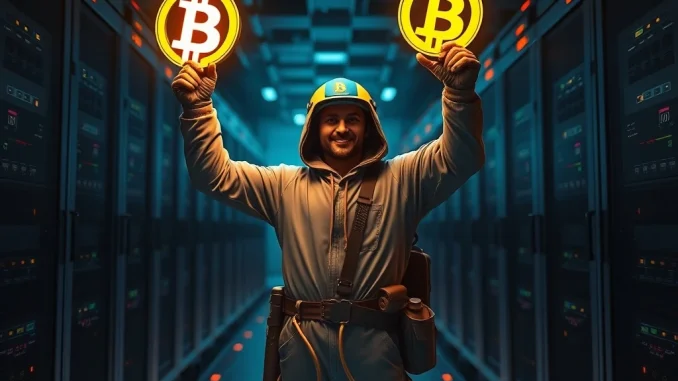
An extraordinary event recently captivated the global cryptocurrency community. A dedicated **solo Bitcoin miner** achieved a truly remarkable feat. This individual successfully mined a Bitcoin block, securing a substantial reward. Such an occurrence highlights the decentralized nature of the network. It also underscores the potential for significant individual gains within the crypto space. This rare success quickly became significant **cryptocurrency news**, sparking discussions across forums and social media platforms. It serves as a powerful reminder of the lottery-like potential inherent in Bitcoin mining.
Understanding the Bitcoin Block Reward Achievement
The **solo Bitcoin miner** successfully validated block 920,472. This pivotal moment occurred around 12:37 a.m. UTC on October 24. Data from the Bitcoin blockchain explorer Mempool confirmed the event. Consequently, the miner received a **Bitcoin block reward** of 3.1 BTC. This amount was valued at approximately $340,000 at the time. This solo effort bypassed the traditional mining pool structure. It delivered the entire reward directly to the individual miner. It stands as a testament to persistence and incredible luck in the highly competitive mining landscape. This type of **Bitcoin mining success** is exceptionally rare.
The Mechanics of BTC Mining: How Blocks are Found
To understand this achievement, one must first grasp the basics of **BTC mining**. Bitcoin mining involves powerful computers solving complex cryptographic puzzles. Miners compete to be the first to find a solution, which allows them to add a new block of verified transactions to the blockchain. The process is energy-intensive. It requires specialized hardware, often referred to as ASICs. When a miner successfully adds a block, they receive the block reward, which includes newly minted bitcoins and transaction fees. This incentive drives network security. It ensures new transactions are processed efficiently.
For a solo miner, the challenge is immense. They compete against vast mining farms and large pools. These entities combine their computational power. A solo miner relies entirely on their own hardware’s hash rate. This makes finding a block an incredibly low-probability event. However, when it happens, the entire **Bitcoin block reward** goes to that single individual. This makes the recent **Bitcoin mining success** particularly noteworthy. It underscores the distributed and probabilistic nature of the Bitcoin network.
The Odds of Solo Bitcoin Mining Success
The probability of a **solo Bitcoin miner** discovering a block is incredibly low. It is often compared to winning a lottery. Mining difficulty adjusts regularly. This ensures new blocks are found approximately every ten minutes. The global hash rate of the Bitcoin network is enormous. Therefore, an individual miner with a modest setup faces astronomical odds. Many solo miners operate for years without finding a single block. This makes the recent event significant **cryptocurrency news**. It inspires hope among smaller participants. It also highlights the unpredictable nature of mining rewards.
Consider the sheer volume of computational power involved. Mining pools control a significant portion of the network’s hash rate. They distribute rewards proportionally among their members. A solo miner, by contrast, throws their hat into the ring alone. They absorb all the costs and risks. Yet, they also stand to gain all the profit from a successful block discovery. This high-risk, high-reward scenario defines solo **BTC mining**. It distinguishes it from pooled mining. The recent event demonstrates that while unlikely, it is not impossible.
What This Means for Cryptocurrency News and the Community
The story of this **solo Bitcoin miner** quickly spread across **cryptocurrency news** outlets. It resonated deeply within the mining community. For many, it represents the original spirit of Bitcoin. Satoshi Nakamoto, Bitcoin’s creator, envisioned a decentralized network where anyone could participate. While large-scale mining operations dominate today, individual successes like this reinforce that vision. It reminds us that the network remains open to all. It further fuels interest in **BTC mining** as a potentially lucrative endeavor, despite the high barriers to entry.
Moreover, this event contributes to the broader narrative of Bitcoin’s resilience. It shows that even with immense centralization concerns surrounding mining pools, individual contributions can still make an impact. This particular **Bitcoin mining success** offers a compelling story. It demonstrates that dedication, combined with a stroke of luck, can lead to substantial financial gains. It will undoubtedly inspire others to try their hand at solo mining, even against formidable odds.
The Future of Individual BTC Mining
While the recent event is exciting, it does not fundamentally change the economics of **BTC mining** for individuals. The high cost of electricity and specialized hardware remains a significant hurdle. Furthermore, the increasing difficulty of mining means that smaller operations become less profitable over time. Most new miners will likely join pools. This provides more consistent, albeit smaller, payouts. However, the allure of a full **Bitcoin block reward** remains powerful for some. They are willing to gamble on a single, massive payout.
Technological advancements could also play a role. More efficient hardware might reduce operational costs. Yet, the arms race in mining technology continues. This makes it difficult for solo miners to keep up. Nevertheless, stories like this **solo Bitcoin miner** will continue to emerge. They will serve as powerful symbols. They represent the dream of striking it rich in the digital gold rush. This ongoing narrative ensures that **cryptocurrency news** will always have exciting tales of individual triumph.
In conclusion, the extraordinary achievement of a **solo Bitcoin miner** finding a block and claiming a $340,000 reward is a rare and inspiring event. It highlights the probabilistic nature of **BTC mining** and the immense potential for individual **Bitcoin mining success**. While the odds remain stacked against solo efforts, this story serves as a powerful reminder of the decentralized opportunities within the Bitcoin network. It continues to capture attention across all **cryptocurrency news** platforms.
Frequently Asked Questions (FAQs)
What is a Bitcoin block reward?
A Bitcoin block reward is the incentive given to the miner who successfully adds a new block of transactions to the Bitcoin blockchain. It consists of newly minted bitcoins and any transaction fees included in that block. This reward is crucial for securing the network and incentivizing miners.
How rare is it for a solo miner to find a Bitcoin block?
It is extremely rare. Solo miners compete against large mining pools and massive farms with significantly more computational power. The odds of a single solo miner finding a block are often compared to winning a major lottery, making such events significant **cryptocurrency news**.
What equipment does a solo Bitcoin miner need?
A solo Bitcoin miner needs specialized hardware called Application-Specific Integrated Circuits (ASICs). These machines are designed specifically for Bitcoin’s SHA-256 hashing algorithm. They also require a stable internet connection and a reliable power source to operate efficiently.
Why do solo miners attempt to mine Bitcoin despite the low odds?
Solo miners are motivated by the chance to receive the entire **Bitcoin block reward** themselves. In a mining pool, the reward is split among many participants. While the odds are low, the potential for a full payout like the recent $340K reward is a powerful draw for those willing to take the risk.
How does this event impact the overall Bitcoin network?
While an individual success, it has minimal direct impact on the network’s overall stability or security. However, it serves as a powerful psychological boost for the community. It reinforces the decentralized ideal and generates positive **cryptocurrency news**, attracting more interest in **BTC mining**.