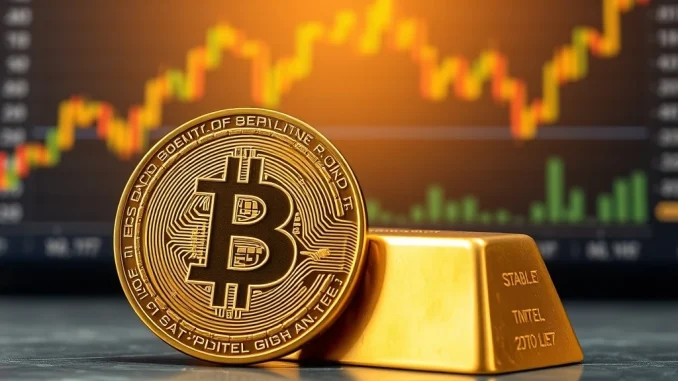
Is Bitcoin truly digital gold? This question often sparks debate among investors and analysts. Despite recent market fluctuations, a prominent financial institution, NH Investment & Securities, reaffirms Bitcoin’s foundational identity. They suggest its role as Bitcoin digital gold remains valid. This perspective offers crucial insights for anyone tracking the evolving cryptocurrency landscape.
Bitcoin Digital Gold: A Valid Narrative Affirmed
On October 24, NH Investment & Securities released a significant statement. The firm confirmed Bitcoin’s robust underlying performance. This holds true despite a continued sluggish trend in the broader virtual asset market. Experts at NH Investment believe institutional events could readily trigger a future rally. This assessment underscores a long-term bullish outlook for the leading cryptocurrency.
Hong Seong-wook, a researcher at NH Investment, offered key observations. He noted that traditional gold increasingly serves as a critical asset for the “debasement trade.” Conversely, Bitcoin has recently underperformed relative to its “digital gold” moniker. Hong acknowledged a common trend: periods of low correlation with gold often occur. This happens because many investors still view Bitcoin as a speculative asset. However, the idea that Bitcoin shares investment characteristics with gold is becoming more widespread. This shift in perception is vital for its long-term adoption.
Understanding the Digital Gold Thesis
The “digital gold” thesis positions Bitcoin as a modern-day store of value. It mirrors gold’s properties like scarcity, durability, and divisibility. Importantly, Bitcoin offers decentralization and censorship resistance. These features appeal to investors seeking alternatives to traditional financial systems. As global economic uncertainties grow, the appeal of assets outside government control increases. Therefore, Bitcoin’s role as a digital alternative to gold gains more traction.
Key characteristics supporting Bitcoin as digital gold include:
- Scarcity: A fixed supply of 21 million coins, ensuring value preservation.
- Portability: Easily transferable across borders, unlike physical gold.
- Divisibility: Can be divided into small units (satoshis), making it accessible.
- Decentralization: No single entity controls its network, reducing systemic risk.
Navigating the Virtual Asset Market Landscape
The virtual asset market has faced headwinds throughout the year. However, NH Investment’s analysis suggests underlying strength. This resilience indicates a maturing market. Price movements often reflect short-term sentiment. Yet, the foundational technology and growing adoption continue to progress. Understanding these dynamics helps investors make informed decisions. It also highlights the difference between temporary market dips and long-term trends.
Market analysts often point to several factors influencing the virtual asset market:
- Macroeconomic conditions, such as inflation and interest rates.
- Regulatory developments across different jurisdictions.
- Technological advancements and network upgrades.
- Increased institutional participation and product offerings.
These elements collectively shape the market’s trajectory. They also influence investor confidence in digital assets. Furthermore, the market continues to expand beyond Bitcoin. It now includes a vast array of altcoins and decentralized finance (DeFi) protocols. This expansion showcases the innovative spirit within the crypto ecosystem.
Institutional Bitcoin and Future Catalysts
Hong asserted that Bitcoin stands as a representative asset for the “debasement trade” alongside gold. He pointed out its recent achievement of new highs during the Chuseok holiday. This surge directly benefited from the debasement narrative. Such performance underscores Bitcoin’s potential. It also highlights its appeal during times of economic uncertainty. Crucially, the increasing interest in institutional Bitcoin adoption could be a major catalyst.
Institutional involvement brings several advantages:
- Increased Liquidity: Larger capital flows enhance market stability.
- Enhanced Legitimacy: Mainstream financial firms entering the space validate crypto.
- New Investment Products: Spot ETFs and other structured products open doors for broader investor access.
These developments pave the way for a more robust and regulated market. They also provide traditional investors with familiar avenues to gain exposure to digital assets. The anticipation of Bitcoin Spot ETFs, for example, has already generated significant market excitement. This indicates the powerful impact of institutional engagement.
The Debasement Trade: Bitcoin’s Crucial Role
The “debasement trade” involves investing in assets expected to hold value during periods of currency devaluation. This often occurs due to excessive money printing or inflationary pressures. Historically, gold has been the go-to asset for this strategy. However, Bitcoin has emerged as a strong contender. Its fixed supply cap makes it inherently resistant to inflationary debasement. This characteristic is a cornerstone of its appeal as a store of value.
Hong concluded that while this year’s performance might seem disappointing, Bitcoin still shows exceptionally strong performance. This assessment factors in its significant gains in 2023 and 2024. This long-term view is essential. It helps investors look beyond short-term volatility. Instead, they focus on the asset’s overall growth trajectory. The debasement narrative strengthens Bitcoin’s fundamental value proposition. It positions the asset as a hedge against economic instability.
Performance and Correlation Dynamics
Bitcoin’s correlation with traditional assets, including gold, often fluctuates. As Hong noted, periods of low correlation are common. This is largely due to Bitcoin’s dual nature. It acts both as a store of value and a speculative growth asset. Investors often treat it differently based on market conditions and their risk appetite. However, as the market matures, its correlation patterns may evolve. Many expect it to align more closely with traditional safe-haven assets over time.
Looking ahead, the crypto market outlook remains largely positive. Institutional interest continues to grow. Technological advancements further enhance network capabilities. Regulatory clarity is also slowly improving. These factors collectively contribute to a promising future for Bitcoin and the wider digital asset ecosystem. Investors should focus on the long-term fundamentals. This approach helps them navigate the inherent volatility of emerging markets. Bitcoin’s journey as digital gold continues to unfold, marked by both challenges and significant opportunities.
Conclusion: Bitcoin’s Enduring Strength
NH Investment & Securities’ analysis provides a compelling argument. Bitcoin’s “digital gold” narrative remains intact and valid. Despite short-term market sluggishness, its underlying performance is strong. Future rallies could be triggered by key institutional events. As the global economic landscape shifts, Bitcoin’s role in the debasement trade becomes increasingly important. Investors should consider its long-term potential. Its fundamental characteristics and growing adoption solidify its position. Bitcoin continues to prove its resilience as a crucial digital asset.
Frequently Asked Questions (FAQs)
Q1: What does NH Investment & Securities mean by Bitcoin’s “digital gold” narrative remaining valid?
NH Investment & Securities suggests that despite recent underperformance compared to traditional gold, Bitcoin retains its core characteristics as a store of value. These include scarcity and resistance to inflation. They believe its fundamental role as a digital alternative to gold is still strong, supported by its overall robust performance over recent years.
Q2: Why does NH Investment consider Bitcoin’s overall performance strong despite a sluggish market?
The firm emphasizes looking at Bitcoin’s performance over a broader timeline. While current market trends might appear slow, Bitcoin recorded significant gains in 2023 and 2024. This indicates strong long-term growth and resilience, suggesting that short-term dips do not negate its overall positive trajectory.
Q3: What is the “debasement trade” and how does Bitcoin fit into it?
The “debasement trade” refers to an investment strategy focused on protecting wealth from currency devaluation, often caused by inflation or excessive money printing. Bitcoin, with its fixed supply limit of 21 million coins, is seen as a strong hedge against such debasement. It acts as a representative asset alongside gold in this trade, as evidenced by its past performance during periods when this narrative gained prominence.
Q4: How might “institutional events” trigger a future rally in the virtual asset market?
Institutional events typically refer to increased adoption by large financial institutions, regulatory approvals for investment products like spot Bitcoin ETFs, or significant corporate investments. These events can inject substantial capital, enhance market legitimacy, and provide easier access for a broader range of investors, thereby acting as powerful catalysts for price rallies in the virtual asset market.
Q5: Why does Bitcoin sometimes show a low correlation with gold, despite its “digital gold” status?
Bitcoin’s low correlation with gold often stems from its perception as a speculative asset by many investors. Its price can be influenced by factors distinct from those affecting traditional safe havens. However, as the market matures and institutional adoption grows, experts anticipate that its correlation with traditional store-of-value assets like gold may strengthen over time.
Q6: What is the general crypto market outlook according to NH Investment’s analysis?
The general crypto market outlook, as inferred from NH Investment’s analysis, remains positive. The firm highlights underlying strength despite current sluggishness and points to institutional events as potential triggers for future rallies. This suggests a belief in the long-term growth and increasing acceptance of digital assets within the broader financial ecosystem.