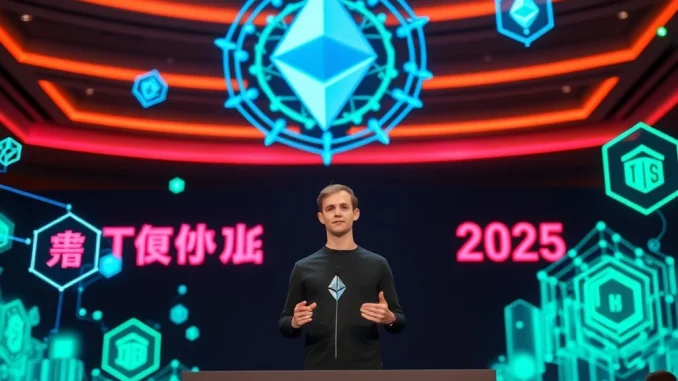
The landscape of digital interaction is rapidly evolving. Consequently, the need for robust and private identification methods has never been more pressing. Ethereum founder Vitalik Buterin recently made a profound statement regarding the future of online identity. He declared Zero-Knowledge (ZK) proof technology as the core solution for digital identity systems. This significant announcement occurred at the highly anticipated Ethereum Shanghai 2025 Summit. Indeed, Buterin’s insights offer a compelling glimpse into how we will verify ourselves in the digital realm. Furthermore, his vision emphasizes both security and user privacy, which are paramount in Web3 development.
Vitalik Buterin’s Vision for Digital Identity
At the Ethereum Shanghai 2025 Summit, Vitalik Buterin articulated a clear vision. He highlighted ZK technology as fundamental to the future of digital identity. Buterin explained that ZK proofs enable fast, secure authentication. Crucially, they do this while safeguarding user privacy. This approach marks a significant departure from traditional identity verification methods. Often, these methods require users to expose excessive personal data. Buterin’s endorsement carries substantial weight. He is a leading figure in the blockchain space. Therefore, his words often signal major shifts and technological directions for the entire ecosystem.
Digital identity refers to the electronic representation of an individual’s unique attributes. This includes credentials and personal information. In the Web3 era, managing this identity securely and privately is vital. Users demand control over their data. They also expect seamless interactions across decentralized applications. ZK technology provides a powerful framework to meet these demands. It allows individuals to prove specific facts about themselves without revealing the underlying data. This paradigm shift empowers users. Consequently, it reduces the risk of data breaches and identity theft. Vitalik Buterin’s focus on this area underscores its importance for mainstream blockchain adoption.
Understanding ZK Technology: A Privacy Powerhouse
Zero-Knowledge (ZK) proof technology represents a groundbreaking cryptographic method. It allows one party (the prover) to convince another party (the verifier) that a statement is true. However, the prover reveals no information beyond the validity of the statement itself. Imagine proving you are over 18 without disclosing your birth date. This is precisely what ZK proofs achieve. They are cryptographic algorithms. These algorithms mathematically guarantee the truthfulness of a claim. Yet, they keep the actual data secret.
The core principles of ZK proofs are:
- Completeness: If the statement is true, the honest prover can convince the honest verifier.
- Soundness: If the statement is false, no dishonest prover can convince the honest verifier.
- Zero-Knowledge: The verifier learns nothing beyond the fact that the statement is true.
This powerful combination makes ZK technology ideal for privacy-preserving applications. For instance, users can prove ownership of an asset. They can also confirm eligibility for a service. All this happens without exposing sensitive details. Such capabilities are transformative for digital identity. They fundamentally change how we approach online verification. Furthermore, they build trust in decentralized systems.
The Evolution of User Experience with Zero-Knowledge Proofs
Buterin highlighted a dramatic improvement in user experience. He noted this progress compared to five years ago. Initially, ZK implementations were complex. They often required significant computational resources. However, advancements in cryptography and engineering have streamlined these processes. Today, ZK-based systems offer a far more intuitive experience. Users can authenticate quickly and efficiently. This occurs without cumbersome data input or extensive waiting times.
Several factors contribute to this enhanced user experience:
- Faster Authentication: ZK proofs enable rapid verification. This minimizes delays in accessing services.
- Reduced Data Sharing: Users share only necessary proofs, not raw data. This simplifies privacy management.
- Streamlined Processes: Modern ZK toolkits and libraries make integration easier for developers.
- Improved Wallet Integration: Many blockchain wallets now support ZK-friendly features. This makes identity management more seamless.
These improvements are crucial for widespread adoption. Users expect convenience alongside security. Zero-Knowledge proofs now deliver on both fronts. Consequently, this makes digital identity solutions more accessible and appealing to a broader audience. The shift from complex cryptographic primitives to user-friendly applications demonstrates significant progress in the field.
Global Adoption and the Future of Ethereum
Vitalik Buterin also revealed that several countries are already adopting systems based on ZK technology. While specific names were not detailed, this indicates a growing global recognition of ZK’s potential. Governments and private entities are exploring ZK proofs. They use them for secure credentials, national digital IDs, and verifiable data sharing. This global movement validates Buterin’s assertion. ZK is indeed a core technology. Its applications extend far beyond niche blockchain use cases.
Ethereum, as a leading blockchain platform, plays a pivotal role in this adoption. The Ethereum ecosystem actively fosters ZK research and development. Many ZK-rollups, for example, are scaling solutions built on Ethereum. These solutions enhance transaction throughput and privacy. Furthermore, Ethereum’s robust developer community continues to innovate. They create new tools and protocols leveraging ZK proofs. This includes decentralized identity (DID) frameworks. These frameworks empower individuals with self-sovereign control over their digital identities. The future of Ethereum is thus deeply intertwined with the continued evolution and deployment of ZK technology. It ensures a more private, secure, and scalable internet.
The Broader Implications of ZK for Web3
Beyond digital identity, ZK technology holds immense implications for the entire Web3 paradigm. It offers solutions for various challenges. These include blockchain scalability, private transactions, and secure computation. ZK-rollups, for instance, bundle thousands of transactions off-chain. They then generate a single ZK proof for verification on the mainnet. This significantly increases transaction capacity. Furthermore, it reduces gas fees on networks like Ethereum.
Private transactions are another critical area. ZK proofs can obscure transaction details. This ensures financial privacy without compromising network integrity. This is vital for enterprise adoption and individual financial freedom. Moreover, ZK technology enables secure multi-party computation. This allows different parties to jointly compute a function. They do this while keeping their individual inputs private. Such capabilities unlock new possibilities for data collaboration and analysis. The ongoing advancements in ZK research promise to reshape the internet’s infrastructure fundamentally. They will build a more secure and privacy-centric digital world.
Vitalik Buterin’s strong endorsement solidifies ZK technology’s position. It is not just a promising innovation. It is a foundational element for the next generation of digital identity. His remarks at the Ethereum Shanghai 2025 Summit underscore a critical shift. The industry is moving towards privacy-preserving and user-centric solutions. As ZK proofs become more sophisticated and user-friendly, their integration into daily digital life will accelerate. This will pave the way for a more secure, private, and efficient online experience for everyone.
Frequently Asked Questions (FAQs)
What are Zero-Knowledge (ZK) proofs?
Zero-Knowledge (ZK) proofs are cryptographic methods. They allow one party to prove a statement is true to another. However, they reveal no additional information beyond the truthfulness of the statement itself. For example, you can prove you meet an age requirement without disclosing your actual birth date.
Why does Vitalik Buterin consider ZK technology crucial for digital identity?
Vitalik Buterin believes ZK technology is crucial because it enables fast and secure authentication. Importantly, it protects user privacy by allowing verification without exposing sensitive personal data. This aligns with the principles of self-sovereign identity in Web3.
How has the user experience with ZK technology improved?
Buterin noted dramatic improvements in user experience compared to five years ago. Advancements have made ZK implementations faster, more efficient, and less computationally intensive. This results in quicker authentication and more streamlined privacy management for users.
Are countries already adopting ZK-based systems?
Yes, Vitalik Buterin stated that several countries are already adopting systems based on ZK technology. This indicates a growing global recognition of ZK proofs for secure credentials, national digital IDs, and verifiable data sharing.
What role does Ethereum play in the development and adoption of ZK technology?
Ethereum is a leading platform for ZK research and development. The ecosystem fosters innovation through ZK-rollups for scaling and various decentralized identity (DID) frameworks. Ethereum’s community actively integrates ZK proofs to enhance privacy, security, and scalability across the blockchain.
What are some other applications of ZK technology beyond digital identity?
Beyond digital identity, ZK technology has significant applications in blockchain scalability (e.g., ZK-rollups), private transactions, and secure multi-party computation. It allows for increased transaction throughput, financial privacy, and collaborative data analysis while keeping inputs confidential.